RSS

Agreement of Purchase and Sale in NS: Legal Force and Closing Costs

I explain that a signed Agreement of Purchase and Sale can become legally binding in Nova Scotia once both parties sign. Understanding the agreement of purchase and sale in NS also means understanding its conditions: they set out what must happen by specified deadlines and may give you a contractual way to end the deal if a condition is not met.

It’s easy to focus on the price and closing date, but the details in the agreement matter just as much. Financing, inspection and insurance conditions can shape your decision, while closing brings its own costs and adjustments.

I’ll explain when an agreement takes effect, which offer conditions Halifax-area buyers may want to consider, and what can be deducted from sale proceeds or added to your closing costs as a buyer. I’ll also cover how deposits, deadlines and closing adjustments fit together, so you can better understand what you’re agreeing to.

Key Takeaways

  • I advise you to confirm that the price, closing date, included items and conditions reflect what you’ve agreed to before both sides sign, as the agreement can then become binding.

  • I recommend financing, inspection and insurance conditions to help protect your purchase; rural properties may also call for water-quality and septic inspection conditions.

  • I recommend tracking every condition deadline carefully. Form 408 is used to waive conditions, and missing the deadline can affect whether the agreement continues.

  • I encourage you to understand how the deposit is handled and what may be deducted from sale proceeds, including mortgage balances, commission, property taxes and legal fees.

  • I recommend budgeting for closing adjustments and location-specific costs, including deed transfer tax, which is paid by the buyer and set municipally in Nova Scotia.

What conditions should Halifax buyers include in a 2026 offer?

I explain that financing, inspection and sale-of-property clauses set out what must happen before your purchase proceeds unconditionally. From signing to closing, I guide you through condition deadlines, required checks and the steps to satisfy or waive conditions before completion.

Financing, inspection, and sale conditions

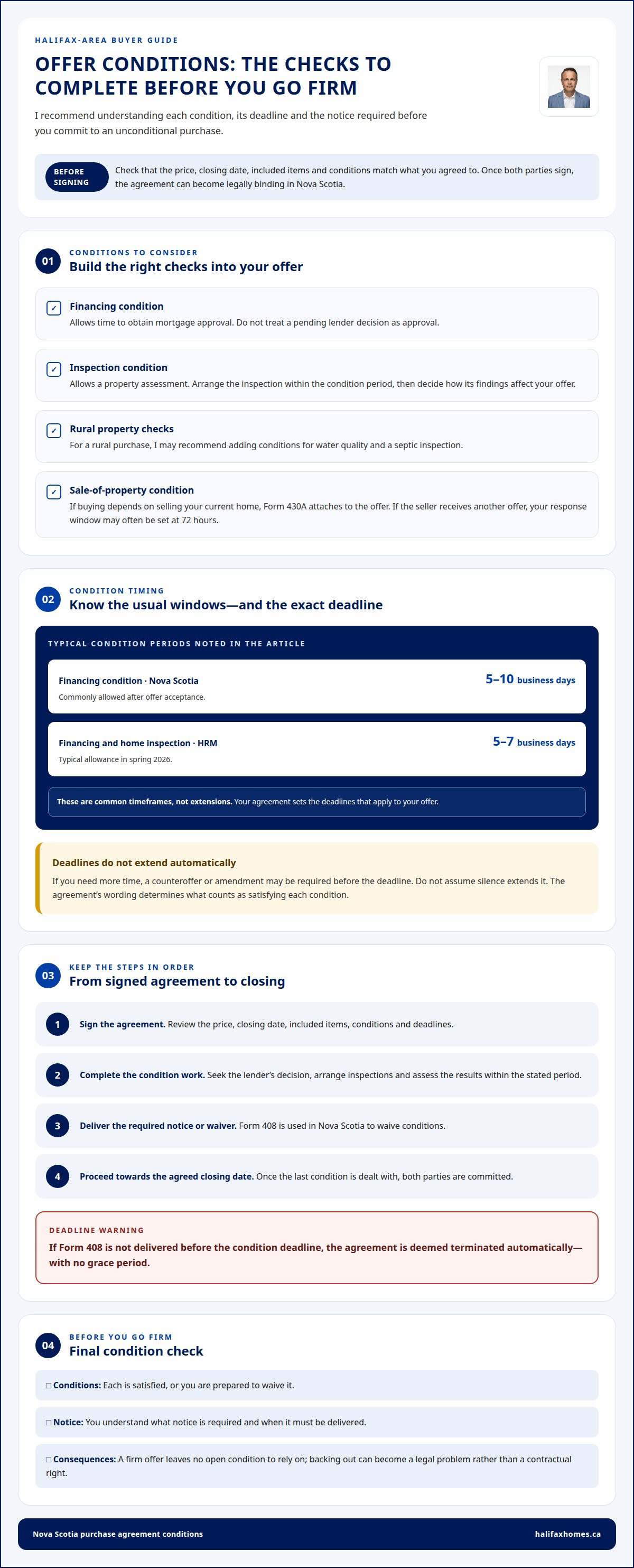
I help you understand that a financing condition gives you time to obtain mortgage approval, while an inspection condition allows a property assessment. In Nova Scotia, a financing condition commonly gives buyers 5 to 10 business days after offer acceptance. In HRM, financing and home inspection conditions typically allow 5 to 7 business days in spring 2026.

For a rural property, I may recommend conditions for water quality and a septic inspection. If your purchase depends on selling your current home, Form 430A attaches to the offer. A seller who receives another offer may give you a response window often set at 72 hours. I’ll help you understand how that clause could affect your obligations and how quickly you must respond.

I also discuss disclosure with you. Form 211 is an optional Property Condition Disclosure Statement that a seller may complete to the best of their knowledge. In a private sale, a Property Disclosure Statement isn’t mandatory unless the parties agree to require one in the contract. Misstatements in a completed statement could result in seller liability.

Condition deadlines and satisfaction steps

I’ll help you make sure each condition identifies what must be done and by when. For financing, seek the lender’s decision. For an inspection condition, arrange the inspection and decide how its findings affect your offer. The agreement’s wording determines what counts as satisfying each condition.

I’ll remind you that deadlines don’t automatically extend if a condition remains unresolved. You and the other party need to address each condition within its stated period and document the next step. If you need more time, a counteroffer or amendment may be required before the deadline. Don’t assume silence extends it.

I’ll help you keep the steps in sequence: sign the agreement, complete condition work by the deadlines, deliver the required notice or waiver, then proceed towards the agreed closing date. If Form 408 isn’t delivered before the condition deadline, the agreement is deemed terminated automatically, with no grace period.

Waiving conditions and going firm

I’ll explain that waiving a condition means giving up that contractual condition rather than keeping it open. Form 408 is used in Nova Scotia to waive conditions in an Agreement of Purchase and Sale. Once you’ve dealt with the last condition, both parties are committed, and backing out becomes a legal problem rather than a contractual right.

Before you go firm, I’ll help you confirm that each condition is satisfied or that you’re prepared to waive it. For example, don’t treat a pending financing decision as approval. A firm offer leaves no open condition to rely on, so your decision can affect your obligations through completion.

I’ll guide you to follow the deadline and required notice stated in the agreement. If a condition can’t be met, the agreement’s terms determine the available next step; missing a deadline isn’t an automatic extension. That’s why I make sure you understand each condition, notice and Form 408 delivery.

Is an Agreement of Purchase and Sale legally binding in Nova Scotia?

Whether an offer is binding depends on the circumstances and the agreement’s terms. The price, deposit, termination terms and required documents all affect what happens between acceptance and closing.

Purchase price and deposit terms

The agreement records the purchase price and deposit, including how the deposit will be credited at closing. In HRM, deposits typically range from $5,000 to $20,000, depending on the price point and circumstances of the offer.

The deposit is part of the purchase price, not an extra payment. Read the amount and payment timing alongside the financing terms: lender approval and your available funds affect whether you can complete the purchase. The agreement should make the parties’ commitments clear, including when the deposit is due and how it will be handled if the contract ends.

Deposits and agreement termination

Buyers typically provide the deposit within a day or two after an agreement is accepted. The listing brokerage holds it in a trust account until closing, when it is credited toward the purchase price.

If a party has the right to terminate under the original agreement, Form 440 can be used to initiate termination and may help release a brokerage-held deposit. The form doesn’t create a right to walk away on its own. The termination must be grounded in the agreement, such as an applicable condition or another agreed term.

Once the buyer has dealt with the final condition, both parties are committed; backing out becomes a legal issue rather than a contractual right. That distinction matters if financing approval changes or the buyer decides against selling their current home. The deposit’s return or release depends on the agreement and a valid termination process, not simply on a change of mind.

Nova Scotia forms and provincial differences

Nova Scotia uses province-specific real estate forms, so forms and procedures from another province shouldn’t be assumed to apply here. Form 400 is commonly used for existing homes; Form 403 is used for new construction, and Form 402 is added for resale condominium purchases.

The form system also has local details. The Nova Scotia Real Estate Commission says the standard Agreement of Purchase and Sale can cover deposits, closing dates, buyer conditions, lawyer review and title investigation. Updated mandatory forms apply to agreements accepted on or after May 1, 2026, so the acceptance date can determine which version applies.

For you, the practical step is to read the actual Nova Scotia form and schedules named in your offer. A seller’s counter-offer using Form 410 voids the original offer, so review the counter’s terms rather than treating it as a simple edit. The signed documents establish the contract the parties must follow through closing.
Understanding the agreement of purchase and sale NS

Meaning and enforceability of a Nova Scotia Agreement of Purchase and Sale

The agreement is the transaction’s working record: it identifies what each party must deliver and when. Understanding a Nova Scotia agreement of purchase and sale means looking beyond the property and price to how the written terms fit together.

Buyer and seller obligations

The buyer’s and seller’s obligations are the promises set out in the agreement. In practical terms, the buyer must meet the purchase terms, while the seller must carry out the sale as agreed. I encourage you to read the clauses as connected commitments, not isolated lines.

For example, a property description, included items and closing arrangements can affect what each party expects to receive or provide. A seller may also complete Form 211, an optional Property Condition Disclosure Statement, to the best of their knowledge. In a private sale, a Property Disclosure Statement isn’t mandatory unless the parties agree to require one in the contract. I’d distinguish that disclosure from the agreement itself: Form 100 is a disclosure document and does not impose contractual obligations.

Nova Scotia closings involve lawyers and deed registration under the Land Registration Act, making accurate transaction documents important. If a disclosure statement contains a misstatement, the seller could face liability. Read the agreement and any disclosure for what each document actually says, rather than assuming one replaces the other.

Consequences of a purchase agreement breach

A breach occurs when a party does not carry out an obligation in the agreement. The other party may then face delays, uncertainty about completion or a legal dispute over the written terms. Keep a clear record of agreed changes, since an informal conversation may not show what the parties ultimately accepted.

Amendments can also affect which terms apply. Under Form 421, if an amendment to an accepted agreement is rejected or receives no response before its deadline, the original agreement terms remain in effect. That makes the status of each proposed change significant: a draft amendment is not necessarily the operative agreement.

Lawyer review before signing

Yes, buyers should consider legal review before signing, particularly if the deal involves a private sale, unfamiliar schedules or wording that changes the usual allocation of responsibilities. A lawyer can explain how the proposed terms apply to the transaction and help identify questions before you commit.

A seller who isn’t using a real estate agent should also consider having a lawyer prepare the Agreement of Purchase and Sale. Early review is most useful when it focuses on the actual wording and property-specific details, rather than assumptions about what a standard form means.

What clauses are typically included in a Nova Scotia real estate purchase agreement?

A Nova Scotia purchase agreement does more than record a price. Its clauses define what is included, when the transaction closes, and how specific risks or costs are handled. According to the Nova Scotia Real Estate Commission, standard terms can cover deposits, closing dates, buyer conditions, lawyer review and title investigation.

I encourage you to look beyond the headline terms and consider how each clause affects your obligations. Fixtures generally stay with the property unless the agreement says otherwise. If you and the seller have different expectations about appliances, equipment or other items, the agreement should identify what stays, what goes and who handles any related payment.

  • Fixtures and included items: I recommend checking for any exceptions to the general rule that fixtures remain. Clear wording can prevent a disagreement over an item such as a built-in appliance.

  • Financed or leased equipment: Form 210 identifies whether equipment will be assumed by the buyer, paid out by the seller or removed. I suggest confirming whether the agreement says you will assume a lease.

  • Title investigation: For an HRM property, the purchaser has until the tenth day following the agreement date to investigate title. I recommend asking your lawyer to review title matters within that defined period.

  • Title migration: The agreement typically determines who pays the cost when title migration is required. I advise reviewing this clause so responsibility is clear before closing.

  • Property adjustments: Property taxes and utility charges are apportioned between buyer and seller based on the closing date. I suggest checking the closing statement to confirm each party’s share.

  • Oil tank and survey: The agreement may address whether the seller will ensure the oil tank is filled on or shortly before closing. I also recommend checking whether the seller will provide a land survey or location certificate if one is available.

Schedules can add terms for a particular property type. Form 404 addresses matters such as environmental assessments and legal road access for vacant land. Form 420 is a blank schedule for adding or modifying conditions in another form, including an offer, counter-offer or amendment. I recommend reading any attached schedule with the main agreement; its wording may shape your duties.

Timing details deserve attention, too. The agreement’s closing is to take place no later than 4:00 p.m. on the Closing Date, unless the parties agree to another time. For a resale condominium, Form 402 is added to Form 400. I suggest confirming that each referenced form is attached and understood, as these identifiers distinguish the main agreement from added terms.

Before you sign, I recommend reviewing the property description, included items, schedules, title provisions and adjustment clauses together. Even a seemingly small term, such as who pays for title migration, can affect the funds or documents needed to complete the sale.

Land Rhindress

I can help you connect the agreement’s terms with your next real estate decision in Halifax, Dartmouth, Bedford, Fall River, Sackville, Westwood Hills, Tantallon, Spryfield, Beaverbank, Eastern Passage, the Eastern Shore, Porters Lake, Cole Harbour and Lower Sackville. If you’re buying, the Home Finder can help focus your search on properties that fit your priorities. If you’re selling, a Home Evaluation can inform your decisions before you review an offer. I can also help you consider how the purchase price, conditions and closing date relate to your plans, while your lawyer advises on the agreement’s legal effect. Clear information makes it easier to weigh the property and its terms together. To discuss your real estate goals in Nova Scotia, contact me.

Plan your next move with clarity

A real estate agreement is one part of a larger decision: choosing a property or preparing your home for sale. A clearer understanding of the agreement of purchase and sale in Nova Scotia can help you consider how its terms fit your plans, but your next steps should also reflect your priorities, timing and property goals. I can help you consider those practical details through a Home Finder, Home Evaluation or Marketing Strategy, depending on whether you’re buying or selling.

If you’re preparing an offer, bring your questions forward before deciding how to proceed. I can help you understand the real estate considerations, while your lawyer can advise on the agreement’s legal terms. Contact Land Rhindress about your offer to discuss your next move. With a clear plan and the right advice, you can take the next step with confidence.

Frequently Asked Questions

What did the NSREC May 2026 forms update change for buyers and sellers?

For agreements accepted on or after May 1, 2026, updated NSREC mandatory forms apply. The update renamed Form 406 and expanded its schedule name to include manufactured homes and leased land communities. Buyers and sellers can use the agreement’s acceptance date to identify which form update applies, then check that the property type and attached schedule are accurately reflected in their paperwork.

What happens if Form 408 is not submitted before the condition deadline?

If Form 408 isn’t delivered before the condition deadline, the Agreement of Purchase and Sale is deemed terminated automatically, with no grace period. A buyer should treat the deadline as a firm point for acting, not as a reminder to deal with later. For example, if financing is still unresolved, the agreement doesn’t automatically stay active while the buyer waits for an answer.

What is an Agreement of Purchase and Sale in Nova Scotia?

It’s the written contract that records the terms for buying and selling a property in Nova Scotia. Beyond identifying the property and price, it can include schedules that add details for a particular transaction. Keep it distinct from disclosure paperwork: Form 100 is a disclosure document and does not impose contractual obligations. The signed agreement and its attached terms set out what the parties have agreed to do.

Is a Nova Scotia Agreement of Purchase and Sale legally binding once signed?

Yes. In Nova Scotia, the agreement becomes binding once both parties sign it, subject to its written terms and conditions. Electronic signatures are generally accepted when both parties agree to sign electronically, and notarization isn’t required for the agreement to be legally binding. Before signing electronically or on paper, make sure the version includes the schedules and amendments that form part of your offer.

What are the deposit rules and typical deposit amounts in Nova Scotia home purchases?

In HRM, real estate deposits typically range from $5,000 to $20,000, depending on the price point and circumstances of the offer. Buyers typically provide the deposit within a day or two after acceptance. The listing brokerage holds it in a trust account until closing, and the amount is credited toward the purchase price. The agreement sets the deposit terms, so check that its amount and timing match your understanding.

What common conditions can buyers include, such as financing, inspection, and sale of their home?

Buyers commonly include financing, inspection and insurance conditions. In HRM, financing and home inspection conditions typically allow 5 to 7 business days in spring 2026. A buyer whose purchase depends on selling their current home can use Form 430A. For rural properties, water-quality and septic inspection conditions may also be relevant. Each condition should identify what must be satisfied and its deadline, so the parties know what happens next.

Read

Ways to honor family memories and move forward

Selling a family home in Halifax or elsewhere in HRM can feel like saying goodbye to a whole chapter. You can ease the emotional toll of selling a family home by taking time to walk through each room, capture photos, or plan a farewell gathering. Children may feel especially unsettled, so give them space to talk about what they’ll miss and ways to feel involved in the move.

It’s natural to feel both sadness and excitement, even when selling is the right decision for your family. Those feelings can coexist: memories can remain meaningful while you make room for what comes next.

This article explains why children can feel deeply attached to a home, how to talk about the move and help them feel included, and how a simple closing ritual can bring a sense of closure. Small, thoughtful steps can make the transition feel more manageable for everyone.

Key Takeaways

  • Make room for mixed feelings by recognizing that sadness and excitement can exist side by side.

  • Preserve the home’s personal history with photos, a scrapbook, or a walk through rooms filled with memories.

  • Children, especially teenagers, may find a move frightening; listening to what they’ll miss can help them feel understood.

  • Create a simple farewell ritual, then give everyone time to adjust before focusing on the possibilities ahead.

  • Explain the move clearly and invite children to help with packing or imagine their new room to give them a sense of involvement.

1. Attachment to a family home and childhood memories

The emotional toll of selling a family home often comes from what each room represents, not just its walls and windows. A kitchen may bring back Sunday dinners, while a doorway marks a child’s first steps. Before preparing to sell, name the memories that matter most. You can feel ready to move and still grieve the life you built there.

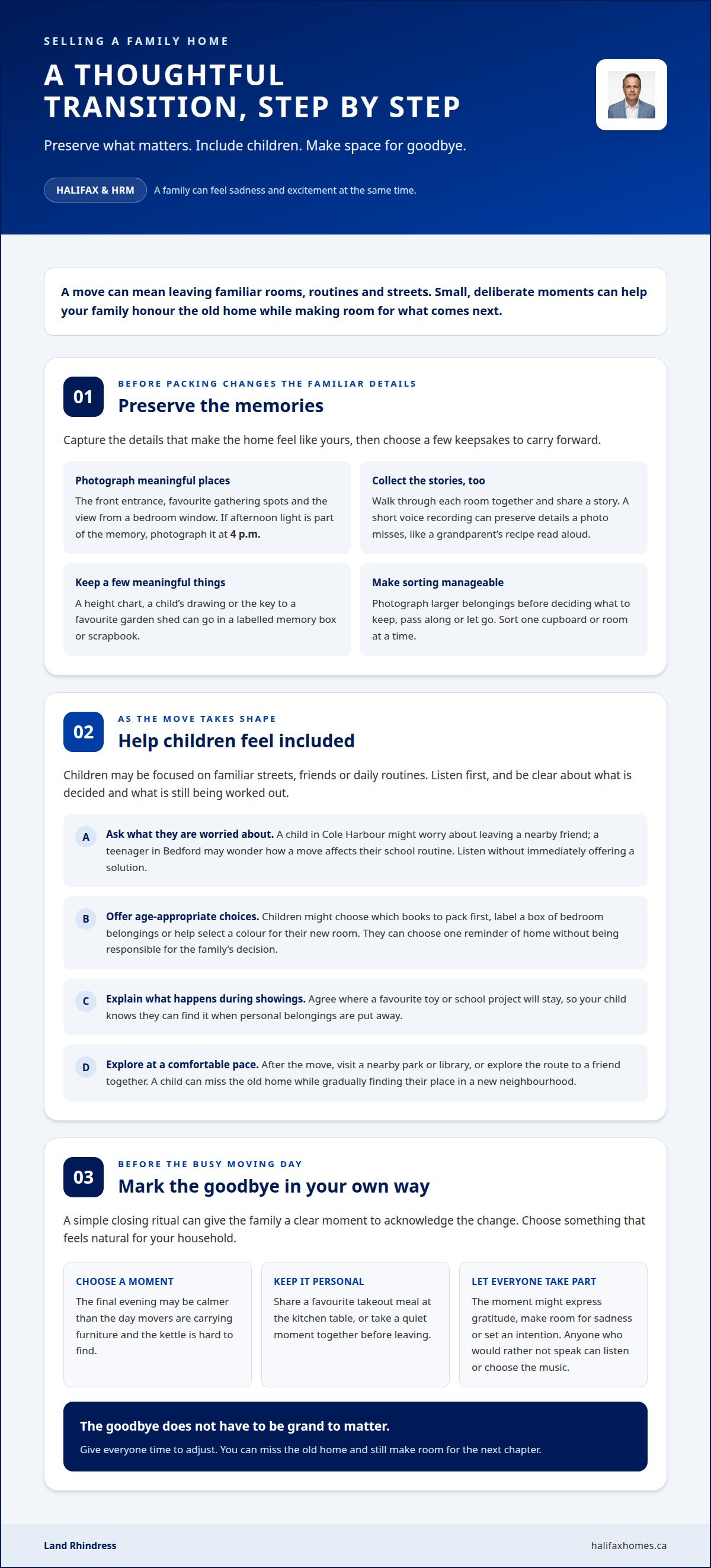
Start documenting the home before packing changes its familiar details. Take photos of the front entrance, favourite gathering spots, and the view from a bedroom window. If afternoon light is part of your family’s memory, photograph how it falls through the home at 4 p.m. Walk through each room together and share one story from that space. A short voice recording can preserve details that a photograph misses, such as a grandparent’s recipe read aloud in the kitchen.

Preserving memories doesn’t mean keeping every belonging. Choose a few meaningful items, such as a height chart, a child’s drawing, or the key to a favourite garden shed. Photograph larger pieces before deciding whether to keep, pass along, or let them go. A labelled memory box gives special objects a home, while a scrapbook can bring photos and handwritten stories together. Sort one cupboard or room at a time instead of trying to clear the whole house in a day.

In Canada, legal and tax considerations depend on who owns the home, how it was used, and who has authority to sell it. Before listing, clarify those details and identify any tax reporting obligations that apply to the owners’ circumstances. For an inherited property, establish who can make decisions and sign documents before sale preparations begin.

When siblings disagree about an inherited home, separate practical decisions from family memories first. Write down each person’s concerns, then agree on how decisions will be made, who is responsible for each task, and how updates will be shared. One sibling might organize records while another coordinates family discussions. Keeping the plan in writing can reduce misunderstandings and help everyone focus on the next step.

Sentimental value belongs in your family’s story, but an asking price should reflect the property’s features and current market evidence. Compare relevant homes by location, condition, size, and features rather than adding imagined value for a renovation or cherished memory. A kitchen that hosted generations of meals may be priceless to you, but buyers assess the home they can see and use.

A real estate agent can manage sale logistics, explain market information, and keep decisions moving while you focus on family conversations. Ask for a clear sequence of steps, from preparing the property to reviewing offers, so each decision has context. A written schedule and regular updates can make the process easier to follow. Then set aside time for a farewell gathering, goodbye letter, or final walk through the rooms that hold your family’s memories.

2. Children’s attachment to the family home

For a child, home can mean more than a building. It may be the bedroom where they read, the driveway where they learned to ride a bike, or the route to a friend’s house. Teenagers may feel especially overwhelmed or frightened by a move. In Halifax and across HRM, even a move between Dartmouth and Bedford can mean leaving familiar streets, nearby friends, and daily routines.

Notice which parts of the change concern your child. A child in Cole Harbour might worry about leaving a nearby friend, while a teenager in Bedford could focus on whether a move will change their school routine. Ask what they’re thinking about, then listen without immediately offering a solution. Their concerns can reveal which parts of home life feel most important to preserve.

Be specific about what you know and what is still being worked out. If your family is moving within HRM, explain what will change in familiar routines, such as how your child will get to activities or see friends. Don’t promise that everything will stay the same. Distinguishing settled plans from open questions helps children understand the move without relying on guesses.

Give children a practical role suited to their age and interests. They might choose which books to pack first, label a box of bedroom belongings, or help select a colour for their new room. A child who wants a small reminder of home can choose one meaningful item. These choices let them take part in the transition without making them responsible for the family’s decision.

Prepare children for what happens while the home is for sale. Explain that buyers may visit and that some personal belongings will be put away before a showing. Agree where a favourite toy or school project will stay, for example, and make sure your child knows they can find it. This can help a child in Dartmouth or Halifax understand why familiar rooms may look different during visits.

After the move, let children get to know their new surroundings at a comfortable pace. Explore a nearby park, library, or route to a friend together, whether your new home is in Sackville, Eastern Passage, or another HRM community. Invite your child to notice what feels familiar and what feels new. They can miss their old home while gradually finding their place in a different neighbourhood.

Emotional toll of selling a family home

3. Creating a closing ritual and moving forward

A closing ritual can give your family a clear moment to mark the change, instead of letting moving day blur into boxes and errands. Choose an action that reflects how your household lives. A family in Dartmouth might share a favourite takeout meal at the kitchen table, while a household in Bedford may prefer a quiet moment together before leaving. Keep the ritual simple and personal.

Decide what you want the ritual to help each person do. It might offer a chance to express gratitude, acknowledge sadness, or set an intention for the next home. Keep its purpose clear so the moment doesn’t become another task to finish. If someone would rather not speak, they can take part by listening or choosing the music.

Choose a time when people can be present. The final evening before the move may work better than the busy day when movers are carrying furniture and someone is searching for the kettle. In Halifax or elsewhere in HRM, schedule the ritual around your moving arrangements rather than assuming a set timetable. A calm pause can make the farewell feel deliberate.

For an inherited home, shape the ritual around your family’s shared history. Siblings could each choose a song connected to the house and explain why it matters. If memories differ, there’s no need to settle on one official version of the past. Make room for each person’s perspective rather than turning a farewell into a debate about who remembers best.

Consider carrying a small tradition into your next home. If Saturday breakfasts were a fixture in the old house, keep that routine after moving to Sackville, Cole Harbour, or another HRM community. Familiar routines can provide continuity while your surroundings change. You might also mark the first week in the new home with a meal or activity your family already enjoys.

Moving forward doesn’t require forgetting the old address. Decide how you want to remember it, perhaps through a family recipe, a framed photograph, or a note kept with important documents. Choose something that fits your life now. As the practical demands of the move ease, let each person revisit memories in their own way and at their own pace.

4. How can parents explain a family home sale to children?

Choose a quiet moment before boxes appear to explain what’s happening. Keep the first conversation simple: “We’ve decided to sell this home, and our family is moving.” Add a reason children can understand, such as needing a different home or being closer to family. Share what you know about the next steps and be honest about what’s still undecided.

Make room for each child’s reaction without correcting it. One child may feel sad about leaving a bedroom, while another may worry about losing a familiar route to a friend’s house. Try saying, “I can see why you’ll miss that.” This acknowledges the feeling without asking a child to approve the sale or pretend to be happy about it.

Answer practical questions directly. If a child asks whether a favourite toy is moving, explain which belongings are coming and when packing begins. If they ask where they’ll sleep, describe the new room once you know the plan. Avoid saying nothing will change. Clear answers help children distinguish what’s decided from what the family is still working out.

Offer choices that give children a real role without making them responsible for the move. They could choose which books go into a labelled box, help decorate their new room, or select a few keepsakes to bring along. Let them decline, too. Packing can feel like a loss if it starts unexpectedly, so explain each task before asking for help.

A visit to the new neighbourhood can help children picture an unfamiliar place. Walk or drive past the new home, notice a nearby park, and point out places the family may use. If school arrangements are settled, explain the plan clearly. If they aren’t, say so plainly instead of guessing. Concrete details give children something useful to ask about.

Give children time to process the news before emphasizing positive possibilities. In a later conversation, you might ask what they’d like to explore near the new home, such as a playground or library. Don’t use those possibilities to dismiss sadness. A child can look forward to a new bedroom and still miss the old one.

Keep the conversation open as the sale progresses. Before a showing, explain that visitors will look through the home and agree where a child’s special belongings will stay. After an important update, such as accepting an offer or setting a moving date, gather the family and explain what happens next. Regular updates and invitations to ask questions help children follow each stage without carrying adult decisions on their own.

Land Rhindress: Home Evaluation

Land Rhindress’s Home Evaluation can help you understand your home’s market position as you consider selling. It offers a practical reference for separating likely market value from the memories attached to the property. That clarity can help you discuss next steps with your family and make informed decisions.

Consider a Home Evaluation when you’re weighing whether to sell, planning a move, or setting realistic expectations before a family conversation. A property’s location, condition, layout, and features all shape its market position. The evaluation can give you a grounded starting point without diminishing what the home means to your family.

If you’re ready to discuss your next step, contact Land Rhindress or visit HalifaxHomes.ca.

Carry your family’s story into what comes next

The emotional toll of selling a family home can’t be measured by the number of boxes packed. What matters is making space for memories while giving your family room to build new ones. Take the next step at a considered pace, with practical decisions guided by what your household needs now.

If you’re weighing a sale, I can help you understand the property’s market position through a Home Evaluation. My Home Finder can support your search for a next home, while a Marketing Strategy can guide how your current property is presented to buyers. Each offers a practical way to move from reflection towards a decision.

Whether you’re still considering the timing or ready to talk through a plan, I’m here to help you explore your options. Contact Land Rhindress today to start a conversation and take your next step with care.

Frequently Asked Questions

Why is selling a family home emotionally difficult?

Selling a family home can feel difficult because everyday routines become tied to important life events. A garage might recall repairing a bicycle with a parent, or a kitchen table might be where family decisions happened. The emotional toll of selling a family home can surface as you make practical choices about a place with personal meaning. In HRM, leaving familiar streets and neighbours can add another layer of change.

How does selling a longtime family home affect mental health and grief?

Leaving a longtime home can bring grief, uncertainty, or irritability, and people in one household may react differently. One person might feel ready to move while another struggles with the change. These feelings aren’t a diagnosis or a sign that selling is the wrong choice. If distress persists or makes daily responsibilities hard to manage, consider talking with a trusted support person or a counsellor.

How can families cope with the emotional stress of selling a home?

Reduce strain by making a shared plan for decisions and tasks. For example, assign one person to track sale paperwork and another to coordinate family updates, then set a regular time to review progress. Keep a short list of upcoming decisions instead of carrying every detail in your head. Protect time for ordinary routines, such as a family meal or a walk.

What practical steps help preserve memories before moving out?

Create a simple digital record alongside any keepsakes. Save selected images in clearly named folders, add brief captions identifying people or occasions, and record a voice note about a detail you might forget. You could also sketch a room layout or write down a family recipe associated with the house. Keeping these records together makes them easier to revisit after the move.

What are common emotional pitfalls when decluttering and staging a family home?

A common pitfall is treating every object as a test of loyalty to the home. Another is rushing to discard belongings during a stressful day and regretting the decision later. Agree on a sorting process first: set aside disputed items, give family members time to decide, and separate personal keepsakes from everyday clutter. Don’t expect the home to feel impersonal; preparing it for buyers needn’t erase its history.

Read

Land for Sale in HRM: Asking Prices and Lot Locations

Across HRM, land prices and lot sizes vary by location and property, so the asking price is only one part of comparing your options.

That range is a useful starting point, but the right parcel depends on what you plan to do with it. A site for a business, a home or a waterfront retreat calls for different considerations, and acreage alone does not tell the whole story.

In this guide to land for sale in HRM, you’ll find current asking prices, Burnside lot locations and sizes, and examples of acreage and waterfront frontage. You’ll also learn how to interpret per-square-foot pricing and compare properties across Halifax, Dartmouth, Fall River and the wider region, focusing on the details that matter to your plans.

Key Takeaways

  • Compare asking prices across HRM by location and property type, not by price alone.

  • Check a parcel’s lot size alongside its asking price to understand what the land offers for your intended use.

  • Waterfront properties vary in acreage and frontage, so compare both measurements when weighing your choices.

  • Use a Home Evaluation to help assess a property’s value as you consider your next step.

Vacant land listings in the Halifax Regional Municipality

HRM listings range from urban lots and industrial sites to rural acreage and waterfront parcels. To compare them, look beyond the asking price to location, lot details and intended use.

Community Locations and Distances

Listings extend from Halifax and Dartmouth to communities such as Blind Bay, Lake Egmont and Elderbank. I use these distances to help compare rural settings with closer-in locations.

Prices vary across the municipality. Search counts are a changing snapshot, not a fixed inventory total.

Zoning and Permitted Uses

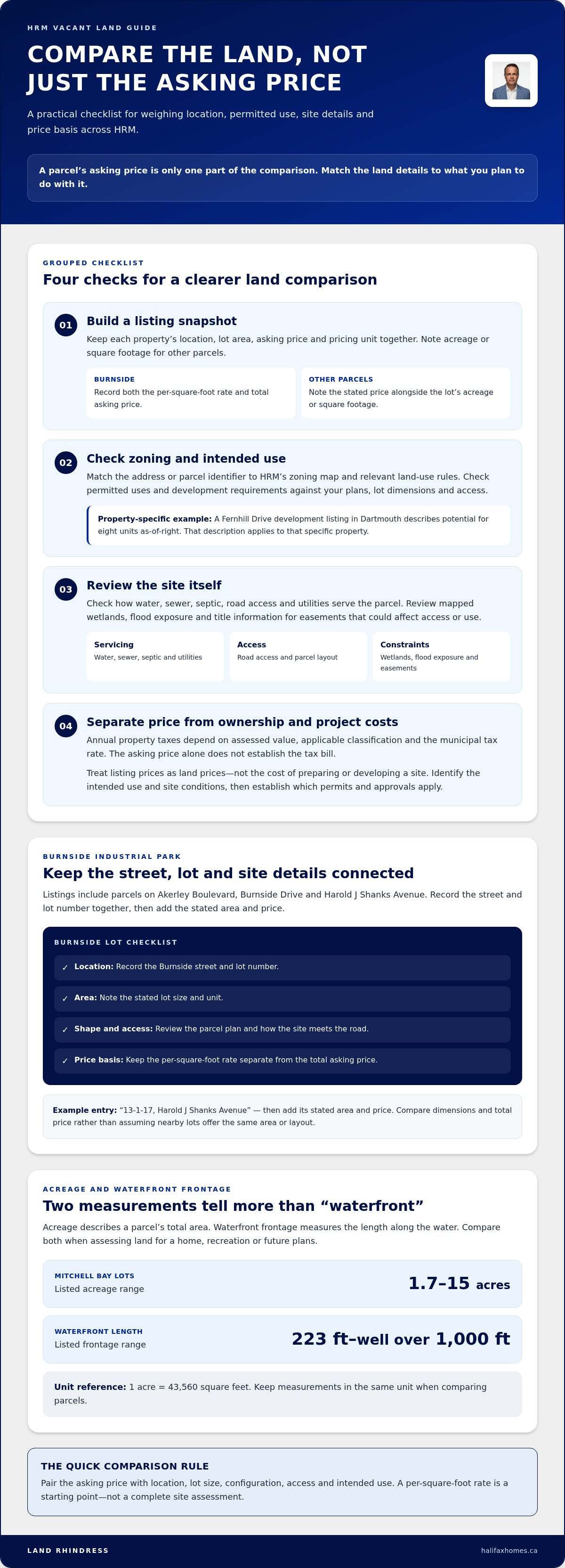
Zoning determines which uses and types of development are allowed on a parcel under applicable rules. Don’t assume a vacant lot can support a home, business or multiple units just because nearby properties appear developed. For example, a Fernhill Drive development listing in Dartmouth describes potential for eight units as-of-right; that description applies to that specific property.

To assess a parcel, match its address or parcel identifier to HRM’s zoning map and relevant land-use rules. Then compare permitted uses and development requirements with your intended project, the lot dimensions and access.

Land Taxes and Site Considerations

Annual property taxes depend on assessed value, applicable classification and the municipal tax rate. The asking price alone does not establish the tax bill. Also examine how water, sewer, septic, road access and utilities serve the site, since servicing can affect whether it suits your plans.

For site risks, review mapped wetlands and flood exposure, as well as title information for easements that could affect access or use. These details can change which parts of a parcel are practical for your plans. According to the Canada Revenue Agency, HST does not apply to exempt real-property sales, including personal-use vacant land sold by an individual.

For construction, identify the intended use and site conditions, then establish which permits and approvals apply to the project. Requirements depend on the parcel and proposed work. Organize your purchase by reviewing zoning and access, assessing servicing and constraints, and planning for transaction closing costs. This keeps the land, project and purchase considerations together before you proceed.

Asking prices for land

When comparing land asking prices in HRM, keep the pricing measure beside each figure. A residential lot may have one total asking price, while industrial land in Burnside can be advertised per square foot and as a total. Treat these as listing prices, not the cost of preparing or developing a site. For a fair comparison, match the measurement to the property.

Burnside Industrial Park listings show how rates and total prices differ by parcel.

Use the unit rate to compare Burnside parcels, but consider the total asking price too. A per-square-foot figure is not a substitute for the full listing price.

Other HRM listings use a single asking amount. I consider location, lot size and intended use alongside each asking price.

To build a useful shortlist, record each property’s location, lot area, asking price and pricing unit. For Burnside, include both the per-square-foot rate and total; for other parcels, note the stated price and acreage or square footage. Keep amounts in Canadian dollars, then compare each property with your plans and budget. This makes it easier to see the full asking price instead of focusing only on a unit rate.

Burnside lot sizes and locations

When comparing Burnside Industrial Park listings, start with the street and lot number. Parcels are located on Akerley Boulevard, Burnside Drive and Harold J Shanks Avenue. Keep each property’s location, area and price together rather than treating the industrial park as one uniform site.

Lot size matters because it shapes the space available for your intended project. Burnside listings use a per-square-foot price, but that rate alone does not tell you a parcel’s dimensions or configuration. Review the stated lot area and plan, then compare the usable site area with access points and your project’s footprint. A larger parcel may still be a poor fit if its layout does not suit your needs.

I recommend recording the street address and lot number together when building a shortlist. Akerley Boulevard, Burnside Drive and Harold J Shanks Avenue are distinct locations, while the lot identifiers distinguish individual parcels. For example, I’d record “13-1-17, Harold J Shanks Avenue” as one entry, then add its stated area and price. This keeps the listing details connected to the correct site.

  • Location: I record the Burnside street and lot number.

  • Area: I note the listing’s stated lot size and unit.

  • Shape and access: I review the parcel plan and how the site meets the road.

  • Price basis: I keep the per-square-foot rate separate from the total asking price.

This comparison is useful when two parcels are on different Burnside streets. Assess Akerley Boulevard and Burnside Drive listings separately from Harold J Shanks Avenue parcels, even when their advertised rates look similar. Check each listing’s dimensions and total price rather than assuming nearby lots offer the same area or layout.

For a practical site comparison, match each lot number to its street, then assess the parcel’s area against the space your plans require. Keep measurements in the same unit for a clear comparison. If one listing gives an area in square feet and another in acres, convert only when the stated areas allow a reliable calculation. Don’t compare the asking rate alone.

Burnside’s per-square-foot format is a useful starting point, not a complete site assessment. Pair the stated lot size with its location, configuration and total asking price. This helps distinguish a parcel that fits your project from one that merely looks comparable on a listing page.

Land for sale HRM

Lot acreage and waterfront frontage

Acreage describes a parcel’s total area; waterfront frontage measures the length along the water. Compare both figures when assessing land for a home, recreation or future plans. One acre equals 43,560 square feet, so the two measurements can help you compare listings that describe size differently.

Mitchell Bay listings illustrate how much waterfront parcels can vary. Available lots are described as ranging from 1.7 to 15 acres, with waterfront lengths from 223 feet to well over 1,000 feet. That spread means “waterfront” alone tells you little about the amount of land or shoreline. Read the acreage and frontage together for each specific parcel.

Other examples show different combinations of area and shoreline:

These examples are not direct price comparisons. The Kelly Point property is a double lot, the Spry Harbour parcel has ocean frontage, and the Taylor Lake listing is described as lakefront. Their asking prices reflect different locations, areas and water settings. Compare each listing’s stated features rather than assuming that more acreage or frontage automatically makes one parcel a better fit.

For a focused comparison, record the lot area, frontage length, water type and asking price together. Keep the units clear: acreage and frontage measurements describe different things. If a listing gives area in square feet, converting it to acres can help you compare it with parcels described in acres. Don’t treat a view as equivalent to direct waterfront access; listing descriptions distinguish ocean-view properties from waterfront and lakefront properties.

Use the listing plan and parcel details to understand where the measured frontage sits in relation to the lot. A shoreline measurement is useful, but the parcel’s shape and layout also matter when you picture how the land may work for your intended use. For example, Kelly Point Drive’s 335 feet of frontage belongs to a double lot, while the Spry Harbour listing describes a 10-acre parcel with approximately 200 feet of ocean frontage. Those are distinct configurations, not interchangeable measurements.

Before shortlisting waterfront land, compare the parcel’s acreage and frontage side by side, then match those details to the setting you want: ocean, lake or another shoreline. This keeps the numbers grounded in the property’s actual description.

Land Rhindress: Home Evaluation

Land Rhindress offers Home Evaluation to help you consider a property’s value as you weigh location, lot size and asking price. It can be a useful next step when comparing options or deciding how a property fits your plans. For a more focused search, Home Finder can help you explore listings that match your priorities.

Bring the details you’ve compared, such as the parcel’s address, acreage and waterfront frontage. These specifics provide a practical starting point for discussing the property and your next move.

Explore Home Evaluation for support with property-value questions. Contact me when you’re ready to discuss your options.

Turn your land search into a clear next step

The right parcel starts with a clear idea of what you want to do with it. Before pursuing land for sale in HRM, decide which locations suit your plans and which site details matter most. That focus can make your next comparison more useful than a long list of possibilities.

Land Rhindress can help with your next step through Home Finder, Home Evaluation or Marketing Strategy, depending on whether you’re searching, assessing a property or preparing to sell. Bring your priorities and questions, and discuss which direction makes sense for your situation.

If you’re ready to talk through your plans for land in the Halifax area, contact Land Rhindress about HRM land. A thoughtful search begins with the right questions, and you can take it one decision at a time.

Frequently Asked Questions

What land parcels are currently for sale in Halifax Regional Municipality (HRM), Nova Scotia?

These examples span different settings and lot types, so compare each listing’s location and parcel details with your plans.

What are the current asking prices for land for sale in HRM?

Asking prices vary by parcel and location. These are individual asking prices, not a market-wide benchmark or a guarantee of the final sale price.

What is the typical price per acre or square foot for vacant land in HRM?

No single rate represents every vacant parcel in HRM. Industrial listings may use a per-square-foot rate, while other properties are advertised with a total asking price and an acreage figure. To compare parcels, divide the asking price by the stated area using consistent units, then consider location and intended use. Treat the result as a listing comparison, not a measure of development costs or final sale value.

What are the property tax rates and annual taxes for vacant land in HRM?

Annual property taxes depend on the land’s assessed value, applicable classification and municipal tax rate. The asking price alone does not establish the annual tax bill.

What are the steps and closing costs involved in buying vacant land in Nova Scotia?

Review zoning and access, assess servicing and site constraints, and identify permits and approvals for the intended project. Plan for transaction closing costs. HST does not apply to exempt real-property sales, including personal-use vacant land sold by an individual.

Read

When to buy in a Dartmouth buyer’s market

A buyer’s market doesn’t mean every home is a bargain or every offer can wait. When navigating a buyer's market in Dartmouth, look for signs that housing supply exceeds demand: more homes to choose from and less competition among buyers. Conditions can shift, and desirable homes may still sell quickly.

It’s reasonable to wonder whether waiting could bring better options or whether the right home might sell while you weigh the market. Judge conditions alongside your priorities, budget and readiness, rather than treating “buyer’s market” as a signal to rush or hold out indefinitely.

Learn how to recognize market signals, assess whether conditions could improve your negotiating position, and decide when a Dartmouth home is worth pursuing. Compare properties, weigh inspection findings and keep your next move grounded in what matters to you.

Key Takeaways

  • Look for supply exceeding demand and more homes to choose from; a buyer’s market is about the balance between buyers and sellers, not a guarantee of a bargain.

  • Track how available listings and competition change over time, and stay ready to act when a suitable Dartmouth home appears.

  • Compare similar properties and weigh location, condition and your priorities before deciding whether an asking price represents value.

  • Use inspection findings to identify issues that may inform your offer or negotiations, while distinguishing cosmetic work from more serious concerns.

  • A Home Evaluation can help you assess a property’s value as you consider your next step.

1. Identifying market conditions

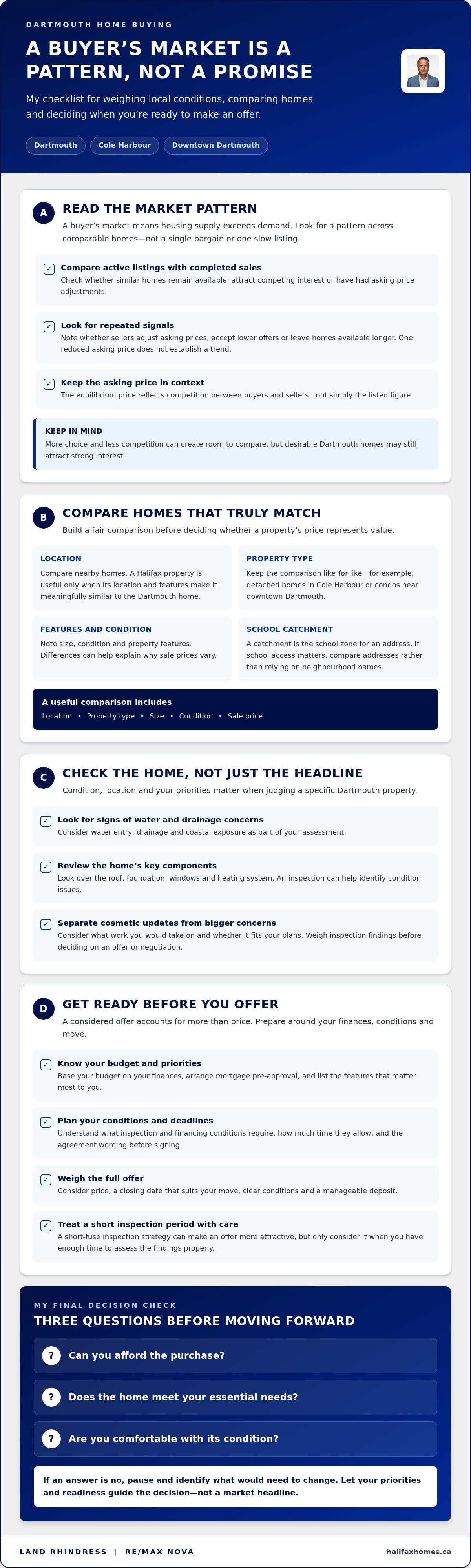
Start by comparing Dartmouth listings with completed sales of similar homes. A buyer’s market occurs when housing supply exceeds demand, often bringing more choice and less competition. One reduced asking price or a home that stays available does not establish a trend. Compare the same property type and nearby area, such as detached homes in Cole Harbour or condos near downtown Dartmouth.

For each comparison, note the location, property type, size, condition and sale price. Then check whether similar homes remain available, attract competing interest or have had asking-price adjustments. A Halifax home is a useful comparison only when its features and location make it meaningfully similar to the Dartmouth property. This keeps broad regional averages from obscuring differences between individual homes.

School location can also shape your shortlist. A catchment is the school zone that determines which school children in a neighbourhood attend. Compare the catchment for each Dartmouth address, then prioritize homes within the same catchment if school access matters to your household. Nearby properties may fall in different catchments, so compare addresses rather than relying on neighbourhood names alone.

Which Dartmouth neighbourhoods offer good value, and how do prices compare with Halifax? Value depends on the property type, condition and location. Compare similar homes in Cole Harbour or downtown Dartmouth with comparable Halifax properties instead of assuming one area is cheaper.

What are recent comparable sale prices in Dartmouth neighbourhoods? Compare completed sales of similar homes in the specific area you’re considering, including Cole Harbour or downtown Dartmouth. Differences in property features and condition can help explain sale-price variations.

What closing costs and taxes should homebuyers budget for in Nova Scotia? Include the applicable deed transfer tax and other purchase costs alongside the offer price. The total depends on the property and applicable charges.

What risks should buyers check for in Dartmouth homes, including flood, coastal and property condition issues? Look for signs of water entry, drainage concerns and coastal exposure, then review the roof, foundation, windows and heating system. An inspection can help identify condition issues that may affect your assessment of the property.

2. Timing a home purchase

I don’t recommend waiting for a perfect moment based only on market headlines. Even in a buyer’s market, a desirable Dartmouth home can sell quickly. Weigh the home’s fit, your finances and your readiness to make a considered offer. Those personal factors are a more useful timing guide than trying to predict every economic shift.

For a Nova Scotia purchase, plan how you’ll handle inspection and financing conditions before making an offer. Set workable deadlines that leave time to review the home and your financing, and read the agreement wording carefully before signing. Understand what each condition requires and when it must be addressed.

First-time buyers can make the process easier to manage by following clear steps. Begin with a budget based on your finances, then arrange mortgage pre-approval. List your essential features, choose Dartmouth areas that suit your daily routine, and view homes that meet those priorities. Before making an offer, review the property’s condition and decide which terms matter to you.

Preparation also helps you avoid making decisions under pressure. Before a viewing, write down questions about the layout, maintenance and any visible work. Afterward, record what you learned while the details are fresh. If a home needs cosmetic updates, for example, identify which changes you’d take on and whether they fit your plans.

When you’re ready to make an offer, consider more than the price. A closing date that suits your move, clear conditions and a manageable deposit all affect how workable an offer is. Sellers may be more willing to negotiate when a property has been listed longer, but terms should still reflect your needs and the home’s merits.

Inspection timing deserves care. A short-fuse inspection strategy means committing to a very quick inspection period to make an offer more attractive while still protecting yourself. Consider that approach only if the inspection arrangements and your schedule leave enough time to assess the findings properly. Speed is no substitute for understanding the home.

My final decision check is simple: can you afford the purchase, does the home meet your essential needs, and are you comfortable with its condition? If one answer is no, pause and identify what would need to change. If all three are yes, you can move forward for reasons that make sense to you, not because a headline says it’s time.

3. What defines a buyer’s market

I describe a buyer’s market as a period when the supply of homes exceeds buyer demand. That can give you more properties to compare and reduce competition, but it doesn’t make every Dartmouth home a bargain. Desirable properties can still attract strong interest, while homes needing work may leave more room to discuss price or terms.

When I assess the market, I look for a pattern rather than relying on one listing. I compare active homes with completed sales of similar properties, then note whether sellers adjust asking prices, accept lower offers or leave homes available longer. If one Dartmouth property stays on the market while comparable homes sell, I consider its condition, location and pricing. Those details can help explain the difference.

I also consider how buyers and sellers compete. Buyers compete with other buyers for a property, while sellers compete with other sellers for offers. When supply exceeds demand, a seller may have fewer interested buyers to choose from. The equilibrium price reflects that competition, not simply the asking price. That distinction helps me assess the context behind a listed figure.

When you ask me about an opening offer, I recommend comparing recent sales of similar Dartmouth homes, then weighing condition, asking price and apparent competition. I’d base the offer on those comparisons and negotiate price or terms around specific differences, such as required repairs or a closing date that can be flexible.

I also look beyond the price. In a buyer’s market, a seller may be more open to discussing terms or accepting a lower price. Possible negotiation points can include contributing to closing costs, including a home warranty or buying down a buyer’s mortgage rate. These are possibilities to discuss, not standard features of every sale.

When a home needs work, I separate cosmetic updates from more serious condition concerns. A property needing paint or minor updates may suit a buyer prepared to take on those projects. If an inspection identifies more serious issues, I’d review the findings carefully. They may support a discussion about a price reduction or seller-paid repairs.

For example, I might compare two similar Dartmouth homes: one is move-in ready, while the other needs cosmetic updates. If the second has been available longer, I’d consider whether its asking price reflects the work involved. A buyer’s market can improve your choices and negotiating position, but I’d still judge the home against its value to you and your budget.

I consider HRM market inventory, the supply of homes for sale, alongside completed sales and current competition. Revisit those signals as you search. If suitable listings grow and sellers become more flexible, you may have more room to negotiate. If a desirable home draws competing interest, I can help you make a timely, considered decision.

Navigating a buyer's market in Dartmouth

4. What are current home prices and market trends in Dartmouth, Nova Scotia?

A useful Dartmouth price trend comes from comparing completed sales of similar homes, not asking prices alone. Compare the same property type and nearby area, then account for size, condition, renovations and features. A condo in downtown Dartmouth and a detached home in Cole Harbour belong in separate comparisons. This keeps one high or low sale from distorting your view.

For a practical comparison, select recently sold properties that match the home you’re considering. Check whether each sale had similar living space, age, lot, parking and condition. Then compare its sale price with the current asking price. If the homes differ, note why: a renovated kitchen or substantial repair needs can explain a gap better than a neighbourhood label.

Across Dartmouth, prices can vary between areas such as Woodlawn, Cole Harbour, Portland Estates and downtown. Those names alone don’t establish which is cheaper: property type, condition and location within each area all affect value. Compare homes that meet your needs, including access to municipal services, commute routes and the school catchment relevant to your household.

To read changing conditions, track three signals together: available listings, completed sales and seller price adjustments. If similar homes remain available longer or sellers reduce asking prices, buyers may have more room to negotiate. If a well-priced property attracts strong interest, buyer-friendly conditions across the market may not apply to that specific home.

Another useful check is the relationship between asking and sold prices for comparable Dartmouth properties. A gap can reflect the seller’s expectations, the home’s condition or competition at the time of sale. It doesn’t automatically mean a home is overpriced. Consider inspection findings and comparable sales before deciding whether to make a lower offer or include repair-related terms.

Market movement also depends on the balance between supply and demand. More available homes can give buyers more choice, including the option to compare nearby neighbourhoods. Yet desirable homes can still sell quickly. Review listings and sales relevant to your preferred property type, rather than assuming every Dartmouth segment moves alike.

For your own price check, write down the property type, area, condition and key features, then compare like with like. Revisit the comparison when new sales appear or asking prices change. This gives you a grounded way to judge whether a Dartmouth home fits its market, without treating a headline or a single sale as the whole story.

Land Rhindress: Home Evaluation

Land Rhindress’s Home Evaluation can help you assess a Dartmouth property’s value against comparable homes and current market conditions. It’s useful when weighing an asking price, preparing an offer or comparing a home that needs updates with one in move-in condition. A grounded evaluation gives you another perspective alongside recent comparable sales and the property’s features.

Use it when you’ve narrowed your search and want to make a more informed decision about value. I can help you consider the details that shape the comparison, including location, property type and condition.

For support with your Dartmouth home search, contact Land Rhindress or visit halifaxhomes.ca.

Make your next move with a clear plan

The right time to act is personal. Your priorities, finances and plans for your next home matter as much as the market’s direction. When navigating a buyer's market in Dartmouth, focus on a decision that works for your life rather than waiting for perfect conditions.

If you’re still exploring, my Home Finder can focus your search on the places and features that matter to you. If your move also involves selling, my Marketing Strategy can help shape that part of the transition. I can also use a Home Evaluation to help you consider a property’s value as you weigh your options.

When you’re ready to talk through your next step, contact Land Rhindress to discuss your move. A thoughtful plan can help you move forward with confidence, one decision at a time.

Frequently Asked Questions

Can market conditions change quickly?

Yes. The balance between listings and buyer interest can shift, and an individual home’s prospects can change as new properties enter the market or competing offers emerge. For example, a Dartmouth buyer comparing homes this week may face different choices after a well-matched listing appears. Reassess available homes and your priorities as you search, rather than relying on an earlier impression of market conditions.

How can you tell which market you’re in?

Compare recent activity for the type of home and Dartmouth area you’re targeting. Look at whether similar properties are attracting offers, adjusting asking prices or remaining available as alternatives appear. For a practical check, review a group of comparable listings together instead of drawing a conclusion from one property. A market can also feel different for detached homes than for condos, so keep property types separate.

Should I wait for a better market?

Wait if buying now would put pressure on your finances or force you to compromise on essential needs. When navigating a buyer's market in Dartmouth, decide what “better” means for you: a suitable home, manageable costs, a preferred location or more choice. Set those priorities before delaying. A future market may offer different conditions, but waiting alone can’t ensure that a particular home or combination of features will become available.

What is a buyer’s market?

A buyer’s market describes conditions where the supply of homes exceeds demand, giving buyers more choice and often reducing competition. That can create more opportunity to compare options and discuss offer terms. It doesn’t mean every seller will accept a lower offer or that every home is priced below its value. The balance can also differ between property types and parts of Dartmouth.

How long are homes taking to sell in Dartmouth, and how common are price reductions?

Selling time and price reductions vary with a home’s location, type, condition, asking price and buyer interest. Rather than applying one timeline or reduction rate to every Dartmouth property, compare homes similar to the one you’re considering. Note when listings change price or status, and whether comparable homes remain available. This gives you context for a specific opportunity without assuming every listing follows the same pattern.

How can buyers find and evaluate homes in Dartmouth's buyer's market?

Start with a focused search based on your preferred areas, property type and essential features. Land Rhindress’s Home Finder can help you find suitable listings, while a Home Evaluation can help you assess a property against comparable homes. When reviewing a candidate, record what matters to you, such as layout, condition and location, then compare those factors across your shortlist before deciding which homes merit a closer look.

Read

What Stays with the House When You Sell in Nova Scotia? A 2026 Guide

Could the wall-mounted TV stay while the television itself goes? It’s the sort of detail that can turn a smooth handover into an awkward surprise. If you’re wondering what stays with the house when you sell NS, the answer often depends on whether an item is attached to the property and, just as importantly, what the written agreement says.

It’s reasonable to expect built-in features to remain and personal belongings to leave, but appliances, TV mounts and smart devices can sit in a grey area. As a Dartmouth-based agent with Land Rhindress, I help clients clarify these details before closing instead of relying on assumptions made during a showing.

In this guide, I’ll explain the usual distinction between fixtures and movable items, identify what buyers and sellers should discuss, and show how clear wording in the Agreement of Purchase and Sale can help prevent misunderstandings. You’ll also find practical reminders for the final walkthrough and handover, so everyone knows what should be there, what’s being taken and what needs to be removed.

Key Takeaways

  • For what stays with the house when you sell NS, rely on the signed agreement’s wording rather than assumptions about what’s usually included.

  • Sort household items into attached features, movable belongings and grey-area items that need clear written terms.

  • Make a room-by-room list of inclusions and exclusions before listing or making an offer to catch likely points of disagreement.

  • If an item becomes a point of dispute, compare the written terms and document any resolution before handover.

What stays with the house when you sell in Nova Scotia? Start with the agreement

The signed agreement’s specific wording is the practical starting point for understanding what stays with the house when you sell NS. A buyer may expect a particular item to be included, while the seller may see it as personal property they plan to take. Familiarity with a home doesn’t mean both parties have the same picture of what comes with it.

I encourage buyers and sellers to settle questions about items in writing before they become handover-day surprises. General conventions can help frame the discussion, but the wording agreed to for this specific sale deserves close attention.

Fixtures and chattels: the plain-language distinction

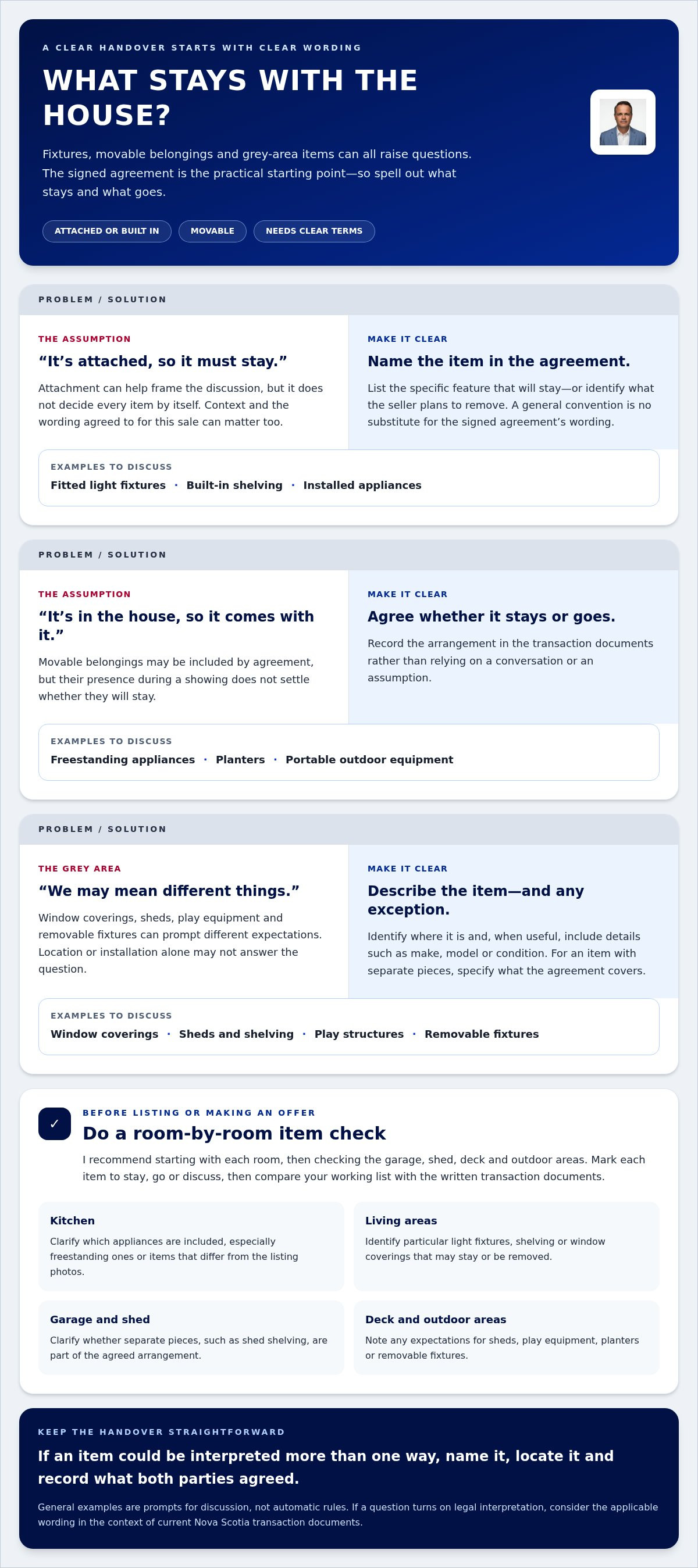
Fixtures are items attached to or incorporated into a property. Depending on the circumstances, examples might include a furnace, a fitted light fixture or built-in shelving. Chattels are movable belongings, such as freestanding furniture, and the parties can agree to include them in the sale. The distinction can help you identify questions to discuss, but it doesn’t decide every item by itself. Attachment, context and the agreement’s wording can all matter. For a general overview, see this legal definition of a fixture in property law.

A general convention is a starting point; an express term in the signed agreement records what these parties have agreed for this sale.

Why written inclusions and exclusions matter

Broad descriptions can leave room for different interpretations. A seller might read “light fixtures included” as referring to the installed fixtures, while a buyer may have a particular fitting in mind. Naming the item and its location makes the intended meaning clearer. The same care applies when the seller plans to remove something a buyer might reasonably expect to remain.

  • List items the parties have agreed will stay.

  • Identify items the seller will remove, especially if they are attached or built in.

  • Record exceptions in the offer or other agreed transaction documents, rather than relying on a conversation or an assumption.

If a question turns on legal interpretation, don’t treat a general explanation as a final answer. Consider the applicable wording in the context of current Nova Scotia transaction documents. Clear, specific terms give both sides a more reliable reference as they prepare for the next steps.

Fixtures, appliances, and outdoor items: how to assess what may remain

When an item could be interpreted in more than one way, consider how it is installed, whether it can be moved and what the agreement says. This practical check can help buyers and sellers work through questions about what stays with the house when you sell NS. The examples below are prompts for discussion, not automatic rules.

Item typeExamples to discussWhat to clarify
Attached or built inLight fixtures, built-in shelving, installed appliancesIs the specific item included, or does the seller plan to remove it?
Movable belongingsFreestanding appliances, planters, portable outdoor equipmentWill it stay by agreement, or leave with the seller?
Needs explicit agreementWindow coverings, sheds, play equipment, removable fixturesIdentify the item and any exception in the written terms.

Inside the home: appliances, fixtures, and built-ins

A built-in appliance and a freestanding refrigerator may look equally essential in a kitchen, but they’re different kinds of items to discuss. Installation can shape how the parties view them without settling the question on its own. The same goes for lighting: specify whether a particular fixture stays, especially if the seller intends to replace it. Built-in shelving and window coverings also deserve a clear description if either party has a specific expectation.

To avoid a “which one did we mean?” moment, identify an item by room or location. Add the model or condition when that helps distinguish it from similar items. A useful rule of thumb: Name the item in dispute; broad assumptions are no substitute for specific wording.

Outside the home: sheds, equipment, and landscaping

Outdoor features call for the same careful look. A shed, play structure or removable fixture may be viewed differently by buyer and seller depending on its installation and the terms they agree to. Permanent landscaping and movable planters can also prompt different expectations. Don’t assume that an item’s location outdoors answers the question; note any exception in the agreed documents.

For items with separate pieces, describe what the agreement covers. A buyer and seller might have different ideas about whether a shed includes its shelving or whether outdoor equipment includes its anchoring hardware. Naming the parts, where relevant, helps make the intended arrangement clearer before the property changes hands.

What stays with the house when you sell NS

Before listing or making an offer: document inclusions and exclusions

A little preparation before a listing goes live or an offer is made can save you from trying to interpret a photo at the last minute. I recommend a room-by-room inventory for items that could prompt different expectations. Treat it as a working list, then compare it with the written transaction documents as the sale progresses.

Build a clear item list before the property is marketed

Start with each room, then add the garage, shed, deck and other outdoor areas. For every item that may be questioned, record whether the seller plans to leave it, remove it or discuss it with the buyer. Include identifying details such as the room, location, make or model, and condition where they help distinguish one item from another.

  • Kitchen: Note which appliances are being offered, especially if some are freestanding or differ from what appears in the listing photos.

  • Living areas: Identify any particular light fixture, shelving unit or window covering that may be included or removed.

  • Outdoor areas: Record plans for items such as a shed, play equipment or movable planters.

Listing descriptions and photographs help buyers understand what they’re viewing and may prompt useful questions. But a photo can’t reliably establish whether a particular item is included. Use the written offer and agreed transaction documents to record the parties’ decisions.

Review the terms before the sale moves toward closing

Follow this process from preparation to handover:

1. Prepare the inventory. As the seller, flag items you intend to remove or are willing to include by agreement. As the buyer, note anything you expect to remain and raise it before making an offer.

2. Compare the wording. Review the item list against the offer and signed transaction documents. If a description conflicts with what either party understood, raise the question early and record any agreed change in writing.

3. Check the property. During the buyer’s last visit, compare the home with the agreed inclusions. My final walkthrough checklist for buyers in Halifax can help you organize that visit.

I’m Land Rhindress with RE/MAX Nova. When you’re preparing a Halifax-area sale, reviewing inclusions and exclusions is one useful part of your planning. Learn more about my real estate services.

From offer to handover: resolve item questions before closing

An item question that surfaces late in the sale can feel bigger than the object itself. A calm, practical first step is to pause and review the written terms. Don’t rely on memory of a showing or conversation; find the specific wording that addresses the item, if there is one.

If an item is disputed or missing

Start by identifying exactly what’s at issue. Is it a particular appliance, a light fixture or another item described in the agreement? Next, locate the relevant written term and compare it with what’s currently at the property. A focused discussion about the wording and the facts can help both sides understand where their expectations differ.

If the parties agree on a resolution, record it in writing through the appropriate transaction documents. A verbal understanding may be remembered differently later, so don’t treat a conversation as a substitute for documenting the decision. This is practical transaction guidance, not legal advice. The legal effect of particular wording depends on the circumstances and should be considered against current Nova Scotia documents.

Make the handover easier for both sides

Before the final visit, sellers can review the agreed inclusions and check that items meant to remain are still in place. Buyers can bring their written terms, look for the named items and note any specific concern while they’re at the property. If something doesn’t match, raise it promptly and keep the discussion tied to the documented agreement.

  • Pause: Avoid making a quick assumption about who is right.

  • Compare: Locate the exact item and relevant written wording.

  • Clarify: Discuss the difference using the agreed terms and observable facts.

  • Document: Record any resolution in writing rather than relying on a verbal understanding.

These steps can help keep an item disagreement from becoming a broader misunderstanding. They don’t determine legal rights or remedies, which depend on the agreement and applicable circumstances. For transaction-specific legal advice, consult a lawyer.

If you’re preparing to sell in Halifax or nearby, review your sale plans with Land Rhindress and keep the details clear from offer to handover.

Set your sale up for a smoother handover

Before your next step, decide which household items could prompt questions and make a note of what you want to happen with each one. That preparation gives you a clearer starting point for conversations with the other party and helps keep your plans aligned as the sale moves forward.

If you’re still weighing what stays with the house when you sell NS, focus on the item that feels least certain. Identify it, review the agreed wording and resolve any difference before handover. I bring more than 20 years of personal and commercial real estate investment experience to helping clients prepare for property decisions across HRM communities, including Halifax, Dartmouth, Bedford, Fall River, Sackville, Westwood Hills, Tantallon, Spryfield, Beaverbank, Eastern Passage, the Eastern Shore, Porters Lake, Cole Harbour and Lower Sackville.

As a RE/MAX Nova agent, I help clients plan sales and evaluate homes across the Halifax Regional Municipality. Contact Land Rhindress to discuss your Halifax-area sale and home evaluation, and take your next step with a clear plan.

Frequently Asked Questions

Can a seller take smart-home devices when selling a house in Nova Scotia?

It depends on the written agreement and how the parties describe the equipment. A removable smart speaker or plug may be viewed differently from a thermostat, doorbell or hub connected to the home’s systems, but that isn’t a legal ruling. Identify each device and any related accessories, such as a hub or mounting plate, in the transaction documents. For legal interpretation, refer to current Nova Scotia documents.

What happens if the seller leaves belongings behind after closing?

There isn’t a universal outcome to rely on if belongings remain after closing. To reduce uncertainty, the parties can state in writing what the seller must remove and by when, including items in a basement, shed or garage. If something is left behind, record what it is and where it was found, then review the agreement before deciding on next steps. Avoid assuming a particular remedy applies.

Should garage door remotes and house keys stay with the property?

Keys and remotes are access items, not physical fixtures, so address them as part of the handover. List what the parties expect to be provided, such as house keys, garage door remotes, mailbox keys or entry fobs. If a keypad or smart lock is involved, note any agreed arrangements for access codes as well. This gives both sides a practical handover reference without assuming an unverified Nova Scotia requirement.

Are sellers expected to leave the house clean when they move out in Nova Scotia?

Don’t assume a universal cleaning standard or a particular condition unless the parties have agreed to it. Buyers and sellers can write down expectations about the property’s condition and the removal of belongings, including items in cupboards or storage areas. A preference for a tidy home may be a practical expectation; it isn’t automatically the same as a term in the transaction documents. Clear wording helps set expectations before move-out.

What should I do if the listing mentions an item but the offer does not?

Raise the discrepancy before proceeding, and don’t assume the listing description settles the item’s status. Marketing material helps describe a home, while signed transaction terms record what the parties have agreed. Point to the exact wording or photograph, identify the item and request clear language that both parties agree to in the transaction documents. If the issue turns on legal interpretation, consider it against current Nova Scotia documents.

Can a buyer request that the seller leave a particular item?

Yes, a buyer can raise a request during negotiations, but making the request doesn’t mean the seller has accepted it. Be precise: identify the item by room, description or model, and include related parts the buyer expects to receive. For example, a request for a wall-mounted television could specify whether it refers to the screen, mount or both. Record any agreed inclusion in the transaction documents.

Read

Buying a Home in Fall River, NS: Custom-Build Decisions for 2026

The perfect Fall River lot can be the wrong starting point for your dream home. When buying a home in Fall River NS, the land’s zoning, servicing and site conditions can affect what you’re able to build, along with the project’s cost and timing. A floor plan is easy to picture; the details beneath it deserve just as much attention.

It’s understandable to weigh a custom build against a new construction home or a resale property. Each option offers a different balance of choice, certainty and work ahead. I’m Land Rhindress, and I bring more than 20 years of personal and commercial real-estate investment experience to helping buyers assess their options.

In this guide, I’ll compare the three paths and outline the lot and project details worth reviewing before you commit, from municipal services and site constraints to school catchments and day-to-day fit. You’ll get a practical way to assess whether a Fall River property suits your plans and budget, and choose a confident next step with local real-estate guidance.

Key Takeaways

  • Compare a custom build, another new home and resale by how much choice, certainty and work each option brings.

  • For buying a home in Fall River NS, start with your daily-life priorities, including location and school catchment needs.

  • Assess the specific lot’s access, boundaries, topography and usable space before settling on a build plan.

  • Separate confirmed property details from assumptions, and review the financial picture before deciding what fits your plans.

  • I can organize a custom home search around your location and property criteria to help you compare relevant Fall River options.

Why buy a custom home in Fall River, NS? Start with your daily-life priorities

Should you customize a build, choose another new home, or buy resale? The right answer depends on how you want to live, not just what looks appealing in a listing. Buying a home in Fall River NS means choosing a location as well as a property type. Start with your routines, priorities and comfort with decisions that may depend on a specific project.

Fall River is part of the Halifax Regional Municipality, and individual properties can come with different settings and practical considerations. For a general introduction to the community, see Fall River, Nova Scotia. Compare actual addresses and property details rather than assuming that every home in the area will suit the same plans.

A custom home purchase is a lot-and-build decision: the property and the proposed home need to work together. A lot may appeal on its own, but its suitability depends on the details of that specific property and project. Before you picture the kitchen, make sure the site can support the bigger plan.

What does buying a custom home mean for you as a buyer?

With a planned custom build, you’re buying into a home project, not simply choosing an existing finished property. Depending on the project and its timing, you may have a say in selected design details or finishes. Those choices aren’t unlimited: the plans, schedule and construction decisions depend on the particular build. With resale, you can assess the existing home as it stands, while any changes are a separate consideration.

How can Fall River fit your household’s priorities?

Map the journeys that shape your week: your commute, regular errands and preferred local services. Then consider how the home’s location supports household routines, from school travel to the places you visit regularly. A catchment is a school zone that determines which school children in a particular neighbourhood attend. School assignments can vary by address, so verify the current catchment for each property rather than relying on a general neighbourhood description.

Water access or views may also matter to your decision. If they’re priorities, include the property’s setting in your research and assess the specific address rather than assuming nearby homes offer the same features. I can organize a custom home search around the locations and property criteria that matter most to you.

Custom home, new build or resale in Fall River: compare the real trade-offs

For buyers considering buying a home in Fall River NS, the choice is not simply “new or old.” A custom build may offer choices within the project, another new home may have selections already made, and resale gives you an existing property to assess. Compare what’s documented, what’s still planned and what could affect your budget or expectations.

Option Buyer choices Details and uncertainties to review
Custom build Some design choices or finishes may be available, depending on the project. Review the lot, plans, agreement, schedule, allowances and any choices still open. Don’t assume every design or construction decision is yours.
Another new build Choices may be limited if plans, finishes or construction are already set. Compare the home’s specifications and included features with what’s actually documented for that property.
Resale You’re assessing an existing home rather than selecting from a build plan. Consider its visible condition and features, then distinguish what you’ve observed from anything that still needs assessment.

Which option offers more choice, and which offers more certainty?

Personalization can be a benefit of a custom project, but the available choices depend on the project and agreement. A completed home lets you see its layout and finishes in place; a home still under construction asks you to rely more on plans and written specifications. Neither route guarantees a particular outcome. Treat verbal expectations as questions to resolve through the property’s documentation.

Apply the same care to warranty claims. A new-home warranty applies to a specific property only where its documentation supports that coverage. Review the records for the home you’re considering rather than assuming all new homes carry identical protection.

How should you compare the full financial picture?

Compare cost categories, not just the asking price. For a build, account for the land and construction scope, then review allowances, upgrades and closing expenses. For a new build or resale, examine the agreed price, included items and closing expenses. The actual amounts depend on the property, agreement and your circumstances, so don’t treat an estimate or allowance as a final figure.

I use the mortgage calculator as one way to organize a preliminary affordability discussion. It can help frame your comparison, but the property documents and your complete financial picture still matter.

Buying a home in Fall River NS

How to assess a Fall River lot for a custom build

A lot’s appearance can be appealing, but the practical question is whether its specific features suit your plans. Follow a clear sequence before treating a promising property as a build-ready choice. For anyone buying a home in Fall River NS, the land and proposed home need to make sense together.

  1. Define your needs. List the home layout, outdoor space and access that matter to your household. This gives you a practical basis for assessing whether the lot’s usable space could fit your plans.

  2. Review the lot records. Look at available property information for boundaries, access and any known easements. Compare those details with what you can observe, and keep confirmed information separate from assumptions.

  3. Confirm site and service details. Assess access, topography and usable space on the specific property. Look at how the driveway could meet the road and whether the slope or drainage may affect your plans. Verify the water and wastewater arrangements, including whether the property relies on municipal services, a well, a septic system or another setup. If there’s a septic system, review the findings of a septic inspection for that property.

  4. Compare your options. Consider how the lot, proposed home and ongoing costs align with your needs. Then compare it with other properties using the same criteria.

A listing description is a starting point for questions, not a substitute for verified property information. Treat a stated feature, service arrangement or possible use as a detail to confirm, not a fact to build your plans around.

How do plans, catchments and ongoing costs affect your decision?

Compare the proposed home’s layout and stated features with how your household lives. A room count alone won’t tell you whether the arrangement works for daily routines, storage or the outdoor space you want. Review ongoing costs as part of your overall budget, using details specific to the lot and proposed home rather than broad assumptions.

If school location matters, verify the current catchment for the specific address. A catchment is the school zone that determines which school children in that area attend, and neighbourhood shorthand may not identify an individual property’s assignment. For a completed home, the final walkthrough checklist can help you organize checks during your last visit before closing.

I can organize a custom home search around your location and property criteria, so you can compare Fall River options using the same priorities. If you’re weighing a wider local search, I can also help you compare areas such as Halifax, Dartmouth, Bedford, Fall River, Sackville, Westwood Hills, Tantallon, Spryfield, Beaverbank, Eastern Passage, the Eastern Shore, Porters Lake, Cole Harbour and Lower Sackville within HRM.

Plan your Fall River custom-home search with a clear next step

A sound decision follows a simple order: define your priorities, compare custom builds with other new homes and resale, assess the specific lot, then review the full financial picture. That sequence helps keep an attractive design or first impression in perspective while you examine the details that affect how a property fits your plans.

How can a custom home search keep your options organized?

I use a custom home search to organize the locations and property criteria that matter to you. Start by recording your preferred parts of Fall River, the home features your household needs and the trade-offs you’re comfortable making. For example, you might prioritize a particular layout over a larger lot, or decide that a specific location matters more than choosing every finish yourself.

Then compare each property against the same criteria. Note what’s documented, what’s proposed and what still needs property-specific verification, including services, site conditions and school catchment. A consistent set of questions makes it easier to weigh options on their merits rather than letting a polished presentation do all the talking.

What should you do before moving forward?

Before deciding, make sure you understand the details that matter to your choice: the lot’s boundaries, access and usable space; its water and wastewater arrangements; the home’s plans and stated features; and the relevant costs under the property agreement. If school assignment is part of your decision, verify the current catchment for the specific address. For a completed home approaching closing, use a final walkthrough checklist to guide your last visit.

I’m Land Rhindress, a RE/MAX Nova agent with more than 20 years of personal and commercial real-estate investment experience. I bring that perspective to helping you organize a Fall River search around your priorities, without assuming one type of home is right for everyone. If you’re buying a home in Fall River NS, I can help you compare options and assess the details that matter to your plans.

Make your Fall River plans with confidence

Choosing between a custom build, another new home and resale starts with the way you want to live. Define your priorities, compare the options, assess the specific lot and review the financial picture before settling on a direction. For a custom build, the property and proposed home need to work together, and details such as services, site conditions and school catchment should be checked for the individual address.

Buying a home in Fall River NS doesn’t require having every answer on day one. A clear set of priorities gives you a practical way to compare properties and identify details that need attention. I’m Land Rhindress, a RE/MAX Nova agent with more than 20 years of personal and commercial real-estate investment experience. I can help you organize a search around the locations and property features that matter to you, or provide a home evaluation as you consider an existing property.

When you’re ready to explore your options, start a custom home search with Land Rhindress. We can take the next step at a pace that suits your plans, with a clear view of what each property offers and what you still need to assess.

Frequently Asked Questions About Buying in Fall River

Is Fall River a good place to buy a custom home?

It can be, depending on what you want from your home, location and daily routine. For buyers considering buying a home in Fall River NS, compare each property’s access, services, school catchment and proposed plans with your priorities. Look at the individual lot rather than assuming every property offers the same features. Use current local information and property records to guide your decision about a specific address.

Can you build a custom home on any lot in Fall River?

No. A lot’s suitability depends on its characteristics and the requirements that apply to that property. Review boundaries, access, zoning, services and possible site constraints before treating a build plan as workable. Water and wastewater arrangements can vary between properties. Verify the details for the lot you’re considering rather than assuming a nearby property has the same setup or that a particular home plan will fit.

How much does it cost to build a custom home in Fall River?

There isn’t one reliable figure for every project. The amount depends on the specific lot and build. Consider the land, construction scope, selected features, servicing and closing expenses, then compare written figures for the property and agreement. Leave room in your planning to assess possible changes before committing. A mortgage calculator can help you explore financing scenarios, but it won’t establish a construction quote.

Is a custom home better than buying a resale home?

Neither is automatically better. A custom build may allow choices shaped around your needs, while a resale home gives you an existing property to assess, including its visible condition and features. Compare the specific home, lot, plans, timing and financial commitments. The best fit depends on your priorities and the trade-offs you’re comfortable managing. A general claim that new or existing homes are always preferable won’t replace a property-by-property comparison.

What should I check before buying land for a custom home?

Review property-specific records, boundaries, access, topography, services and any known site constraints. Confirm current zoning and other applicable requirements using reliable information for that lot. Consider whether its usable space suits your proposed home and household needs. Check whether water comes from municipal services, a well or another arrangement, and how wastewater is handled. If there’s a septic system, review its documentation and the findings of a septic inspection instead of assuming it suits your plans.

Should I choose the lot before planning a custom home?

Start by defining your priorities, then assess potential lots against the home you hope to build. Land can affect access, servicing, layout and which plans may suit the property, so don’t assume a preferred design will fit before reviewing the specific site. A custom home search can help you organize preferred locations and property criteria as you compare options. I can help you keep those priorities clear while you explore Fall River properties.

Read

How to Calculate Home Equity in Halifax: A Step-by-Step Guide

That Property Valuation Services Corporation (PVSC) assessment notice sitting on your counter doesn't tell you what your house would sell for today. If you want to know how to calculate home equity Halifax homeowners can actually bank on, you have to separate provincial tax formulas from real-world market value.

You're not alone if you feel uncertain about where you stand. With HRM market inventory shifting and active listings up 18% across the Halifax-Dartmouth region, it's easy to worry about borrowing against an inaccurate estimate or mistiming an upgrade. With more than 20 years of real estate investment experience here with Land Rhindress, I hear these concerns from local homeowners every week.

You'll learn the exact formula to calculate your usable equity based on realistic sale prices rather than outdated municipal paperwork. I'll walk you through the numbers step by step, unpack the crucial difference between assessed and fair market value, and help you determine the best strategic next step for your home.

Key Takeaways

  • Establish the foundational formula that separates your home's fair market value from outstanding secured debt.

  • Walk through three practical steps on how to calculate home equity Halifax homeowners can trust before making major financial moves.

  • See how local market drivers like HRM market inventory and neighbourhood School Zone Premiums influence your true property value.

  • Identify strategic paths to direct built-up equity toward upsizing to a larger home or downsizing comfortably within Nova Scotia.

The Home Equity Formula: What Halifax Homeowners Need to Know

Understanding how to calculate home equity Halifax homeowners hold begins with one straightforward equation: your home's current fair market value minus all outstanding debts secured against it. Plain and simple, equity represents the portion of the property you truly own free and clear.

In practice, the home equity formula reflects wealth that builds in two ways: regular mortgage payments chip away at your principal balance, while broader property appreciation across HRM increases your home's gross worth over time. Getting this calculation right, however, depends entirely on using accurate figures rather than assumptions.

Market Value Versus PVSC Assessed Value

The most frequent mistake I see across HRM is confusing a Property Valuation Services Corporation (PVSC) assessment with actual market value. PVSC values exist solely to calculate your municipal tax bill. Because Nova Scotia's Capped Assessment Program (CAP) limits annual assessment increases on owner-occupied properties, your taxable assessed value is often significantly lower than what buyers would pay today. Recent sales in your immediate neighbourhood provide the only reliable benchmark for fair market value, which is why booking an objective home evaluation is the best starting point.

Identifying All Claims Against Your Property

Once you establish a realistic sale price, you must tally every dollar secured against the home. Your primary mortgage balance makes up the largest deduction, but other secured facilities count against your equity as well. Be sure to account for:

  • Home Equity Lines of Credit (HELOCs), whether fully drawn or partially used

  • Second mortgages or private bridge financing

  • Any municipal clean energy loans or liens registered directly on title

Always log in to your mortgage portal or check your latest lender statement to confirm your balance. Looking at original approval papers will give you an outdated figure and skew your equity calculations.

How to Calculate Your Home Equity in 3 Clear Steps

Working out how to calculate home equity Halifax property owners can rely on does not require complex accounting. It simply takes three methodical steps using real-time figures. Running these numbers gives you the clarity needed to plan your next transition with total confidence.

Step 1: Establishing Current Fair Market Value

Start by pulling recent neighbourhood sales rather than list prices or computer estimates. Automated algorithms cannot account for your upgraded heat pump, basement layout, or street-specific appeal in areas like Bedford or Dartmouth. Booking a comprehensive home evaluation gives you a precise baseline built on hyper-local comparative market sales.

Step 2: Totalling Your Outstanding Secured Balances

Next, gather your liabilities. Log into your primary mortgage account to get your current principal balance to the penny. Include every facility secured by your title:

  • The current balance on your primary mortgage term

  • Any drawn balance on a secured Home Equity Line of Credit (HELOC)

  • Any secondary private or builder charges registered on the property

Leave out unsecured personal loans, car financing, or credit card balances. Only debts secured directly against the civic address affect your property equity calculation.

Step 3: Calculating Gross Equity and Usable Equity

Subtract your total secured debt from your home's fair market value. The resulting figure is your gross home equity. If your home evaluates at $600,000 and your remaining balance is $350,000, your gross equity equals $250,000.

Keep in mind that gross equity is not entirely liquid. If you plan to borrow against your home equity through refinancing, Canadian rules restrict borrowing to a maximum of 80% loan-to-value of the appraised amount. You can test various payoff timelines and loan amounts with an online mortgage calculator to see how different repayment choices fit your monthly household budget.

Key Local Factors Influencing Equity Across Halifax Neighbourhoods

When figuring out how to calculate home equity Halifax buyers and sellers often forget that real estate values are hyper-local. A detached house in Lower Sackville responds to different market forces than a character home on the Halifax peninsula. Right now, HRM market inventory sits at balanced levels, which means micro-neighbourhood details dictate your equity far more than broad headlines.

Neighbourhood Demand Across Dartmouth, Bedford, and Beyond

Location within the municipality drives long-term price performance. Desirable pockets in Bedford and Dartmouth hold value consistently due to reliable municipal services, quick transit access, and reputable school catchments. In fact, a noticeable School Zone Premium often adds substantial value to properties inside sought-after school districts compared to similar houses just streets away. If you're weighing different HRM communities, check out our guide on buying a condo vs house in Dartmouth to see how property types shape equity gains.

Strategic Home Features That Enhance Property Value

Physical property improvements also play an outsized role in growing equity. Halifax buyers pay close attention to practical energy efficiency and future utility:

  • Adding a legally permitted secondary suite generates rental income potential, which raises appraisal value for future buyers.

  • Installing an energy-efficient heat pump paired with an updated electrical panel slashes heating bills and boosts market appeal.

  • Municipal shifts like ER-3 zoning allow up to eight dwelling units on select residential lots, creating new valuation upside for prime HRM parcels.

  • Routine maintenance protects your baseline value against coastal Nova Scotia dampness and roof wear.

If you're wondering how local demand impacts your next purchase, start a custom home search with our Home Finder tool to track neighbourhood sale trends in real time.

How to calculate home equity Halifax

Strategic Ways to Use Your Halifax Home Equity

Learning how to calculate home equity Halifax properties generate is only half the equation; the real power lies in how you put that wealth to work. Whether you want to fund a well-earned retirement or expand your living space, accumulated equity gives you substantial financial flexibility across HRM.

Local homeowners often direct their equity into three key strategies:

  • Trading up: Rolling built-up equity into a larger detached house in family-friendly neighbourhoods like Fall River, Cole Harbour, or Bedford.

  • Downsizing: Liquidating property wealth from a large family home to purchase an accessible condo or bungalow, freeing up cash for personal retirement plans.

  • Adding a secondary suite: Reinvesting home value into an approved rental suite to generate reliable monthly cash flow under current municipal planning rules.

Trading Up to a Larger Home in HRM

If your household has outgrown its current footprint, your equity often serves as the entire down payment for your next purchase. Ask your lender about a porting and blend strategy, which lets you transfer an existing favourable interest rate to a new property while borrowing any additional funds at prevailing market rates.

Before making offers, always deduct transaction expenses and legal fees from your gross equity so you know your true net proceeds. Once you have that dollar figure locked down, you can review active listings with our curated home finder tool to target your ideal neighbourhood.

Getting an Accurate Professional Valuation

Online valuation tools provide quick estimates, but they cannot evaluate your renovated kitchen, heat pump installations, or private backyard lot. Automated algorithms also miss sudden micro-market shifts in local street competition.

A comparative market analysis delivers an exact baseline derived from recent, verified sales in your immediate area. Backed by more than 20 years of real estate investment experience here at RE/MAX Nova, I can walk through your property, assess its unique features, and deliver a reliable price point. Whenever you're ready for clear numbers, book a personalized home evaluation to see what your property is genuinely worth in today's HRM market.

Turn Your Calculated Equity into Confident Next Steps

Mastering how to calculate home equity Halifax properties hold strips away the guesswork and gives you a clear financial picture. Provincial tax assessments never reflect true market value. Deducting your total secured debt from a realistic market valuation reveals exactly what you have built. Whether your goal involves upsizing to a larger family home, downsizing to streamline life, or simply knowing your net worth, accurate data is essential.

As a dedicated RE/MAX Nova agent with more than 20 years of personal and commercial real estate investment experience across HRM, I help local owners separate rumour from real sale numbers every day. When you want to find out what your property can genuinely achieve in today's shifting market, request your complimentary Halifax home evaluation with Land Rhindress and take your next step with complete certainty.

Frequently Asked Questions

Can I use my PVSC property assessment to calculate my home equity?

No, you shouldn't use your PVSC assessment notice to calculate home equity. PVSC values exist solely for municipal property tax calculations and often reflect capped figures under Nova Scotia's Capped Assessment Program (CAP). That taxable assessed figure is usually substantially lower than what buyers pay in neighbourhoods like Dartmouth or Bedford. To master how to calculate home equity Halifax homeowners can actually rely on, always use verified comparable market sales instead.

How much equity can I borrow from my home in Nova Scotia?

Under standard Canadian federal lending guidelines, you can generally borrow up to 80% of your home's appraised fair market value through a refinanced mortgage. If you choose a Home Equity Line of Credit (HELOC), the revolving limit typically caps at 65% of the property's appraised value. You must deduct your remaining mortgage principal from that threshold to find your usable borrowing capacity. Always verify final borrowing terms with a licensed Canadian mortgage lender.

How often does my home equity change in Halifax?

Your equity changes every single month. Every regular mortgage payment reduces your principal debt balance, which gradually increases your equity stake. On the valuation side, equity fluctuates with shifting HRM market inventory and seasonal buyer demand. In an active market across Fall River, Sackville, or the peninsula, property values shift across quarterly cycles, making an annual professional review the smartest way to keep your financial estimates accurate.

What happens to my home equity if HRM market prices decline?

When property prices soften, your gross equity drops because your outstanding mortgage debt stays the same while your home's market value dips. However, this paper loss only matters if you must sell immediately. If you plan to remain in your home long term, steady monthly principal payments continue to rebuild that equity cushion over time. In a balanced market, well-maintained properties with modern updates resist price dips much better than neglected listings.

Does building a secondary suite immediately increase my Halifax home equity?

Adding an approved secondary suite typically boosts your equity, but the exact increase depends on build quality and municipal compliance. Permitted secondary suites generate legal rental income, which appeals strongly to Halifax investors and multi-generational families. If the market value added by the suite exceeds the construction costs, your net equity increases immediately. An appraisal will verify the added market value based on local demand and rental rates across HRM neighbourhoods.

Is home equity taxable when I sell my primary residence in Canada?

In Canada, gains from the sale of an eligible primary residence are exempt from capital gains tax under the Principal Residence Exemption. When you sell your home in Nova Scotia, the net equity proceeds you pocket after paying off your lender and transaction expenses are generally tax-free. If you rented out a portion of the house or used it commercially, specific Canada Revenue Agency rules may apply, so consult a tax specialist.

Read

Understanding seller disclosure statements Nova Scotia: 5 risks

TL;DR: Nova Scotia sellers must disclose all known structural defects and system issues via a Property Condition Disclosure Statement to avoid post-closing legal liabilities.

  • Budgeting for a standard home inspection between $500 and $1,000 identifies major structural issues early.

  • Best-for longtime homeowners to complete full forms while investors should use limited disclosure routes.

  • The 10-year new home warranty provides alternative structural protection when standard disclosure forms are unavailable.

Failing to report hidden property defects on a Nova Scotia disclosure statement (Property Condition Disclosure Statement) can trigger costly legal liabilities. A standard home inspection typically runs within a standard market price range to catch major structural issues early. Homeowners in Halifax Regional Municipality protect their real estate investments by disclosing past damages accurately before closing a sale.

The decisions that matter are which disclosure route fits your seller profile, how hidden defects turn into repair bills and lawsuits, and how buyers should read the form beside a physical inspection before waiving conditions. The sections that follow map those choices to concrete filing paths, cost exposure, and review steps.

Table of contents

Match your seller profile to the right disclosure path

Your selling situation determines how you handle a disclosure statement in Nova Scotia. Choosing the wrong disclosure path creates unnecessary legal liability during negotiations. Local buyers expect transparency regarding home systems, especially in older Halifax Regional Municipality neighborhoods.

Three situations we see in practice point to different routes:

  • Longtime homeowners should complete the form fully, because you know the history of your roof, heating systems, and basement door (walk-out basement) upgrades best.

  • An investor or landlord selling a rental fits the limited disclosure route, since you cannot report on daily structural details you have not personally witnessed.

  • Estate executors represent the third profile: because you never lived in the property, you sign a formal exemption instead of guessing.

Working with Land Rhindress helps you choose the right disclosure path for your transaction style. Sellers who leave the path unclear raise the odds of disputes once negotiations start.

Hidden defects can cost you repairs, fees, and housing bills

Hiding home issues leads to severe court fines, mandatory repair costs, and legal damages.

When defects stay off a disclosure statement, buyers can sue for breach of contract and force you to pay for expensive foundation or roof fixes out of pocket. That same gap can leave you covering the buyer's legal fees and temporary housing costs, which strips bargaining power once the problems surface.

According to Statistics Canada 2021 data, detailed housing surveys track structural integrity across residential properties, proving that official records expose undisclosed physical flaws easily. Failing to declare failing sewage systems (septic inspection) or unpermitted work near city services (municipal services) opens you up to costly litigation. Budgeting for a standard home inspection in the $500 to $1,000 range before listing is the practical counter-move that catches structural issues early and reduces post-closing claims.

Reading Land Rhindress on closing day in Nova Scotia helps you prepare properly for closing day in Halifax Regional Municipality.

Tip: Budgeting for a standard inspection before listing prevents post-closing litigation.

Accurate disclosure shifts legal risk away from you

Accurate disclosures shield you from future legal liability by establishing full transparency before a transaction closes. Completing a disclosure statement shifts risk away from you by documenting known property flaws early.

I’m Land Rhindress, and I know that for families here, a house is more than just four walls; it is a seat in a classroom (catchment). After decades in the Halifax-Dartmouth region, I still work from the communities and local patterns that shape how Nova Scotia sales close. Treat this form as an insurance policy for your transaction.

Transparent disclosures safeguard your investment: disclosing past repairs on sewage systems or city services stops buyers from claiming hidden defects later.

Protection Feature Seller Benefit
Documented Defect History Shields against post-sale legal claims
Verified Upgrades Proves proper maintenance of systems
Transparency Clearances Smooths closing with buyer agents

When evaluating coastal real estate, refer to the Nova Scotia Ocean View Homes: 2026 Buyer's Guide for regional details. The Buyer Agent Commission Trap Most FSBO sellers eventually realize they still have to pay the buyer's agent, usually around 2.5% plus sales tax (HST). Disclosing known conditions upfront keeps your sale on firmer ground through closing.

Understanding seller disclosure statements Nova Scotia

5 Steps that keep your disclosure statement accurate

You can complete your disclosure statement correctly by gathering exact property records before signing. Reviewing historical home repairs early prevents last-minute closing delays, because missing structural details often trigger contract disputes. Local households often treat a home as more than shelter, since it also secures access to neighborhood schools.

  1. Gather property records: Collect invoices for recent upgrades, roof repairs, and historical work.

  2. Inspect critical systems: Check the condition of your sewage systems and note any past water issues.

  3. Detail local connections: Verify details regarding city services and your local school zone.

  4. Draft the form: Complete every question on the form honestly based on your direct knowledge.

  5. Update changes: Provide prompt updates to the buyer if a new defect appears before closing.

If you are Moving to Dartmouth Nova Scotia: The Ultimate 2026, neighborhood buyers expect clear records. Clear, timely answers protect the path to closing.

When estate and foreclosure sales skip the disclosure form

Sellers are exempt from providing a disclosure statement during estate sales, bank foreclosures, or court-ordered transactions.

Executors usually lack personal history with the building, so estate trustees simply cannot comment on hidden defects or aging sewage systems.

Sellers who never lived in the property are also excused. Buying a home without this background information creates real risk, because omitting this form leaves you to investigate structural issues on your own.

Purchasing an exempt property demands a careful, thorough private property check. You can explore public historical context near sites like Wentworth Park, Nova Scotia according to Wikipedia's 2025 entry, but local records will not reveal hidden plumbing leaks.

Alternative guarantees offer strong protection when official paperwork is absent. Professionally landscaped and backed by a 10-year new home warranty, a new build also includes a complete four-piece stainless steel appliance package, making it move-in ready. Buying new builds suits risk-averse buyers, while exempt heritage homes fit experienced renovators.

Tip: When seller disclosure statements are unavailable, relying on a 10-year new home warranty provides alternative structural protection.

Use the disclosure with inspections to set price and repairs

You must evaluate a disclosure statement alongside your physical inspection before waiving purchase conditions.

Identified defects let you adjust contract terms before signing deals in Halifax Regional Municipality. If you are choosing between two options in Dartmouth, balance past repairs against immediate utility upgrades. A seller note about an old roof helps you set a realistic offer price. Cross-reference every reported repair against municipal services (city services) records to verify utility hookups. If the paperwork mentions water entry near a walk-out basement (basement door), schedule a specialized septic inspection (sewage systems) or drainage check right away.

When assessing local properties, check how house boundaries align with the local school zone boundaries; that step protects your resale value. If you notice incomplete seller answers, ask for written clarification immediately. Agents use these disclosure details to negotiate repairs or price adjustments before closing.

For condo buyers, reviewing past maintenance records helps you gauge future reserve fund (condo savings) health. Confirm local ER-3 zoning (property rules) details if you plan to alter the structure. Land Rhindress helps buyers examine these disclosure details to spot hidden risks early. Use these written seller statements as your baseline roadmap when scheduling professional home Inspectors.

Frequently asked questions

HOW DOES THE DISCLOSURE STATEMENT HELP THE SELLERS?

A disclosure statement helps sellers by providing a clear record of known home conditions to prevent legal disputes later. You protect yourself by listing known defects, structural issues, or past damage in written detail.

HOW DOES THE DISCLOSURE STATEMENT HELP THE BUYERS?

Buyers gain insight into a property's history and current condition before making a formal offer. This document alerts you to potential repairs involving sewage systems or city services. Land Rhindress helps buyers review these forms carefully to spot potential red flags early.

HOW DOES THE DISCLOSURE STATEMENT HELP THE INDUSTRY MEMBER?

Real estate agents use the document to keep communication clear between the parties during negotiations. It clarifies property features like the school zone or local property rules (ER-3 zoning) directly from the seller's knowledge. Professional agents rely on these facts to draft accurate purchase agreements for their clients.

HOW SHOULD THE DISCLOSURE STATEMENT BE USED?

You should use the disclosure statement as a starting reference point alongside professional home inspections. Buyers must review each detail, while sellers complete every section truthfully. Cross-check seller claims with qualified Inspectors before you waive conditions.

WHEN IS A DISCLOSURE STATEMENT NOT AVAILABLE?

A disclosure statement is typically unavailable when a property is sold through an estate, foreclosure, or bank power of sale. In these situations, the seller has never lived in the home and lacks knowledge about its physical condition. You should secure an independent home inspection when this document cannot be provided.

Understanding Nova Scotia Disclosures

Reviewing a disclosure statement carefully protects your real estate purchase in 2026.

As an agent living in Halifax Regional Municipality for most of my life, I help local buyers review property documents. Our team offers a 10-year new home warranty to build extra trust for your investment.

Whether you need a full statement, a limited filing, or an exemption, and whether you are weighing repair notes against inspection findings before you waive conditions, clear disclosure choices cut legal exposure on both sides of the deal. Ask for a personalized walkthrough or document review today. Contact me at halifaxhomes.ca for direct assistance with your property goals.

Read

Homes Near Top Bedford, NS Schools: 2026 Family Guide

What if the perfect backyard you're touring today is actually ten metres on the wrong side of your preferred school's boundary line? In Bedford, where the Halifax Regional Centre for Education recently updated catchments for the 2026-2027 year, that's a question I hear from parents every single week. Searching for homes for sale near good schools Bedford NS shouldn't feel like a high-stakes guessing game. I'm Land Rhindress with RE/MAX Nova, and I know that for families here, a house is more than just four walls; it's a guaranteed seat in a top-tier classroom.

I understand the frustration of watching boundaries shift or feeling priced out of the West Bedford area where the average house price hit $899,570 this August. You want certainty that your investment will hold its value and keep your kids in their current peer groups. This guide provides a clear map of our best local schools and their corresponding neighbourhoods to give you total confidence in your move. I'll walk you through the latest HRCE changes, highlight the most stable family neighbourhoods, and show you how to find the right property before the competition even knows it's listed.

Key Takeaways

  • Learn how to navigate the latest 2026 HRCE boundary changes to ensure your children are enrolled in your preferred Bedford school.

  • Discover the most stable neighbourhoods for homes for sale near good schools Bedford NS to protect your long-term property value.

  • Master the essential steps for verifying a property’s catchment area before you commit to a purchase in this competitive market.

  • Understand why West Bedford remains a top choice for families and how to balance modern amenities with educational priorities.

  • Find out how my specialized Home Finder service can help you secure a family home in a top school zone before other buyers even see the listing.

I have watched the community of Bedford evolve from a quiet suburb into the HRM's premier educational destination. As a RE/MAX Nova agent, I see the data every day. Families prioritize education above almost everything else. The Halifax Regional Centre for Education (HRCE) manages a network here that consistently draws people from across the country. When you search for homes for sale near good schools Bedford NS, you aren't just buying a property. You are investing in a stable asset. School-adjacent real estate holds its value remarkably well even when the broader market shifts. The demand for these specific catchments remains high year-round. The "Bedford Basin" lifestyle adds another layer of value. It's where academic excellence meets natural beauty. You can spend your mornings at school events and your afternoons walking the historic trails at Hemlock Ravine Park. It's a balanced way of life that is hard to find elsewhere in Nova Scotia.

The Reputation of Charles P. Allen High School

Charles P. Allen High School, or "CPA," is the crown jewel of our local system. The facility in West Bedford is a state-of-the-art campus that rivals some colleges. It offers incredible athletic facilities and modern learning spaces. For families with teenagers, this school is often the primary reason they choose Bedford. This reputation directly influences the local market. Executive homes within the CPA catchment are highly sought after and often move quickly. Finding homes for sale near good schools Bedford NS often starts with a focus on this specific high school and its exceptional academic record.

Elementary Excellence: Basinview vs. Bedford South

Our elementary schools offer two distinct but equally excellent cultures. Basinview Drive Community School has an established feel with a very active parent community. It is perfect for those who want a traditional neighbourhood vibe. Bedford South School reflects the newer, more diverse growth of the area. Both schools are powerhouses for French Immersion, which is a massive priority for local parents. These schools foster a tight-knit community feel where your kids will build friendships that last well into their high school years.

Top Bedford Neighbourhoods Mapped to Top Schools

I have helped countless families navigate these specific streets to ensure they hit their target catchment. In my experience at RE/MAX Nova, the search for homes for sale near good schools Bedford NS often leads to three primary areas. Each offers a different lifestyle, but all share a commitment to academic quality. The standards set by Nova Scotia's Department of Education and Early Childhood Development ensure that schools across these neighbourhoods remain high performing, which keeps local property values resilient.

Basinview Drive is a classic choice for those who love mature trees and walking distance to the elementary school. It feels established and quiet. Bedford South offers a more international, diverse atmosphere with a mix of single family homes and luxury condos. If you are debating between property types, you might find my guide on buying a condo vs house in Dartmouth helpful for a broader suburban perspective.

West Bedford: Innovation and New Construction

West Bedford is the "new" Bedford. It is dominated by modern builds and is the primary catchment for the state of the art Charles P. Allen High School. The growth near the Gary Martin Drive area has been explosive. You will find everything here from stylish semi-detached homes to massive luxury executive builds. It is a fast paced market where listings often sell quickly because of the proximity to the BMO Centre and newer retail hubs. This area is perfect for families who want a turnkey home with the latest energy efficient features.

The Ravines and South Bedford

The Ravines is a premier family destination established in the early 2000s. It is characterized by larger lots and a very close proximity to the Bedford South School. This area is particularly popular with parents who commute to the Halifax Peninsula because it cuts down on travel time significantly. You get the benefit of a suburban neighbourhood feel without being too far from the city centre. If you want to see exactly what is available in these zones right now, my Home Finder service can filter listings specifically by school boundary.

Navigating Catchment Areas and Market Realities

Buying a house based on a map pin is a risky move in the HRM. I always tell my clients at RE/MAX Nova that the "closest" school is not necessarily your "assigned" school. To avoid a heartbreaking mistake, your first step must be using the HRCE "Home Address Lookup" tool. Even being one street over can change your child's entire educational path. This is especially true now, as the September 2026 boundary changes have moved several West Bedford streets, like Belle Street and Brookline Drive, into the Kingswood Elementary catchment. Don't guess on this detail.

You also need to understand the provincial "School Review" process. Boundaries in growing areas like Bedford are not permanent; they shift to manage population density. When you are looking at homes for sale near good schools Bedford NS, I can help you identify which areas have the most stable boundaries and which ones are currently under review. If you are worried about the higher price tags in these prime zones, look for properties with "suite potential." Adding a secondary suite can provide rental income to help offset the costs of living in a top-tier neighbourhood.

The "School Zone Premium": Is it Worth It?

There is an undeniable ROI when you buy in a powerhouse catchment. These homes typically sell faster and closer to the asking price, even when the broader market slows down. It's a form of insurance for your investment. If you are planning to sell your current property to upgrade into one of these zones, I recommend starting with a professional Home Evaluation. Knowing your current equity is the first step in seeing how a school-zone premium fits into your long-term wealth strategy. You can then use my Mortgage Calculator to run the numbers on different price points.

Commuting from Bedford to Downtown Halifax

A great school is only half the battle. You also have to live with the commute. Driving from West Bedford via the 102 can take 30 to 45 minutes during peak morning hours. If you choose a home closer to the Bedford Highway, you might shave off time but deal with more local congestion. Many parents utilize the "park and ride" options, and the community is eagerly watching the progress of the proposed Bedford Ferry. Balancing your child's education with your own daily sanity is a key part of the search. If you want to see what is available in the most convenient pockets, start your custom property search here.

Homes for sale near good schools Bedford NS

Finding Your Bedford Home with Land Rhindress

I don't just find you a house; I find you a community where your kids will thrive. When searching for homes for sale near good schools Bedford NS, the difference between the right school and a daily headache is often just one block. My deep local roots with RE/MAX Nova mean I know exactly where those lines are drawn, even when they shift. I have seen the frustration of parents who realize too late they bought on the wrong side of a street, only to find their children are zoned for a school they didn't choose. I am here to act as your steady hand during this transition, ensuring your investment aligns perfectly with your family's educational goals and long term resale value.

My Home Finder service is specifically designed for busy parents who don't have time to refresh listings every ten minutes. We can target specific school zones and catchments before properties even hit the general market. This proactive approach gives you a significant advantage in a competitive area like West Bedford or the Ravines, where family sized homes move at a brisk pace. By combining the global reach of RE/MAX Nova with my local specialization, you get the best of both worlds: professional efficiency and a neighbourly touch.

Customized School-Zone Searches

Every family has different needs. Whether you are looking for a neighbourhood with a strong French Immersion program, proximity to a specific community centre, or an International Baccalaureate (IB) pathway, I can filter your search to match those goals. While I can't promise to do your kid's math homework, I can definitely find them the best possible place to sit down and do it. We will look at everything from commute times to the long term stability of the local school review process to ensure your move is a permanent success.

Ready to Make the Move?

Choosing a home is a major life event, and you deserve a resource rich partner who is invested in your journey. I invite you to join me for a no-obligation coffee chat to discuss Bedford's 2026 market and your specific needs. If you are dreaming of a property that offers both top tier education and a stunning vista, check out my guide on Nova Scotia ocean view homes. Let's start the process today and find the perfect Bedford neighbourhood for your family.

Take the Next Step for Your Family’s Education

Finding the right home in Bedford is about more than just square footage; it's about securing a place in a community where your children can excel. We've looked at how the 2026 HRCE boundary updates impact specific streets and why certain neighbourhoods like West Bedford and the Ravines continue to lead the market. Buying one of the homes for sale near good schools Bedford NS is a strategic move that protects your investment while giving your kids access to top-tier facilities like Charles P. Allen High School.

As your dedicated guide at RE/MAX Nova, I bring deep local knowledge of these catchments to ensure you never end up on the wrong side of a boundary line. My goal is to make this transition as smooth and predictable as possible. I'm ready to help you filter through the noise and find a property that matches your family’s unique needs, from French Immersion access to manageable commute times. You don't have to navigate this competitive market alone.

Start your customized Bedford Home Finder search with Land Rhindress and let's find the perfect fit for your next chapter. Your ideal neighbourhood is waiting.

Frequently Asked Questions

How do I check which school a specific Bedford house is zoned for?

As your RE/MAX Nova agent, I suggest using the Halifax Regional Centre for Education (HRCE) Home Address Lookup tool. It is the definitive way to verify which school a specific property is zoned for. Simply enter the civic address to see the designated elementary, junior high, and high school. I recommend checking this before making an offer on homes for sale near good schools Bedford NS, as boundaries can change annually. This ensures you aren't caught off guard.

Are there private school options in or near Bedford, NS?

Yes, Bedford has several respected private options. Bedford Academy is a well-known preparatory school located right in the community. Sandy Lake Academy is another choice nearby. While many families move here specifically for the high-quality public system, these private institutions offer specialized curricula or smaller class sizes. I can help you find properties that are conveniently located near these campuses if private education is your priority. These schools add to the diverse educational landscape of our town.

What is the most popular elementary school in Bedford for 2026?

For 2026, West Bedford School remains incredibly popular due to its modern facilities and proximity to newer developments. However, Bedford South School and Basinview Drive Community School continue to be top choices for their established reputations and strong French Immersion programs. The "best" school often depends on your child's specific needs, such as athletic programs or language requirements. I suggest touring the neighbourhoods to see which community feels like the right fit for your family's lifestyle.

Does living near a good school in Bedford really increase my home’s resale value?

Finding homes for sale near good schools Bedford NS is a smart strategy because these properties hold their value better during market downturns. Buyers with families consistently prioritize education, which keeps demand high for these specific streets. Investing in a home near a reputable school like Charles P. Allen High School is often seen as a form of financial insurance. It ensures your property remains attractive to a wide pool of future buyers when you eventually decide to sell.

How competitive is the real estate market in West Bedford right now?

The West Bedford market is very competitive right now. With an average house price of $899,570 in August 2026 and only 2.7 months of supply across the HRM, it remains a firm seller's market. Family-sized homes in prime school zones often receive multiple offers within days of hitting the market. To succeed here, you need to be prepared with a mortgage pre-approval and a clear understanding of your priorities so you can act quickly on new listings.

Can I request a school transfer if I buy a home just outside the catchment?

You can submit an "Out-of-Area" request through the HRCE, but approval is never guaranteed. It depends entirely on whether the school has extra space after all students within the catchment are registered. For the 2026-2027 year, there is a limited sibling exemption policy for West Bedford School, but this is a temporary measure. Relying on a transfer is risky. It is always safer to purchase a home within the confirmed boundary of your preferred school to ensure enrolment.

Read

Townhouses for Sale in Sackville NS: Your 2026 Buyer's Guide

What if the secret to beating the Halifax bidding wars isn't a bigger budget, but a smarter location? I'm Land Rhindress with RE/MAX Nova, and I've helped many families realize that you don't need to overextend yourself to find a modern, stylish home within a twenty-minute commute of the city centre. You might feel like the dream of homeownership is slipping away as you manage rising costs and confusing condo fees, but the market is actually shifting in your favour.

I understand the stress of searching for townhouses for sale in Sackville NS that fit your budget while offering the lifestyle your family deserves. With inventory levels up over 12 per cent this year, there is more opportunity now than we have seen in half a decade. This guide is my promise to help you cut through the noise. I will break down the hidden costs of Sackville real estate, explain the latest 2026 first-time homebuyer incentives, and show you exactly how my local expertise can help you secure a property without the typical HRM headache. Let's get you moving toward a home that makes sense for your future.

Key Takeaways

  • Learn why Sackville offers a superior lifestyle-per-dollar ratio compared to Bedford, while keeping you within a twenty-minute commute of the city centre.

  • Understand the distinct advantages of Lower versus Middle Sackville to help you choose between established communities and newer, larger developments.

  • Demystify the financial differences between freehold and condominium ownership so you can plan for monthly costs and maintenance with confidence.

  • Discover how to simplify your search for townhouses for sale in Sackville NS by using my specialized Home Finder tool to identify off-market opportunities.

  • Get the latest insights on 2026 market trends and provincial incentives that are helping local buyers overcome affordability challenges.

Why Sackville Townhouses are the Smart Move in 2026

I've spent years watching the HRM market evolve, and in 2026, Sackville stands out as the premier choice for balance. While the Halifax Peninsula feels increasingly out of reach for many, the townhouses for sale in Sackville NS provide a modern lifestyle without the crushing mortgage. You're looking at a 20-minute commute to downtown Halifax or the Burnside Business Park. This makes it a dream for professionals who want to reclaim their evenings instead of sitting in traffic.

Comparing costs is eye-opening. While Bedford prices often soar, the average home price in Lower Sackville was $598,568 as of August 2026. This price point allows you to invest in a property that holds its value while keeping your monthly payments manageable. You can use my mortgage calculator to see exactly how these numbers fit your specific budget and goals.

The Sackville Community Lifestyle

The community of Lower Sackville offers a unique mix of suburban peace and urban convenience. Outdoor enthusiasts love being minutes away from First Lake and Second Lake, where the trail systems are perfect for morning runs or weekend walks. If you prefer indoor recreation, the Sackville Sports Stadium is a local staple for swimming and skating. Along Sackville Drive, you'll find a vibrant commercial hub with everything from local diners to major retailers. It's an established, family-friendly area with schools and recreation centres that have served generations of residents.

Market Trends: Sackville Real Estate in 2026

The 2026 market is showing signs of healthy normalization. In July 2026, active residential listings across the province were up 12.3 per cent compared to the previous year. This increase in inventory is great news for you because it means more choice and less pressure during your search. While sales have slowed slightly, staying 10.6 per cent below the 10-year average for July, well-maintained townhouses for sale in Sackville NS remain in high demand. New transit initiatives are also connecting the area more efficiently, which helps protect your property value over the long term. I'm seeing a shift toward a more balanced market where buyers actually have the time to make informed decisions.

Navigating the Sackville Market: Lower vs. Middle Sackville

Not all townhouses for sale in Sackville NS are created equal. You need to know which pocket aligns with your daily routine before you start booking viewings. I've spent years helping buyers at RE/MAX Nova distinguish between these areas, and the choice usually comes down to whether you value established character or modern expansion. Many buyers get overwhelmed by the options, but I'm here to help you simplify the search.

Lower Sackville: Convenience and Character

Lower Sackville is the traditional heart of the community. Here, you'll find mature landscaping and townhouses that sit within walking distance of the Sackville Terminal. It's perfect if you rely on transit for your Halifax commute. The official community profile highlights how this district balances residential peace with commercial density. As of August 2026, the average home price in Lower Sackville was $598,568, making it a very accessible entry point for HRM buyers. Keep an eye on streets like Cavalier Drive or Nictaux Drive. These "hidden gem" areas often feature resale townhouses with solid bones and established value that are hard to beat.

Middle Sackville: Modern Living and Growth

If you prefer energy-efficient builds and open-concept layouts, Middle Sackville is where you should focus. This area has seen massive growth, particularly around the Margeson Drive corridor. These newer townhouses often feature larger footprints and contemporary finishes that you won't find in older stock. You're also much closer to the newer highway exits. This is a major win for those who travel frequently toward the Annapolis Valley or the airport. While prices here can trend slightly higher than the Lower Sackville average, the investment in modern infrastructure often pays off in lower utility costs and fewer immediate renovations.

Finding the right street can be tough when listings move fast. If you're tired of missing out on the best townhouses for sale in Sackville NS, you can use my Home Finder tool to get notified the second a property that matches your specific criteria hits the market.

Freehold vs. Condominium Townhouses: What You Need to Know

When you browse townhouses for sale in Sackville NS on national listing sites, they often look identical from the curb. However, the ownership structure makes a massive difference in your daily life and monthly budget. I often see buyers get confused because generic platforms fail to distinguish between these two models. At RE/MAX Nova, I make it a priority to ensure you understand exactly what you are buying before you sign on the dotted line.

A freehold townhouse means you own the structure and the land it sits on. You have total control over your property, but you also have total responsibility for every shingle and blade of grass. In contrast, a condominium townhouse involves shared ownership of common elements. This usually includes the exterior of the building, the roof, and the surrounding grounds. Identifying the difference in an MLS® listing often requires looking at the "Condo Fee" field; if it is zero, you are likely looking at a freehold property.

Understanding Condo Fees in the HRM

Condo fees in the Sackville area typically cover essential services like snow removal, professional landscaping, and long-term roof repairs. For a busy professional, this "lock and leave" lifestyle is a significant advantage. You don't have to worry about shovelling the driveway before a 7:00 AM commute to Halifax. It is vital to remember that these fees are factored into your debt-to-income ratio by lenders, which affects your total borrowing power. When we evaluate a condo property, I will help you review the Estoppel Certificate and Status Certificate. These Nova Scotia documents are crucial for understanding the financial health of the condo corporation and ensuring there are no hidden special assessments waiting for you.

Freehold Maintenance: The True Cost

Choosing a freehold property gives you the freedom to paint your front door any colour you like or build a custom deck without seeking board approval. This flexibility comes with the need to budget for big-ticket items. I recommend my clients set aside a small "reserve fund" of their own to handle future siding or roofing needs. You can use my mortgage calculator to compare monthly costs between a freehold mortgage payment and a condo payment that includes fees. This helps you realize which option provides the best long-term value for your specific financial situation.

If you aren't sure which ownership style fits your long-term goals, you can start your personalized search today to see the best of both worlds currently available in the Sackville market.

Townhouses for sale in Sackville NS

Finding Your Perfect Sackville Home with Land Rhindress

Searching for townhouses for sale in Sackville NS requires more than just a casual scroll through a mobile app. I'm Land Rhindress with RE/MAX Nova, and I've built my career on providing the professional oversight that generic listing sites simply can't offer. I use the full extent of my brokerage's resources to identify off-market opportunities and upcoming listings before they're visible to the general public. This proactive approach is essential in a market where inventory, though rising, still moves quickly for high-quality properties.

I believe in a service-oriented style that takes the pressure off your shoulders. Whether we're navigating a multiple-bid situation or negotiating repairs after an inspection, I act as your steady hand and advocate. My commitment is to ensure you feel fully supported during this significant life transition, combining modern efficiency with the personal touch of a local specialist who knows every corner of the Sackville community.

The Home Finder Advantage

Generic search engines often leave you buried in outdated or irrelevant data. My Home Finder tool solves this by delivering tailored results directly to your inbox based on your specific criteria. We can customize your search for specific features like walk-out basements, fenced yards, or proximity to the Sackville Terminal. If you're still weighing your options between different neighbourhoods in the HRM, you might find it helpful to learn about buying a condo vs house in Dartmouth for additional regional context.

Next Steps: From Viewing to Closing

Once we identify a few townhouses for sale in Sackville NS that catch your eye, we'll book your first round of viewings. I'll provide a professional evaluation of each property to ensure the asking price aligns with current market data. As we move toward a successful offer, I'll walk you through the final walkthrough checklist to ensure your new home is in perfect condition before the keys are handed over. If you're ready to move forward with confidence, contact me, Land Rhindress, for a personalized consultation. Let's start the journey toward securing your dream home in Sackville today.

Your Next Step Toward a Sackville Home

Sackville is no longer just a search option; it's a strategic choice for anyone looking to maximize their lifestyle in the HRM. We have explored how the twenty-minute commute to the Halifax city centre pairs with a much more accessible price point than our neighbours in Bedford. Whether you decide on the modern builds of Middle Sackville or the established charm of Lower Sackville, understanding the financial nuances of freehold versus condominium ownership is your first step toward a confident purchase.

I'm here to ensure you don't just find a property, but the right home among the current townhouses for sale in Sackville NS. As your RE/MAX Nova representative, I'll provide the expert local knowledge and supportive guidance you need to navigate every offer and inspection. You don't have to manage this life transition alone. Start your Sackville home search with my Home Finder tool to see the latest opportunities today. I look forward to helping you find your place in this vibrant community.

Frequently Asked Questions

What is the average price for a townhouse in Sackville NS in 2026?

The average home price in Lower Sackville was $598,568 in August 2026, while the broader Sackville and Beaverbank area averaged $723,643. Townhouse prices typically sit within these ranges depending on whether they are older resale units or newer builds in Middle Sackville. These figures represent a snapshot in time, so I recommend a professional evaluation to understand the current value of specific townhouses for sale in Sackville NS before you make an offer.

Are there many new construction townhouses currently available in Sackville?

Yes, Middle Sackville is currently the primary hub for new construction townhouses, particularly near the Margeson Drive corridor. These developments focus on energy-efficient builds and modern layouts. While overall residential inventory in the province reached a five-year high in July 2026, these specific new builds move quickly. I can help you monitor these developments through my Home Finder tool to ensure you see new opportunities as soon as they reach the market.

How much is the Deed Transfer Tax in the Halifax Regional Municipality?

The Deed Transfer Tax in the Halifax Regional Municipality is a one-time fee due when the title of a property is transferred to a new owner. This tax is calculated as a percentage of the purchase price and is a significant part of your closing costs. I suggest all my clients budget for this expense early to ensure a smooth closing. Please contact me directly for the most current municipal rates as you plan your budget.

Is Lower Sackville a safe neighbourhood for young families?

Lower Sackville is an exceptionally family-friendly community with a strong sense of local pride. It features established schools, the Sackville Sports Stadium, and extensive trail systems around First Lake. Many young families choose this area because of the balance between suburban safety and urban convenience. As a local specialist with RE/MAX Nova, I can show you specific neighbourhood pockets that offer the quiet, community-focused lifestyle you're looking for while keeping you close to essential amenities.

Do Sackville townhouses typically have condo fees?

It depends on the specific development. You'll find both freehold townhouses, where you own the land and have no monthly fees, and condominium townhouses, which include fees for shared maintenance. In Sackville, older developments are often freehold, while many newer complexes in Middle Sackville operate under a condo corporation. These fees typically cover snow removal and exterior upkeep, which can be a major benefit for busy professionals who want to simplify their home maintenance.

How long does the average townhouse stay on the market in Sackville?

The market in 2026 has transitioned toward a more balanced state, meaning homes are staying on the market slightly longer than they did during the peak years. While high-demand townhouses for sale in Sackville NS still attract quick interest, buyers now have more time to conduct inspections and due diligence. This normalization is a positive shift, as it allows for a more methodical and less stressful buying experience compared to the frantic bidding wars of the past.

Read

Investing in Dartmouth: Multi-Family Homes for Sale in 2026

With median rents for two-bedroom units in Dartmouth hitting $2,275 this year, the dream of a property that pays for itself isn't just a fantasy; it's a calculated reality for savvy investors looking at multi-family homes for sale Dartmouth NS. I know that the current market can feel like a lot to take in. You're likely weighing the Bank of Canada's 2.25% policy rate against your potential cash flow, while trying to decipher how HRM zoning changes impact your bottom line. It's a significant transition, and you deserve a steady hand to help you make the right move.

I'm Land Rhindress, and at RE/MAX Nova, I specialize in turning these complex variables into clear opportunities. In this guide, I'll show you which Dartmouth neighbourhoods are currently seeing the highest rental demand and how to leverage new regulations that allow for increased density on residential lots. We'll also look at how to spot hidden maintenance costs before they become your problem. You'll gain the local expertise needed to find a property that doesn't just sit in your portfolio but actively works for your future growth.

Key Takeaways

  • I'll show you why Dartmouth offers a superior price-per-door ratio compared to the Halifax Peninsula, providing better initial yields for your capital.

  • Learn how I use my Home Finder tool to identify the best multi-family homes for sale Dartmouth NS that fit your specific investment criteria and budget.

  • I'll help you demystify the HRM Centre Plan and explain how recent zoning changes allow for higher density and more units on your property.

  • Discover my strategies for "house-hacking" that can significantly offset your mortgage costs while you build long-term equity.

  • Gain insights into the professional etiquette required for viewing tenanted properties and how I help you source off-market opportunities.

Why Dartmouth Multi-Family Homes Are the HRM’s Best Kept Secret

I've watched the community of Dartmouth evolve from a quiet neighbour into a primary destination for investors who prioritize cash flow. At RE/MAX Nova, I often speak with clients who are tired of the slim margins found on the Halifax Peninsula. They're discovering that Dartmouth offers a yield-to-price ratio that's hard to beat in 2026. This shift isn't just a trend; it's a fundamental change in how people view the "City of Lakes" as a place to build wealth.

The Dartmouth vs. Halifax Investment Value

Choosing multi-family homes for sale Dartmouth NS often means a lower entry price without sacrificing rental income. While Halifax prices have climbed, Dartmouth has maintained more accessible points for duplexes and triplexes. The gap in rent prices between the two cities has narrowed significantly. Tenants are now willing to pay premium rates to live near the Dartmouth waterfront or the revitalized downtown core. I've observed that the average price gap between Dartmouth and Halifax multi-family units remains wide enough to offer a noticeably higher cap rate for properties on the east side of the harbour. This lower cost of entry, combined with a median two-bedroom rent of $2,275, creates a much stronger path to positive cash flow.

The Shift in Dartmouth’s Rental Demographics

Dartmouth isn't just about lower prices; it's about a lifestyle that attracts high-quality, long-term tenants. Young professionals are flocking here for shorter commutes and a vibrant social scene. With new local amenities, craft breweries, and improved ferry access, the demand for housing has reached new heights. This demographic shift has pushed the vacancy rate to a tight 2.7%, which helps ensure your units stay occupied and your investment remains stable.

I've noticed that properties near the core are appreciating rapidly as the area becomes more walkable and connected. If you use my Home Finder tool, you can filter for these high-demand pockets specifically. It's a proactive way to find a reliable investment for long-term growth before the rest of the market catches up. The 2026 outlook for the Dartmouth core remains strong, with stable interest rates providing a predictable environment for your next acquisition.

Maximizing Your Investment: From House-Hacking to Portfolios

As an agent with RE/MAX Nova, I've seen how the right strategy can turn a simple property purchase into a life-changing financial engine. I'm Land Rhindress, and I often suggest "house-hacking" as the most effective entry point for those exploring multi-family homes for sale Dartmouth NS. This method allows you to live in one unit while your tenants' rent covers the majority of your mortgage and expenses. It's a proactive way to build equity while keeping your own living costs at a minimum.

The House-Hacking Strategy in Dartmouth

This approach turns your primary residence into a high-performing asset. You can use my mortgage calculator to visualize how rental income from a second or third unit directly impacts your monthly affordability. In Canada, owner-occupied multi-family properties often benefit from lower down payment requirements and specific tax advantages that aren't available to pure investors. I focus on finding "owner-plus-one" configurations that offer a balance of privacy and profit, ensuring you don't have to sacrifice your lifestyle to build your portfolio.

Analyzing Cash Flow and Cap Rates

Before we make an offer on any multi-family homes for sale Dartmouth NS, we need to ensure the numbers align with your long-term goals. In the 2026 market, a strong capitalization (cap) rate should provide a healthy margin over the current borrowing costs. We'll carefully factor in the 1.115% residential property tax rate and the 2.6% CAP rate for 2026 to protect your cash flow. To calculate the net operating income for a triplex, you subtract all annual operating expenses, including insurance and maintenance, from the total annual rental income generated by all three units.

Preparing for the responsibilities of being a local landlord is just as important as the initial purchase. From understanding Nova Scotia's tenancy laws to managing upkeep in our Atlantic climate, I'll provide the guidance you need to manage your property with confidence. If you want to see which neighbourhoods currently offer the best rental yields, my Home Finder tool is a great place to start your search with real-time data.

Navigating Dartmouth Neighbourhoods and Zoning Regulations

I realize that zoning can be the most confusing part of buying multi-family properties. It's often the hurdle that stops investors in their tracks before they even get started. At RE/MAX Nova, I help you cut through the technical jargon to find the "street-by-street" reality of each property. Understanding the difference between a legal multi-unit and a non-conforming property is essential. A non-conforming property might have functioned as a triplex for decades, but without the proper legal status, you could face significant hurdles when trying to renovate or refinance. I make it my mission to ensure you know exactly what you're buying.

Top Dartmouth Neighbourhoods for Multi-Unit Properties

  • Downtown Dartmouth: This is the heart of the action. While entry costs are higher here, the appreciation potential is unmatched. It's the primary destination for tenants who want walkability and a vibrant social scene.

  • Woodlawn and Westphal: If you're looking for larger lots and more affordable price points, these areas are excellent. They often provide the physical space needed for backyard suites or additions that can increase your unit count.

  • North End Dartmouth: I'm seeing incredible growth in this pocket. It's a prime spot for value-add investments where a strategic renovation can significantly boost your rental income and property value.

Zoning and the HRM Centre Plan

The HRM Centre Plan has fundamentally changed how we look at density in our city. As of 2026, many serviced residential lots now permit a minimum of four dwelling units. In specific "Established Residential 3" (ER-3) zones, you may even be permitted to develop up to eight units depending on the size of the lot. When we look at multi-family homes for sale Dartmouth NS, I'll help you identify whether a property is designated as ER-1, ER-2, or something more flexible.

The plan simplifies the process of adding secondary suites, but you still need to account for building permit fees. These currently sit at $4.04 per square metre for new residential buildings with four or fewer units. If you're debating whether a full house is the right move or if you should start smaller, you might find my guide on Buying a Condo vs House in Dartmouth helpful for your decision-making process.

If you're ready to see how these zoning rules apply to a specific property you've found, I can provide a personalized Home Evaluation to help you understand its true development potential.

Multi-family homes for sale Dartmouth NS

Your Path to Multi-Family Ownership in Dartmouth

Moving from market analysis to a successful closing requires more than just browsing listings. I help you identify "off-market" or "coming soon" multi-family homes for sale Dartmouth NS before they hit the public portals. In a competitive market like ours, having an early look at a property can be the difference between securing a high-yield asset and missing out entirely. As your agent at RE/MAX Nova, I use my local network to find opportunities that match your specific criteria, ensuring you aren't just reacting to the market but leading it.

Viewing a tenanted property requires a specific set of rules and etiquette. I handle the coordination with current owners and tenants to ensure we respect the required notice periods while getting you the access you need. During these viewings, I help you look past the cosmetic details to assess the structural integrity and the true state of the units. We don't just look at the walls; we review the existing lease terms and tenant history. Negotiating repairs or adjustments to lease terms during the due diligence period is where my expertise protects your bottom line.

Financing Your Multi-Family Purchase

Your financial strategy depends heavily on your intended use of the property. If you plan to live in one of the units, you may qualify for a lower down payment than you would for a pure investment property. Lenders in Nova Scotia often allow you to use a percentage of the projected rental income to help you qualify for a larger mortgage. This can significantly increase your purchasing power. For larger buildings with five or more units, I'll help you connect with a commercial mortgage broker who understands the specific requirements of multi-unit financing in the HRM.

Getting Started with a Personalized Search

I am committed to finding a property that meets your financial goals and long-term growth plans. The best way to begin is by setting up a structured search that works for you. You can use my Home Finder tool to receive real-time alerts for new duplexes and triplexes in your target neighbourhoods. If you already own property and are looking to sell and trade up into a larger multi-unit building, I can provide a detailed Home Evaluation to determine your current equity. Let's work together to make your 2026 investment goals a reality.

Securing Your Financial Future in the City of Lakes

We've explored why Dartmouth is the smart play for 2026. From the significant price-per-door advantage over the Halifax Peninsula to the density opportunities unlocked by the HRM Centre Plan, the potential for growth is undeniable. Whether you're planning to house-hack your first duplex or expand a professional portfolio, the current market stability and high rental demand provide a solid foundation for your success. It's about making the numbers work for your long-term goals.

Finding the right multi-family homes for sale Dartmouth NS requires more than just luck; it takes a personalized market strategy and deep local knowledge. As a specialist in Dartmouth investment properties at RE/MAX Nova, I'm here to help you navigate zoning laws and identify high-yield opportunities before they're gone. You don't have to tackle this significant life transition alone. I'll be the steady hand you need to move forward with confidence.

Start your Dartmouth multi-family search with Land Rhindress today and take the first step toward a property that truly works for you. I'm excited to help you find your next great investment and see your portfolio grow.

Frequently Asked Questions

Is a duplex considered a multi-family home in Nova Scotia?

Yes, a duplex is absolutely considered a multi-family home in our market. It's often the ideal starting point for those looking at multi-family homes for sale Dartmouth NS because it balances residential comfort with investment potential. Whether it's a side-by-side or a top-bottom configuration, a duplex allows you to manage one set of tenants while maintaining your own space. It's a popular choice for first-time investors looking to build equity quickly.

How much down payment do I need for a triplex in Dartmouth?

Your down payment requirement depends on whether you plan to live in one of the units. If you're house-hacking a triplex as your primary residence, you might qualify for a down payment as low as 10% on the portion of the purchase price. However, for a pure investment property where you live elsewhere, you'll generally need at least 20% down. I always recommend speaking with a specialist to confirm your specific financial situation.

Can I use the rental income to help qualify for my mortgage?

You can definitely use rental income to boost your mortgage application. Most lenders in the HRM will consider a portion of the projected or current rent, often around 50% to 80%, as part of your total qualifying income. This is a game-changer for affordability when searching for multi-family homes for sale Dartmouth NS. You'll usually need to provide current leases or a professional market rent appraisal to satisfy the bank's requirements during the process.

What is the HRM Centre Plan and how does it affect multi-family homes?

The HRM Centre Plan is a comprehensive land-use strategy designed to guide growth and density in our urban core. For investors, it's a major win because it has simplified the process for adding units to existing lots. In many Dartmouth neighbourhoods, you can now have a minimum of four units on a serviced lot. Some specific zones even allow up to eight units, making it much easier to scale your investment without a lengthy rezoning process.

Are there specific inspections I should get for a multi-unit property?

Investing in multi-unit properties requires a more specialized due diligence process. Beyond a standard home inspection, you should prioritize a fire safety and egress check to ensure all units meet the provincial building code. I also suggest a sewer lateral inspection and a thorough review of the electrical system to see if units are separately metered. Confirming the legal zoning status with the municipality is also a critical step I help my clients manage.

Is it better to buy a multi-family home in Dartmouth or Halifax?

While Halifax has its charms, I believe Dartmouth currently offers a superior yield-to-price ratio. You'll often find lower entry prices here for duplexes and triplexes, but the rents remain competitive with the Halifax Peninsula. This means your monthly cash flow is usually stronger on the Dartmouth side. As an agent at RE/MAX Nova, I've seen how the ongoing revitalization of the downtown core keeps tenant demand growing while maintaining better value for your initial investment.

Read

Land Transfer Tax Calculator Nova Scotia: Estimating Your 2026 Closing Costs

Imagine sitting at your lawyer's desk in Halifax, ready to sign for your new home, only to realize your closing costs are thousands of dollars higher than you budgeted. It's a nightmare scenario that happens more often than you'd think, especially with the recent 2026 tax adjustments. I know how stressful that uncertainty feels when you're trying to organize your finances for such a major life transition. As your guide at RE/MAX Nova, I believe you deserve total clarity before you ever reach the closing table.

I've designed this guide to act as your personal land transfer tax calculator Nova Scotia resource, helping you estimate your total bill with confidence. Whether you're a local moving within the HRM or someone navigating the 10% non-resident tax penalty, I'll show you exactly how these numbers are calculated. We'll explore the 1.5% municipal rate, the latest residency proof extensions, and specific exemptions that might apply to your situation. By the end of this article, you'll have a clear dollar figure for your tax bill and the peace of mind that comes with being fully prepared.

Key Takeaways

  • I'll explain how the 1.5% municipal rate in the HRM is calculated so you can budget accurately for your 2026 move.

  • Discover how to use a land transfer tax calculator Nova Scotia approach to uncover exactly what you'll owe before you reach the closing table.

  • I'll help you identify common exemptions for transfers between spouses or family members that could potentially reduce your tax burden.

  • Learn the strict 2026 rules for non-residents to ensure you don't face an unexpected 10% tax on your property purchase price.

  • I've included details on how a Home Evaluation and a Mortgage Calculator work together to protect your cash flow and simplify your transition.

Understanding the Nova Scotia Deed Transfer Tax

When you start looking for a home in the Halifax Regional Municipality, you'll quickly hear about the Deed Transfer Tax, or DTT. I'm Land Rhindress, and at RE/MAX Nova, I've helped countless buyers navigate this specific part of the purchase process. While the official name sounds a bit technical, most of my clients simply call it "land transfer tax." This fee is a one-time charge triggered whenever a property title changes hands. It's a vital revenue stream that helps fund the local services we all rely on in communities like Dartmouth and Bedford, including road maintenance and emergency services.

Understanding Land transfer tax in Canada is the first step toward a stress-free closing day. One thing I always tell my buyers is that this tax is a "hard" closing cost. Unlike some other fees, you cannot roll the DTT into your mortgage. You must have this cash available on closing day. This is why many people look for a land transfer tax calculator Nova Scotia resource early in their search; knowing the number helps you protect your down payment and avoid a cash shortfall.

The Difference Between DTT and Property Tax

It's easy to confuse these two, but they serve very different purposes. The DTT is a one-time transaction fee paid at the start of your homeownership journey. In contrast, property tax is an ongoing annual levy based on your home's assessed value. I've seen many first-time buyers forget to separate these in their budgets. Using a land transfer tax calculator Nova Scotia tool can help you visualize this one-time cost versus your recurring monthly bills. I make sure my clients understand that while property taxes are often split into monthly payments through your lender, the DTT is a lump sum due immediately.

Who Pays the Tax in a Nova Scotia Transaction?

In nearly every transaction I handle, the buyer, officially known as the grantee, is responsible for paying the tax. This payment is typically handled by your lawyer and must be submitted to the municipality within 30 days of the transfer registration. If you miss this window, the municipality charges a 10% penalty on the tax amount. That's a significant, unnecessary expense that I help my clients avoid through proactive planning and clear communication with their legal team. Making sure you have the exact dollar figure ready well before the deadline is a key part of my service-oriented approach.

Calculating Your Tax: HRM Rates and Non-Resident Rules

In the Halifax Regional Municipality, the math is straightforward but the stakes are high. The Municipal Deed Transfer Tax (MDTT) in the HRM is set at 1.5% of the property's purchase price. If you're looking at a $500,000 home in Sackville or Fall River, your municipal tax bill will be exactly $7,500. It's a significant sum that needs to be ready in cash. Because this tax is calculated on the greater of the purchase price or the property's assessed value, I always advise my clients at RE/MAX Nova to double-check their budget using a land transfer tax calculator Nova Scotia strategy to ensure no surprises at the lawyer's office.

Municipal Rates Across Nova Scotia

The rate isn't uniform across our province. In the HRM, which covers a massive area from the downtown core to Eastern Passage and Porters Lake, the tax rate is 1.5% of the sale price. However, some rural municipalities charge as little as 0%. If you're moving between different areas, it's vital to verify the specific local rate for your target neighbourhood. To help manage the rest of your monthly costs, you can use my mortgage calculator to see how your loan fits alongside these upfront fees. Knowing these numbers early helps you move forward with professional confidence.

The 10% Non-Resident Tax Trap

For those moving to Nova Scotia from Ontario or abroad, the math changes dramatically. As of August 2026, the Provincial Deed Transfer Tax (PDTT) for non-residents is 10% of the property's value. This applies to buyers who don't intend to make the property their primary residence within a specific timeframe. There is some relief for those planning a permanent move. Recent administrative changes effective August 7, 2026, have extended the timeline for buyers to establish residency from six months to one year. This gives you more breathing room to move in and claim an exemption.

Even with this extension, you'll still need to provide proof of residency within that one-year window to avoid the tax or qualify for a refund. The refund application window was also doubled to two years as of August 7, 2026. If you're an out-of-province investor, you must include this 10% figure when using a land transfer tax calculator Nova Scotia approach. This ensures you don't face a massive 'cash shortfall' on closing day, which is a situation I work hard to prevent for every one of my clients.

Land transfer tax calculator Nova Scotia

Exemptions and the Mandatory Affidavit of Value

While the 1.5% rate in the HRM is standard, not every transaction requires a large cheque to the municipality. I often guide clients through specific scenarios where exemptions apply, potentially saving them thousands of dollars. The most common exemptions I see involve transfers between spouses or from a parent to a child for "nominal consideration," which is typically a token amount like one dollar. Additionally, as of August 7, 2026, property willed to a non-resident after a death is now exempt from the Provincial Deed Transfer Tax. This is a vital update for families managing estates from outside the province.

Registered charities and certain non-profit organizations also qualify for exemptions when purchasing property for their charitable goals. However, even if your transaction qualifies for a zero-dollar tax bill, the paperwork remains mandatory. This is where many buyers get tripped up. You cannot simply skip the process because no money is changing hands. Every purchaser must complete a Deed Transfer Affidavit of Value. This document is a sworn statement declaring the property's actual value, ensuring the Land Registration Office has an accurate record of the transfer.

The Land Registration Office acts as the gatekeeper for these funds and documents. They won't register the new deed until the tax is paid or the exemption is verified through the affidavit. If you're unsure if the price you're paying reflects the current market reality, I recommend getting a professional Home Evaluation to ensure your Affidavit of Value is accurate and defensible. This proactive step prevents delays at the registration office and keeps your closing on track.

If your land transfer tax calculator Nova Scotia estimate shows a zero-dollar balance, you still need to file. I make it my mission to ensure my clients have every form signed and every exemption documented well before the moving truck arrives. By handling these details early, we ensure that your transition into your new home is as smooth as possible, without any last-minute administrative hurdles standing in your way. Using a land transfer tax calculator Nova Scotia approach combined with local expertise is the best way to verify you aren't paying a cent more than required.

Planning for Closing Day with Professional Confidence

Closing day should be a celebration, not a scramble for extra cash. I've developed a methodical approach to ensure you're fully prepared for the final steps of your purchase. My goal at RE/MAX Nova is to move you from information gathering to resource provision as efficiently as possible, keeping you one step ahead of the deadlines. While many buyers start with a generic land transfer tax calculator Nova Scotia tool, I'll help you look at the whole picture to ensure your transition is seamless.

The first step is to request a professional home evaluation. This ensures your purchase price aligns with current market reality, which is critical when you're swearing the mandatory Affidavit of Value. Next, I recommend you use my mortgage calculator to clearly separate your long-term loan from your immediate cash-on-hand needs. You'll also need to coordinate with your lawyer to finalize the legal paperwork and ensure all funds are sitting in their trust account at least 48 hours before closing. This simple timing trick avoids bank delays that could otherwise stall your possession.

Avoiding Cash-Flow Surprises in the HRM

I always recommend that my clients in Dartmouth and Sackville maintain a 1.5% to 2% closing cost buffer. This small reserve covers the deed transfer tax plus smaller adjustments like fuel oil or property tax pro-rating. Before the tax is finalized and the deed is registered, it's vital to complete a thorough inspection. I provide a final walkthrough checklist to help you verify the property's condition one last time. This proactive step ensures you're getting exactly what you paid for before the legal transfer is complete.

Leveraging Local Expertise with Land Rhindress

Using a land transfer tax calculator Nova Scotia resource is helpful, but it's no substitute for boots-on-the-ground knowledge. My affiliation with RE/MAX Nova gives me access to the latest market data, allowing me to spot trends before they hit the news. Starting with a free home evaluation is the smartest first step you can take to protect your investment. I'm committed to being your expert guide and a steady hand, from our first search with the Home Finder tool to the moment you realize your dream of homeownership on closing day.

Move Forward with Professional Confidence

Navigating the closing process in the HRM shouldn't be a source of stress. By understanding the 1.5% municipal rate and the specific 2026 residency updates, you've already taken the most important step toward a successful move. While using a land transfer tax calculator Nova Scotia strategy helps you estimate the numbers, true confidence comes from local expertise and precise documentation. Whether you're qualifying for a family exemption or navigating non-resident requirements, having a clear plan ensures there are no surprises at the lawyer's office.

As a professional Realtor with RE/MAX Nova, I specialize in helping buyers across Halifax, Dartmouth, and Bedford manage these complex closing costs with ease. I'm here to ensure your purchase price aligns with market reality and that every form is filed correctly. Let's make your transition into your new home as smooth as possible.

Ready to find your next home? Start your search with my HRM Home Finder tool today.

Frequently Asked Questions

Is land transfer tax the same as deed transfer tax in Nova Scotia?

Yes, they are the exact same thing. While most people use the term "land transfer tax" in casual conversation, the legal name in our province is the Deed Transfer Tax, or DTT. It is a one-time fee triggered when a property title is transferred from a seller to a buyer. In the Halifax Regional Municipality, this tax is collected by the city to fund local infrastructure and municipal services.

Can I add the land transfer tax to my mortgage amount?

No, you cannot roll this tax into your mortgage loan. It is a "hard" closing cost that must be paid in cash, usually through your lawyer's trust account on closing day. This is why using a land transfer tax calculator Nova Scotia strategy is so vital during your initial budgeting phase. You need to ensure your liquid savings cover both your down payment and this tax without a shortfall.

What is the non-resident deed transfer tax rate in 2026?

The non-resident Provincial Deed Transfer Tax rate is currently 10% of the property's value. This applies to buyers who don't reside in Nova Scotia. However, as of August 7, 2026, the province extended the timeline to establish residency from six months to one year. If you move here permanently within that window, you can claim an exemption or a refund, though you must still pay the 1.5% municipal tax.

Are first-time home buyers exempt from land transfer tax in Halifax?

No, there is currently no specific exemption for first-time home buyers in the Halifax Regional Municipality. Every buyer is responsible for the 1.5% municipal rate regardless of whether it is their first home or their fifth. While some other Canadian provinces offer rebates for first-time purchasers, Nova Scotia's system requires this payment from everyone. I help my clients at RE/MAX Nova plan for this expense right from the start.

What happens if I don't pay my deed transfer tax on time?

If the tax isn't paid within 30 days of the property transfer, the municipality charges a 10% penalty on the outstanding tax amount. This is a steep price to pay for a simple administrative delay. Your lawyer typically manages the payment to the Land Registration Office, but you must ensure the funds are in their trust account. I stay in close contact with your legal team to ensure these deadlines are met.

Do I need to pay tax if I am transferring property to a family member?

You may qualify for an exemption if the transfer is between spouses or to a child for "nominal consideration," such as one dollar. Even if no money changes hands, you are still required to file a Deed Transfer Affidavit of Value. Additionally, as of August 7, 2026, property willed to a non-resident is exempt from the 10% provincial tax. I always recommend verifying your specific family situation with a land transfer tax calculator Nova Scotia approach.

Read