That Property Valuation Services Corporation (PVSC) assessment notice sitting on your counter doesn't tell you what your house would sell for today. If you want to know how to calculate home equity Halifax homeowners can actually bank on, you have to separate provincial tax formulas from real-world market value.
You're not alone if you feel uncertain about where you stand. With HRM market inventory shifting and active listings up 18% across the Halifax-Dartmouth region, it's easy to worry about borrowing against an inaccurate estimate or mistiming an upgrade. With more than 20 years of real estate investment experience here with Land Rhindress, I hear these concerns from local homeowners every week.
You'll learn the exact formula to calculate your usable equity based on realistic sale prices rather than outdated municipal paperwork. I'll walk you through the numbers step by step, unpack the crucial difference between assessed and fair market value, and help you determine the best strategic next step for your home.
Key Takeaways
Establish the foundational formula that separates your home's fair market value from outstanding secured debt.
Walk through three practical steps on how to calculate home equity Halifax homeowners can trust before making major financial moves.
See how local market drivers like HRM market inventory and neighbourhood School Zone Premiums influence your true property value.
Identify strategic paths to direct built-up equity toward upsizing to a larger home or downsizing comfortably within Nova Scotia.
The Home Equity Formula: What Halifax Homeowners Need to Know
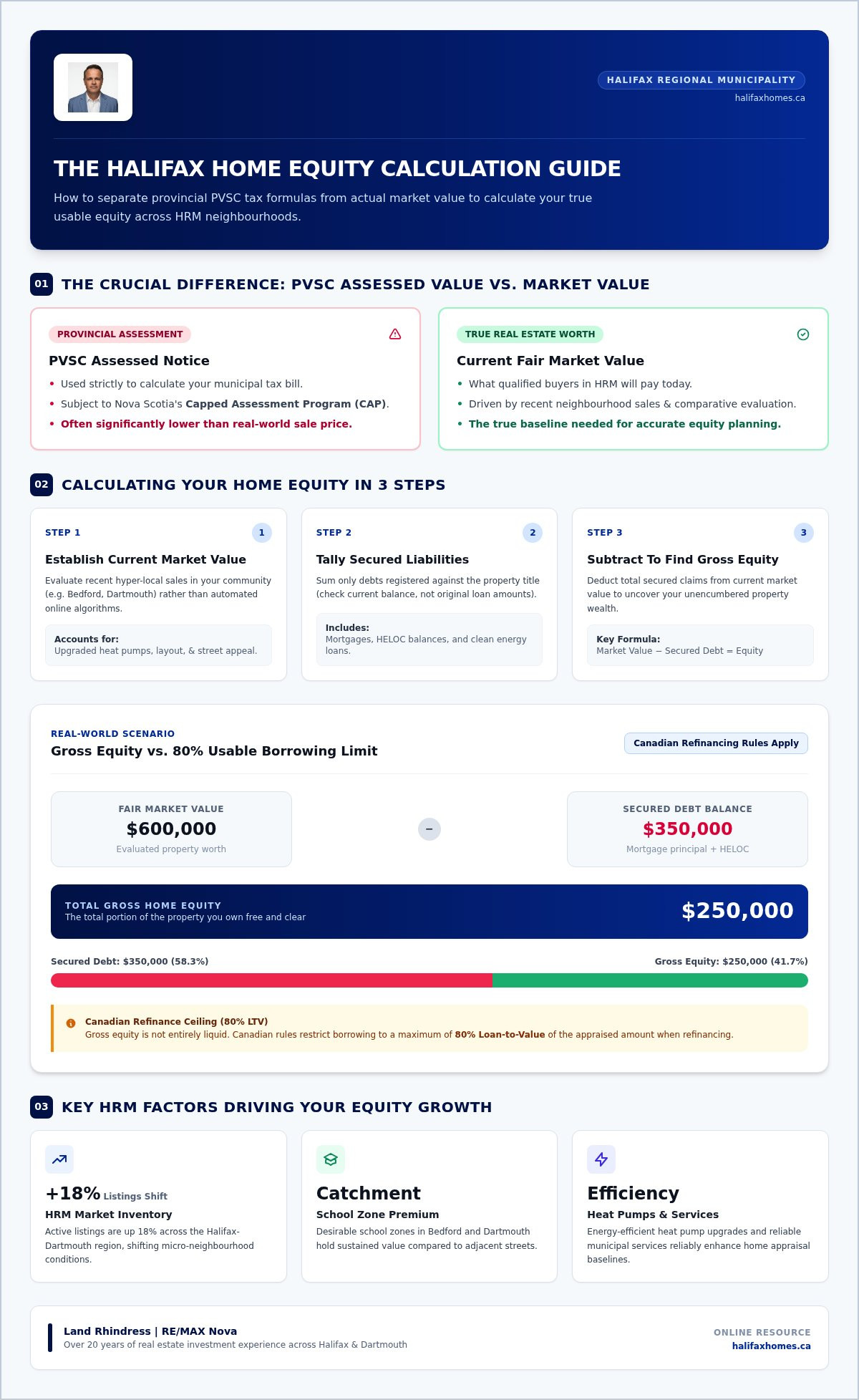
Understanding how to calculate home equity Halifax homeowners hold begins with one straightforward equation: your home's current fair market value minus all outstanding debts secured against it. Plain and simple, equity represents the portion of the property you truly own free and clear.
In practice, the home equity formula reflects wealth that builds in two ways: regular mortgage payments chip away at your principal balance, while broader property appreciation across HRM increases your home's gross worth over time. Getting this calculation right, however, depends entirely on using accurate figures rather than assumptions.
Market Value Versus PVSC Assessed Value
The most frequent mistake I see across HRM is confusing a Property Valuation Services Corporation (PVSC) assessment with actual market value. PVSC values exist solely to calculate your municipal tax bill. Because Nova Scotia's Capped Assessment Program (CAP) limits annual assessment increases on owner-occupied properties, your taxable assessed value is often significantly lower than what buyers would pay today. Recent sales in your immediate neighbourhood provide the only reliable benchmark for fair market value, which is why booking an objective home evaluation is the best starting point.
Identifying All Claims Against Your Property
Once you establish a realistic sale price, you must tally every dollar secured against the home. Your primary mortgage balance makes up the largest deduction, but other secured facilities count against your equity as well. Be sure to account for:
Home Equity Lines of Credit (HELOCs), whether fully drawn or partially used
Second mortgages or private bridge financing
Any municipal clean energy loans or liens registered directly on title
Always log in to your mortgage portal or check your latest lender statement to confirm your balance. Looking at original approval papers will give you an outdated figure and skew your equity calculations.
How to Calculate Your Home Equity in 3 Clear Steps
Working out how to calculate home equity Halifax property owners can rely on does not require complex accounting. It simply takes three methodical steps using real-time figures. Running these numbers gives you the clarity needed to plan your next transition with total confidence.
Step 1: Establishing Current Fair Market Value
Start by pulling recent neighbourhood sales rather than list prices or computer estimates. Automated algorithms cannot account for your upgraded heat pump, basement layout, or street-specific appeal in areas like Bedford or Dartmouth. Booking a comprehensive home evaluation gives you a precise baseline built on hyper-local comparative market sales.
Step 2: Totalling Your Outstanding Secured Balances
Next, gather your liabilities. Log into your primary mortgage account to get your current principal balance to the penny. Include every facility secured by your title:
The current balance on your primary mortgage term
Any drawn balance on a secured Home Equity Line of Credit (HELOC)
Any secondary private or builder charges registered on the property
Leave out unsecured personal loans, car financing, or credit card balances. Only debts secured directly against the civic address affect your property equity calculation.
Step 3: Calculating Gross Equity and Usable Equity
Subtract your total secured debt from your home's fair market value. The resulting figure is your gross home equity. If your home evaluates at $600,000 and your remaining balance is $350,000, your gross equity equals $250,000.
Keep in mind that gross equity is not entirely liquid. If you plan to borrow against your home equity through refinancing, Canadian rules restrict borrowing to a maximum of 80% loan-to-value of the appraised amount. You can test various payoff timelines and loan amounts with an online mortgage calculator to see how different repayment choices fit your monthly household budget.
Key Local Factors Influencing Equity Across Halifax Neighbourhoods
When figuring out how to calculate home equity Halifax buyers and sellers often forget that real estate values are hyper-local. A detached house in Lower Sackville responds to different market forces than a character home on the Halifax peninsula. Right now, HRM market inventory sits at balanced levels, which means micro-neighbourhood details dictate your equity far more than broad headlines.
Neighbourhood Demand Across Dartmouth, Bedford, and Beyond
Location within the municipality drives long-term price performance. Desirable pockets in Bedford and Dartmouth hold value consistently due to reliable municipal services, quick transit access, and reputable school catchments. In fact, a noticeable School Zone Premium often adds substantial value to properties inside sought-after school districts compared to similar houses just streets away. If you're weighing different HRM communities, check out our guide on buying a condo vs house in Dartmouth to see how property types shape equity gains.
Strategic Home Features That Enhance Property Value
Physical property improvements also play an outsized role in growing equity. Halifax buyers pay close attention to practical energy efficiency and future utility:
Adding a legally permitted secondary suite generates rental income potential, which raises appraisal value for future buyers.
Installing an energy-efficient heat pump paired with an updated electrical panel slashes heating bills and boosts market appeal.
Municipal shifts like ER-3 zoning allow up to eight dwelling units on select residential lots, creating new valuation upside for prime HRM parcels.
Routine maintenance protects your baseline value against coastal Nova Scotia dampness and roof wear.
If you're wondering how local demand impacts your next purchase, start a custom home search with our Home Finder tool to track neighbourhood sale trends in real time.
Strategic Ways to Use Your Halifax Home Equity
Learning how to calculate home equity Halifax properties generate is only half the equation; the real power lies in how you put that wealth to work. Whether you want to fund a well-earned retirement or expand your living space, accumulated equity gives you substantial financial flexibility across HRM.
Local homeowners often direct their equity into three key strategies:
Trading up: Rolling built-up equity into a larger detached house in family-friendly neighbourhoods like Fall River, Cole Harbour, or Bedford.
Downsizing: Liquidating property wealth from a large family home to purchase an accessible condo or bungalow, freeing up cash for personal retirement plans.
Adding a secondary suite: Reinvesting home value into an approved rental suite to generate reliable monthly cash flow under current municipal planning rules.
Trading Up to a Larger Home in HRM
If your household has outgrown its current footprint, your equity often serves as the entire down payment for your next purchase. Ask your lender about a porting and blend strategy, which lets you transfer an existing favourable interest rate to a new property while borrowing any additional funds at prevailing market rates.
Before making offers, always deduct transaction expenses and legal fees from your gross equity so you know your true net proceeds. Once you have that dollar figure locked down, you can review active listings with our curated home finder tool to target your ideal neighbourhood.
Getting an Accurate Professional Valuation
Online valuation tools provide quick estimates, but they cannot evaluate your renovated kitchen, heat pump installations, or private backyard lot. Automated algorithms also miss sudden micro-market shifts in local street competition.
A comparative market analysis delivers an exact baseline derived from recent, verified sales in your immediate area. Backed by more than 20 years of real estate investment experience here at RE/MAX Nova, I can walk through your property, assess its unique features, and deliver a reliable price point. Whenever you're ready for clear numbers, book a personalized home evaluation to see what your property is genuinely worth in today's HRM market.
Turn Your Calculated Equity into Confident Next Steps
Mastering how to calculate home equity Halifax properties hold strips away the guesswork and gives you a clear financial picture. Provincial tax assessments never reflect true market value. Deducting your total secured debt from a realistic market valuation reveals exactly what you have built. Whether your goal involves upsizing to a larger family home, downsizing to streamline life, or simply knowing your net worth, accurate data is essential.
As a dedicated RE/MAX Nova agent with more than 20 years of personal and commercial real estate investment experience across HRM, I help local owners separate rumour from real sale numbers every day. When you want to find out what your property can genuinely achieve in today's shifting market, request your complimentary Halifax home evaluation with Land Rhindress and take your next step with complete certainty.
Frequently Asked Questions
Can I use my PVSC property assessment to calculate my home equity?
No, you shouldn't use your PVSC assessment notice to calculate home equity. PVSC values exist solely for municipal property tax calculations and often reflect capped figures under Nova Scotia's Capped Assessment Program (CAP). That taxable assessed figure is usually substantially lower than what buyers pay in neighbourhoods like Dartmouth or Bedford. To master how to calculate home equity Halifax homeowners can actually rely on, always use verified comparable market sales instead.
How much equity can I borrow from my home in Nova Scotia?
Under standard Canadian federal lending guidelines, you can generally borrow up to 80% of your home's appraised fair market value through a refinanced mortgage. If you choose a Home Equity Line of Credit (HELOC), the revolving limit typically caps at 65% of the property's appraised value. You must deduct your remaining mortgage principal from that threshold to find your usable borrowing capacity. Always verify final borrowing terms with a licensed Canadian mortgage lender.
How often does my home equity change in Halifax?
Your equity changes every single month. Every regular mortgage payment reduces your principal debt balance, which gradually increases your equity stake. On the valuation side, equity fluctuates with shifting HRM market inventory and seasonal buyer demand. In an active market across Fall River, Sackville, or the peninsula, property values shift across quarterly cycles, making an annual professional review the smartest way to keep your financial estimates accurate.
What happens to my home equity if HRM market prices decline?
When property prices soften, your gross equity drops because your outstanding mortgage debt stays the same while your home's market value dips. However, this paper loss only matters if you must sell immediately. If you plan to remain in your home long term, steady monthly principal payments continue to rebuild that equity cushion over time. In a balanced market, well-maintained properties with modern updates resist price dips much better than neglected listings.
Does building a secondary suite immediately increase my Halifax home equity?
Adding an approved secondary suite typically boosts your equity, but the exact increase depends on build quality and municipal compliance. Permitted secondary suites generate legal rental income, which appeals strongly to Halifax investors and multi-generational families. If the market value added by the suite exceeds the construction costs, your net equity increases immediately. An appraisal will verify the added market value based on local demand and rental rates across HRM neighbourhoods.
Is home equity taxable when I sell my primary residence in Canada?
In Canada, gains from the sale of an eligible primary residence are exempt from capital gains tax under the Principal Residence Exemption. When you sell your home in Nova Scotia, the net equity proceeds you pocket after paying off your lender and transaction expenses are generally tax-free. If you rented out a portion of the house or used it commercially, specific Canada Revenue Agency rules may apply, so consult a tax specialist.