
I explain that a signed Agreement of Purchase and Sale can become legally binding in Nova Scotia once both parties sign. Understanding the agreement of purchase and sale in NS also means understanding its conditions: they set out what must happen by specified deadlines and may give you a contractual way to end the deal if a condition is not met.
It’s easy to focus on the price and closing date, but the details in the agreement matter just as much. Financing, inspection and insurance conditions can shape your decision, while closing brings its own costs and adjustments.
I’ll explain when an agreement takes effect, which offer conditions Halifax-area buyers may want to consider, and what can be deducted from sale proceeds or added to your closing costs as a buyer. I’ll also cover how deposits, deadlines and closing adjustments fit together, so you can better understand what you’re agreeing to.
Key Takeaways
I advise you to confirm that the price, closing date, included items and conditions reflect what you’ve agreed to before both sides sign, as the agreement can then become binding.
I recommend financing, inspection and insurance conditions to help protect your purchase; rural properties may also call for water-quality and septic inspection conditions.
I recommend tracking every condition deadline carefully. Form 408 is used to waive conditions, and missing the deadline can affect whether the agreement continues.
I encourage you to understand how the deposit is handled and what may be deducted from sale proceeds, including mortgage balances, commission, property taxes and legal fees.
I recommend budgeting for closing adjustments and location-specific costs, including deed transfer tax, which is paid by the buyer and set municipally in Nova Scotia.
What conditions should Halifax buyers include in a 2026 offer?
I explain that financing, inspection and sale-of-property clauses set out what must happen before your purchase proceeds unconditionally. From signing to closing, I guide you through condition deadlines, required checks and the steps to satisfy or waive conditions before completion.
Financing, inspection, and sale conditions
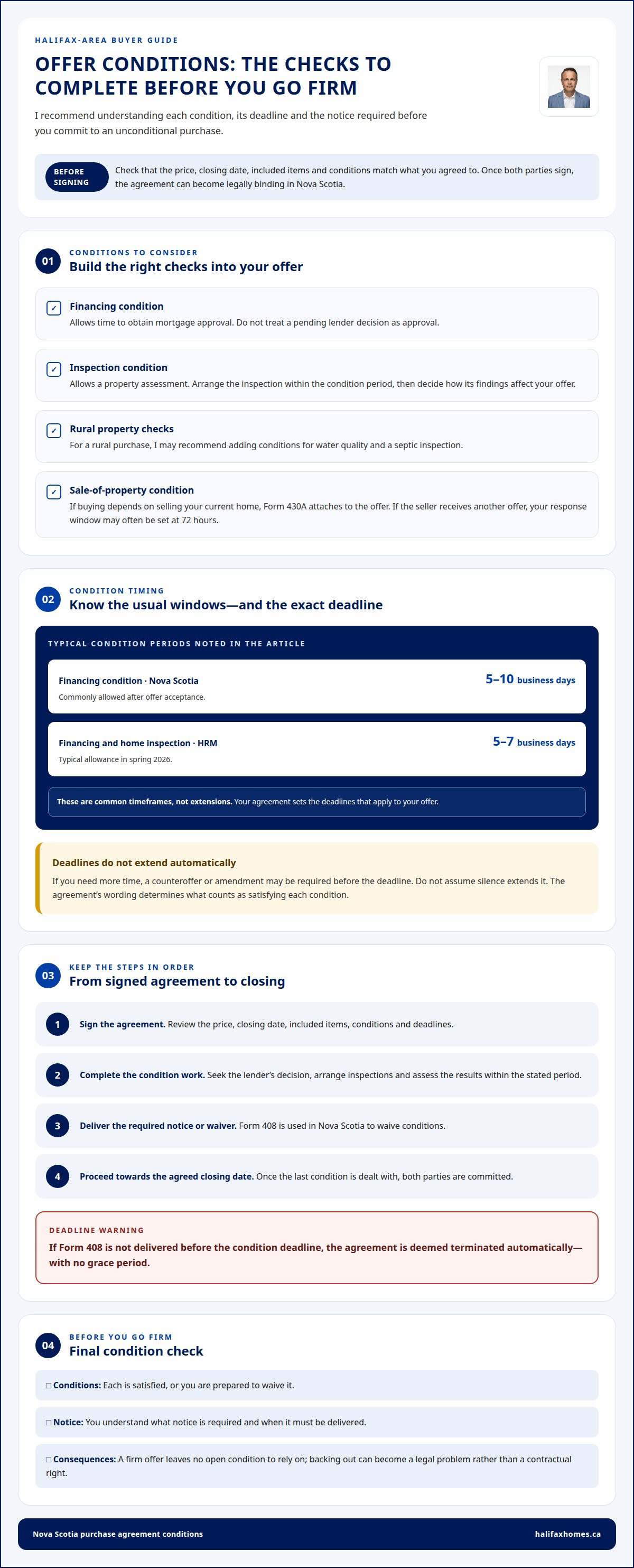
I help you understand that a financing condition gives you time to obtain mortgage approval, while an inspection condition allows a property assessment. In Nova Scotia, a financing condition commonly gives buyers 5 to 10 business days after offer acceptance. In HRM, financing and home inspection conditions typically allow 5 to 7 business days in spring 2026.
For a rural property, I may recommend conditions for water quality and a septic inspection. If your purchase depends on selling your current home, Form 430A attaches to the offer. A seller who receives another offer may give you a response window often set at 72 hours. I’ll help you understand how that clause could affect your obligations and how quickly you must respond.
I also discuss disclosure with you. Form 211 is an optional Property Condition Disclosure Statement that a seller may complete to the best of their knowledge. In a private sale, a Property Disclosure Statement isn’t mandatory unless the parties agree to require one in the contract. Misstatements in a completed statement could result in seller liability.
Condition deadlines and satisfaction steps
I’ll help you make sure each condition identifies what must be done and by when. For financing, seek the lender’s decision. For an inspection condition, arrange the inspection and decide how its findings affect your offer. The agreement’s wording determines what counts as satisfying each condition.
I’ll remind you that deadlines don’t automatically extend if a condition remains unresolved. You and the other party need to address each condition within its stated period and document the next step. If you need more time, a counteroffer or amendment may be required before the deadline. Don’t assume silence extends it.
I’ll help you keep the steps in sequence: sign the agreement, complete condition work by the deadlines, deliver the required notice or waiver, then proceed towards the agreed closing date. If Form 408 isn’t delivered before the condition deadline, the agreement is deemed terminated automatically, with no grace period.
Waiving conditions and going firm
I’ll explain that waiving a condition means giving up that contractual condition rather than keeping it open. Form 408 is used in Nova Scotia to waive conditions in an Agreement of Purchase and Sale. Once you’ve dealt with the last condition, both parties are committed, and backing out becomes a legal problem rather than a contractual right.
Before you go firm, I’ll help you confirm that each condition is satisfied or that you’re prepared to waive it. For example, don’t treat a pending financing decision as approval. A firm offer leaves no open condition to rely on, so your decision can affect your obligations through completion.
I’ll guide you to follow the deadline and required notice stated in the agreement. If a condition can’t be met, the agreement’s terms determine the available next step; missing a deadline isn’t an automatic extension. That’s why I make sure you understand each condition, notice and Form 408 delivery.
Is an Agreement of Purchase and Sale legally binding in Nova Scotia?
Whether an offer is binding depends on the circumstances and the agreement’s terms. The price, deposit, termination terms and required documents all affect what happens between acceptance and closing.
Purchase price and deposit terms
The agreement records the purchase price and deposit, including how the deposit will be credited at closing. In HRM, deposits typically range from $5,000 to $20,000, depending on the price point and circumstances of the offer.
The deposit is part of the purchase price, not an extra payment. Read the amount and payment timing alongside the financing terms: lender approval and your available funds affect whether you can complete the purchase. The agreement should make the parties’ commitments clear, including when the deposit is due and how it will be handled if the contract ends.
Deposits and agreement termination
Buyers typically provide the deposit within a day or two after an agreement is accepted. The listing brokerage holds it in a trust account until closing, when it is credited toward the purchase price.
If a party has the right to terminate under the original agreement, Form 440 can be used to initiate termination and may help release a brokerage-held deposit. The form doesn’t create a right to walk away on its own. The termination must be grounded in the agreement, such as an applicable condition or another agreed term.
Once the buyer has dealt with the final condition, both parties are committed; backing out becomes a legal issue rather than a contractual right. That distinction matters if financing approval changes or the buyer decides against selling their current home. The deposit’s return or release depends on the agreement and a valid termination process, not simply on a change of mind.
Nova Scotia forms and provincial differences
Nova Scotia uses province-specific real estate forms, so forms and procedures from another province shouldn’t be assumed to apply here. Form 400 is commonly used for existing homes; Form 403 is used for new construction, and Form 402 is added for resale condominium purchases.
The form system also has local details. The Nova Scotia Real Estate Commission says the standard Agreement of Purchase and Sale can cover deposits, closing dates, buyer conditions, lawyer review and title investigation. Updated mandatory forms apply to agreements accepted on or after May 1, 2026, so the acceptance date can determine which version applies.
For you, the practical step is to read the actual Nova Scotia form and schedules named in your offer. A seller’s counter-offer using Form 410 voids the original offer, so review the counter’s terms rather than treating it as a simple edit. The signed documents establish the contract the parties must follow through closing.
Meaning and enforceability of a Nova Scotia Agreement of Purchase and Sale
The agreement is the transaction’s working record: it identifies what each party must deliver and when. Understanding a Nova Scotia agreement of purchase and sale means looking beyond the property and price to how the written terms fit together.
Buyer and seller obligations
The buyer’s and seller’s obligations are the promises set out in the agreement. In practical terms, the buyer must meet the purchase terms, while the seller must carry out the sale as agreed. I encourage you to read the clauses as connected commitments, not isolated lines.
For example, a property description, included items and closing arrangements can affect what each party expects to receive or provide. A seller may also complete Form 211, an optional Property Condition Disclosure Statement, to the best of their knowledge. In a private sale, a Property Disclosure Statement isn’t mandatory unless the parties agree to require one in the contract. I’d distinguish that disclosure from the agreement itself: Form 100 is a disclosure document and does not impose contractual obligations.
Nova Scotia closings involve lawyers and deed registration under the Land Registration Act, making accurate transaction documents important. If a disclosure statement contains a misstatement, the seller could face liability. Read the agreement and any disclosure for what each document actually says, rather than assuming one replaces the other.
Consequences of a purchase agreement breach
A breach occurs when a party does not carry out an obligation in the agreement. The other party may then face delays, uncertainty about completion or a legal dispute over the written terms. Keep a clear record of agreed changes, since an informal conversation may not show what the parties ultimately accepted.
Amendments can also affect which terms apply. Under Form 421, if an amendment to an accepted agreement is rejected or receives no response before its deadline, the original agreement terms remain in effect. That makes the status of each proposed change significant: a draft amendment is not necessarily the operative agreement.
Lawyer review before signing
Yes, buyers should consider legal review before signing, particularly if the deal involves a private sale, unfamiliar schedules or wording that changes the usual allocation of responsibilities. A lawyer can explain how the proposed terms apply to the transaction and help identify questions before you commit.
A seller who isn’t using a real estate agent should also consider having a lawyer prepare the Agreement of Purchase and Sale. Early review is most useful when it focuses on the actual wording and property-specific details, rather than assumptions about what a standard form means.
What clauses are typically included in a Nova Scotia real estate purchase agreement?
A Nova Scotia purchase agreement does more than record a price. Its clauses define what is included, when the transaction closes, and how specific risks or costs are handled. According to the Nova Scotia Real Estate Commission, standard terms can cover deposits, closing dates, buyer conditions, lawyer review and title investigation.
I encourage you to look beyond the headline terms and consider how each clause affects your obligations. Fixtures generally stay with the property unless the agreement says otherwise. If you and the seller have different expectations about appliances, equipment or other items, the agreement should identify what stays, what goes and who handles any related payment.
Fixtures and included items: I recommend checking for any exceptions to the general rule that fixtures remain. Clear wording can prevent a disagreement over an item such as a built-in appliance.
Financed or leased equipment: Form 210 identifies whether equipment will be assumed by the buyer, paid out by the seller or removed. I suggest confirming whether the agreement says you will assume a lease.
Title investigation: For an HRM property, the purchaser has until the tenth day following the agreement date to investigate title. I recommend asking your lawyer to review title matters within that defined period.
Title migration: The agreement typically determines who pays the cost when title migration is required. I advise reviewing this clause so responsibility is clear before closing.
Property adjustments: Property taxes and utility charges are apportioned between buyer and seller based on the closing date. I suggest checking the closing statement to confirm each party’s share.
Oil tank and survey: The agreement may address whether the seller will ensure the oil tank is filled on or shortly before closing. I also recommend checking whether the seller will provide a land survey or location certificate if one is available.
Schedules can add terms for a particular property type. Form 404 addresses matters such as environmental assessments and legal road access for vacant land. Form 420 is a blank schedule for adding or modifying conditions in another form, including an offer, counter-offer or amendment. I recommend reading any attached schedule with the main agreement; its wording may shape your duties.
Timing details deserve attention, too. The agreement’s closing is to take place no later than 4:00 p.m. on the Closing Date, unless the parties agree to another time. For a resale condominium, Form 402 is added to Form 400. I suggest confirming that each referenced form is attached and understood, as these identifiers distinguish the main agreement from added terms.
Before you sign, I recommend reviewing the property description, included items, schedules, title provisions and adjustment clauses together. Even a seemingly small term, such as who pays for title migration, can affect the funds or documents needed to complete the sale.
Land Rhindress
I can help you connect the agreement’s terms with your next real estate decision in Halifax, Dartmouth, Bedford, Fall River, Sackville, Westwood Hills, Tantallon, Spryfield, Beaverbank, Eastern Passage, the Eastern Shore, Porters Lake, Cole Harbour and Lower Sackville. If you’re buying, the Home Finder can help focus your search on properties that fit your priorities. If you’re selling, a Home Evaluation can inform your decisions before you review an offer. I can also help you consider how the purchase price, conditions and closing date relate to your plans, while your lawyer advises on the agreement’s legal effect. Clear information makes it easier to weigh the property and its terms together. To discuss your real estate goals in Nova Scotia, contact me.
Plan your next move with clarity
A real estate agreement is one part of a larger decision: choosing a property or preparing your home for sale. A clearer understanding of the agreement of purchase and sale in Nova Scotia can help you consider how its terms fit your plans, but your next steps should also reflect your priorities, timing and property goals. I can help you consider those practical details through a Home Finder, Home Evaluation or Marketing Strategy, depending on whether you’re buying or selling.
If you’re preparing an offer, bring your questions forward before deciding how to proceed. I can help you understand the real estate considerations, while your lawyer can advise on the agreement’s legal terms. Contact Land Rhindress about your offer to discuss your next move. With a clear plan and the right advice, you can take the next step with confidence.
Frequently Asked Questions
What did the NSREC May 2026 forms update change for buyers and sellers?
For agreements accepted on or after May 1, 2026, updated NSREC mandatory forms apply. The update renamed Form 406 and expanded its schedule name to include manufactured homes and leased land communities. Buyers and sellers can use the agreement’s acceptance date to identify which form update applies, then check that the property type and attached schedule are accurately reflected in their paperwork.
What happens if Form 408 is not submitted before the condition deadline?
If Form 408 isn’t delivered before the condition deadline, the Agreement of Purchase and Sale is deemed terminated automatically, with no grace period. A buyer should treat the deadline as a firm point for acting, not as a reminder to deal with later. For example, if financing is still unresolved, the agreement doesn’t automatically stay active while the buyer waits for an answer.
What is an Agreement of Purchase and Sale in Nova Scotia?
It’s the written contract that records the terms for buying and selling a property in Nova Scotia. Beyond identifying the property and price, it can include schedules that add details for a particular transaction. Keep it distinct from disclosure paperwork: Form 100 is a disclosure document and does not impose contractual obligations. The signed agreement and its attached terms set out what the parties have agreed to do.
Is a Nova Scotia Agreement of Purchase and Sale legally binding once signed?
Yes. In Nova Scotia, the agreement becomes binding once both parties sign it, subject to its written terms and conditions. Electronic signatures are generally accepted when both parties agree to sign electronically, and notarization isn’t required for the agreement to be legally binding. Before signing electronically or on paper, make sure the version includes the schedules and amendments that form part of your offer.
What are the deposit rules and typical deposit amounts in Nova Scotia home purchases?
In HRM, real estate deposits typically range from $5,000 to $20,000, depending on the price point and circumstances of the offer. Buyers typically provide the deposit within a day or two after acceptance. The listing brokerage holds it in a trust account until closing, and the amount is credited toward the purchase price. The agreement sets the deposit terms, so check that its amount and timing match your understanding.
What common conditions can buyers include, such as financing, inspection, and sale of their home?
Buyers commonly include financing, inspection and insurance conditions. In HRM, financing and home inspection conditions typically allow 5 to 7 business days in spring 2026. A buyer whose purchase depends on selling their current home can use Form 430A. For rural properties, water-quality and septic inspection conditions may also be relevant. Each condition should identify what must be satisfied and its deadline, so the parties know what happens next.