
Across HRM, land prices and lot sizes vary by location and property, so the asking price is only one part of comparing your options.
That range is a useful starting point, but the right parcel depends on what you plan to do with it. A site for a business, a home or a waterfront retreat calls for different considerations, and acreage alone does not tell the whole story.
In this guide to land for sale in HRM, you’ll find current asking prices, Burnside lot locations and sizes, and examples of acreage and waterfront frontage. You’ll also learn how to interpret per-square-foot pricing and compare properties across Halifax, Dartmouth, Fall River and the wider region, focusing on the details that matter to your plans.
Key Takeaways
Compare asking prices across HRM by location and property type, not by price alone.
Check a parcel’s lot size alongside its asking price to understand what the land offers for your intended use.
Waterfront properties vary in acreage and frontage, so compare both measurements when weighing your choices.
Use a Home Evaluation to help assess a property’s value as you consider your next step.
Vacant land listings in the Halifax Regional Municipality
HRM listings range from urban lots and industrial sites to rural acreage and waterfront parcels. To compare them, look beyond the asking price to location, lot details and intended use.
Community Locations and Distances
Listings extend from Halifax and Dartmouth to communities such as Blind Bay, Lake Egmont and Elderbank. I use these distances to help compare rural settings with closer-in locations.
Prices vary across the municipality. Search counts are a changing snapshot, not a fixed inventory total.
Zoning and Permitted Uses
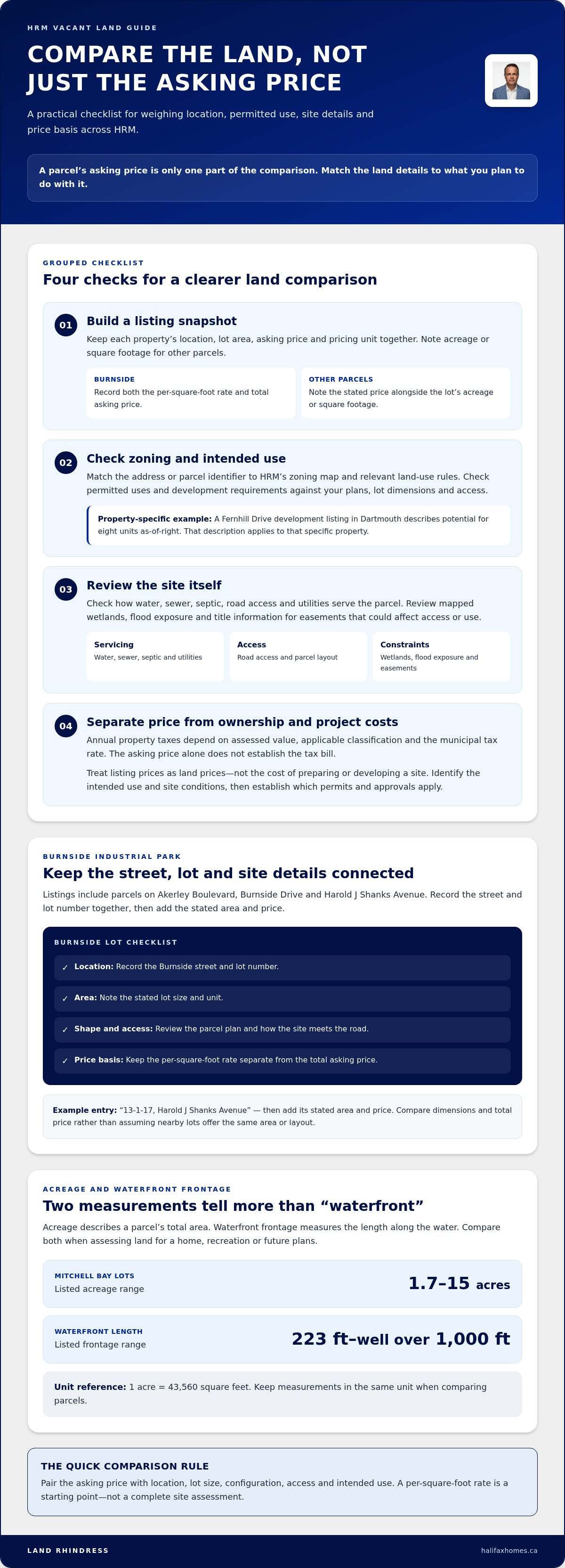
Zoning determines which uses and types of development are allowed on a parcel under applicable rules. Don’t assume a vacant lot can support a home, business or multiple units just because nearby properties appear developed. For example, a Fernhill Drive development listing in Dartmouth describes potential for eight units as-of-right; that description applies to that specific property.
To assess a parcel, match its address or parcel identifier to HRM’s zoning map and relevant land-use rules. Then compare permitted uses and development requirements with your intended project, the lot dimensions and access.
Land Taxes and Site Considerations
Annual property taxes depend on assessed value, applicable classification and the municipal tax rate. The asking price alone does not establish the tax bill. Also examine how water, sewer, septic, road access and utilities serve the site, since servicing can affect whether it suits your plans.
For site risks, review mapped wetlands and flood exposure, as well as title information for easements that could affect access or use. These details can change which parts of a parcel are practical for your plans. According to the Canada Revenue Agency, HST does not apply to exempt real-property sales, including personal-use vacant land sold by an individual.
For construction, identify the intended use and site conditions, then establish which permits and approvals apply to the project. Requirements depend on the parcel and proposed work. Organize your purchase by reviewing zoning and access, assessing servicing and constraints, and planning for transaction closing costs. This keeps the land, project and purchase considerations together before you proceed.
Asking prices for land
When comparing land asking prices in HRM, keep the pricing measure beside each figure. A residential lot may have one total asking price, while industrial land in Burnside can be advertised per square foot and as a total. Treat these as listing prices, not the cost of preparing or developing a site. For a fair comparison, match the measurement to the property.
Burnside Industrial Park listings show how rates and total prices differ by parcel.
Use the unit rate to compare Burnside parcels, but consider the total asking price too. A per-square-foot figure is not a substitute for the full listing price.
Other HRM listings use a single asking amount. I consider location, lot size and intended use alongside each asking price.
To build a useful shortlist, record each property’s location, lot area, asking price and pricing unit. For Burnside, include both the per-square-foot rate and total; for other parcels, note the stated price and acreage or square footage. Keep amounts in Canadian dollars, then compare each property with your plans and budget. This makes it easier to see the full asking price instead of focusing only on a unit rate.
Burnside lot sizes and locations
When comparing Burnside Industrial Park listings, start with the street and lot number. Parcels are located on Akerley Boulevard, Burnside Drive and Harold J Shanks Avenue. Keep each property’s location, area and price together rather than treating the industrial park as one uniform site.
Lot size matters because it shapes the space available for your intended project. Burnside listings use a per-square-foot price, but that rate alone does not tell you a parcel’s dimensions or configuration. Review the stated lot area and plan, then compare the usable site area with access points and your project’s footprint. A larger parcel may still be a poor fit if its layout does not suit your needs.
I recommend recording the street address and lot number together when building a shortlist. Akerley Boulevard, Burnside Drive and Harold J Shanks Avenue are distinct locations, while the lot identifiers distinguish individual parcels. For example, I’d record “13-1-17, Harold J Shanks Avenue” as one entry, then add its stated area and price. This keeps the listing details connected to the correct site.
Location: I record the Burnside street and lot number.
Area: I note the listing’s stated lot size and unit.
Shape and access: I review the parcel plan and how the site meets the road.
Price basis: I keep the per-square-foot rate separate from the total asking price.
This comparison is useful when two parcels are on different Burnside streets. Assess Akerley Boulevard and Burnside Drive listings separately from Harold J Shanks Avenue parcels, even when their advertised rates look similar. Check each listing’s dimensions and total price rather than assuming nearby lots offer the same area or layout.
For a practical site comparison, match each lot number to its street, then assess the parcel’s area against the space your plans require. Keep measurements in the same unit for a clear comparison. If one listing gives an area in square feet and another in acres, convert only when the stated areas allow a reliable calculation. Don’t compare the asking rate alone.
Burnside’s per-square-foot format is a useful starting point, not a complete site assessment. Pair the stated lot size with its location, configuration and total asking price. This helps distinguish a parcel that fits your project from one that merely looks comparable on a listing page.
Lot acreage and waterfront frontage
Acreage describes a parcel’s total area; waterfront frontage measures the length along the water. Compare both figures when assessing land for a home, recreation or future plans. One acre equals 43,560 square feet, so the two measurements can help you compare listings that describe size differently.
Mitchell Bay listings illustrate how much waterfront parcels can vary. Available lots are described as ranging from 1.7 to 15 acres, with waterfront lengths from 223 feet to well over 1,000 feet. That spread means “waterfront” alone tells you little about the amount of land or shoreline. Read the acreage and frontage together for each specific parcel.
Other examples show different combinations of area and shoreline:
These examples are not direct price comparisons. The Kelly Point property is a double lot, the Spry Harbour parcel has ocean frontage, and the Taylor Lake listing is described as lakefront. Their asking prices reflect different locations, areas and water settings. Compare each listing’s stated features rather than assuming that more acreage or frontage automatically makes one parcel a better fit.
For a focused comparison, record the lot area, frontage length, water type and asking price together. Keep the units clear: acreage and frontage measurements describe different things. If a listing gives area in square feet, converting it to acres can help you compare it with parcels described in acres. Don’t treat a view as equivalent to direct waterfront access; listing descriptions distinguish ocean-view properties from waterfront and lakefront properties.
Use the listing plan and parcel details to understand where the measured frontage sits in relation to the lot. A shoreline measurement is useful, but the parcel’s shape and layout also matter when you picture how the land may work for your intended use. For example, Kelly Point Drive’s 335 feet of frontage belongs to a double lot, while the Spry Harbour listing describes a 10-acre parcel with approximately 200 feet of ocean frontage. Those are distinct configurations, not interchangeable measurements.
Before shortlisting waterfront land, compare the parcel’s acreage and frontage side by side, then match those details to the setting you want: ocean, lake or another shoreline. This keeps the numbers grounded in the property’s actual description.
Land Rhindress: Home Evaluation
Land Rhindress offers Home Evaluation to help you consider a property’s value as you weigh location, lot size and asking price. It can be a useful next step when comparing options or deciding how a property fits your plans. For a more focused search, Home Finder can help you explore listings that match your priorities.
Bring the details you’ve compared, such as the parcel’s address, acreage and waterfront frontage. These specifics provide a practical starting point for discussing the property and your next move.
Explore Home Evaluation for support with property-value questions. Contact me when you’re ready to discuss your options.
Turn your land search into a clear next step
The right parcel starts with a clear idea of what you want to do with it. Before pursuing land for sale in HRM, decide which locations suit your plans and which site details matter most. That focus can make your next comparison more useful than a long list of possibilities.
Land Rhindress can help with your next step through Home Finder, Home Evaluation or Marketing Strategy, depending on whether you’re searching, assessing a property or preparing to sell. Bring your priorities and questions, and discuss which direction makes sense for your situation.
If you’re ready to talk through your plans for land in the Halifax area, contact Land Rhindress about HRM land. A thoughtful search begins with the right questions, and you can take it one decision at a time.
Frequently Asked Questions
What land parcels are currently for sale in Halifax Regional Municipality (HRM), Nova Scotia?
These examples span different settings and lot types, so compare each listing’s location and parcel details with your plans.
What are the current asking prices for land for sale in HRM?
Asking prices vary by parcel and location. These are individual asking prices, not a market-wide benchmark or a guarantee of the final sale price.
What is the typical price per acre or square foot for vacant land in HRM?
No single rate represents every vacant parcel in HRM. Industrial listings may use a per-square-foot rate, while other properties are advertised with a total asking price and an acreage figure. To compare parcels, divide the asking price by the stated area using consistent units, then consider location and intended use. Treat the result as a listing comparison, not a measure of development costs or final sale value.
What are the property tax rates and annual taxes for vacant land in HRM?
Annual property taxes depend on the land’s assessed value, applicable classification and municipal tax rate. The asking price alone does not establish the annual tax bill.
What are the steps and closing costs involved in buying vacant land in Nova Scotia?
Review zoning and access, assess servicing and site constraints, and identify permits and approvals for the intended project. Plan for transaction closing costs. HST does not apply to exempt real-property sales, including personal-use vacant land sold by an individual.