
The perfect Fall River lot can be the wrong starting point for your dream home. When buying a home in Fall River NS, the land’s zoning, servicing and site conditions can affect what you’re able to build, along with the project’s cost and timing. A floor plan is easy to picture; the details beneath it deserve just as much attention.
It’s understandable to weigh a custom build against a new construction home or a resale property. Each option offers a different balance of choice, certainty and work ahead. I’m Land Rhindress, and I bring more than 20 years of personal and commercial real-estate investment experience to helping buyers assess their options.
In this guide, I’ll compare the three paths and outline the lot and project details worth reviewing before you commit, from municipal services and site constraints to school catchments and day-to-day fit. You’ll get a practical way to assess whether a Fall River property suits your plans and budget, and choose a confident next step with local real-estate guidance.
Key Takeaways
Compare a custom build, another new home and resale by how much choice, certainty and work each option brings.
For buying a home in Fall River NS, start with your daily-life priorities, including location and school catchment needs.
Assess the specific lot’s access, boundaries, topography and usable space before settling on a build plan.
Separate confirmed property details from assumptions, and review the financial picture before deciding what fits your plans.
I can organize a custom home search around your location and property criteria to help you compare relevant Fall River options.
Why buy a custom home in Fall River, NS? Start with your daily-life priorities
Should you customize a build, choose another new home, or buy resale? The right answer depends on how you want to live, not just what looks appealing in a listing. Buying a home in Fall River NS means choosing a location as well as a property type. Start with your routines, priorities and comfort with decisions that may depend on a specific project.
Fall River is part of the Halifax Regional Municipality, and individual properties can come with different settings and practical considerations. For a general introduction to the community, see Fall River, Nova Scotia. Compare actual addresses and property details rather than assuming that every home in the area will suit the same plans.
A custom home purchase is a lot-and-build decision: the property and the proposed home need to work together. A lot may appeal on its own, but its suitability depends on the details of that specific property and project. Before you picture the kitchen, make sure the site can support the bigger plan.
What does buying a custom home mean for you as a buyer?
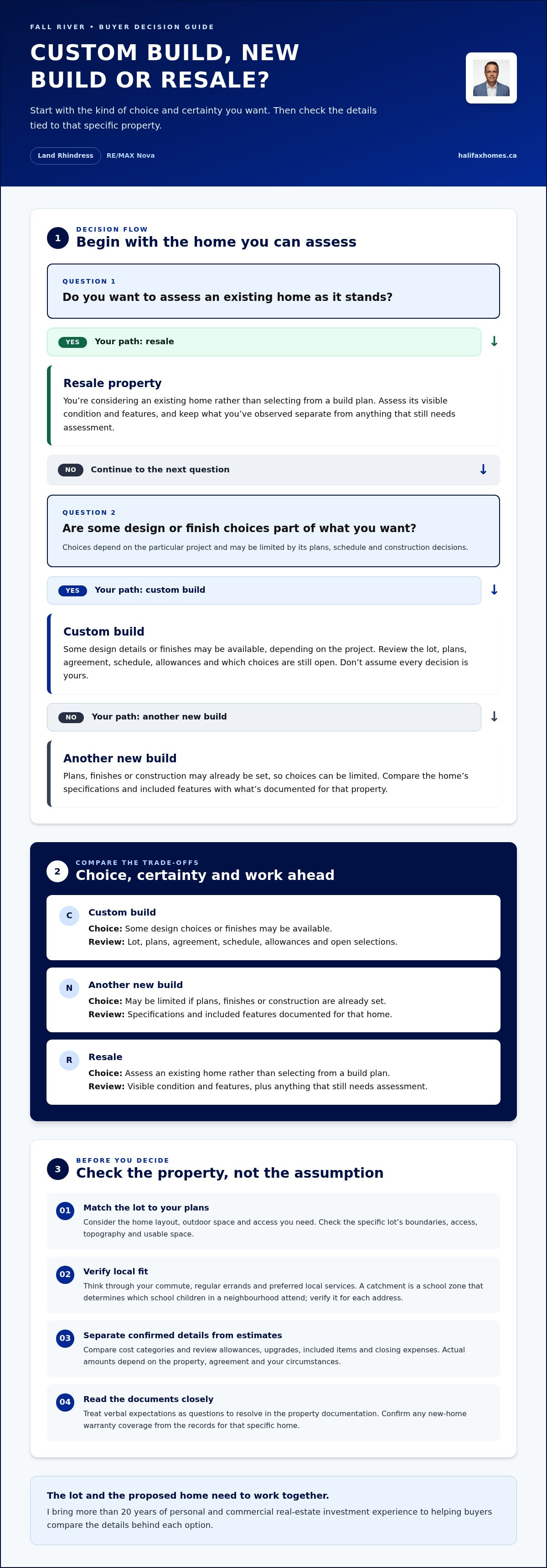
With a planned custom build, you’re buying into a home project, not simply choosing an existing finished property. Depending on the project and its timing, you may have a say in selected design details or finishes. Those choices aren’t unlimited: the plans, schedule and construction decisions depend on the particular build. With resale, you can assess the existing home as it stands, while any changes are a separate consideration.
How can Fall River fit your household’s priorities?
Map the journeys that shape your week: your commute, regular errands and preferred local services. Then consider how the home’s location supports household routines, from school travel to the places you visit regularly. A catchment is a school zone that determines which school children in a particular neighbourhood attend. School assignments can vary by address, so verify the current catchment for each property rather than relying on a general neighbourhood description.
Water access or views may also matter to your decision. If they’re priorities, include the property’s setting in your research and assess the specific address rather than assuming nearby homes offer the same features. I can organize a custom home search around the locations and property criteria that matter most to you.
Custom home, new build or resale in Fall River: compare the real trade-offs
For buyers considering buying a home in Fall River NS, the choice is not simply “new or old.” A custom build may offer choices within the project, another new home may have selections already made, and resale gives you an existing property to assess. Compare what’s documented, what’s still planned and what could affect your budget or expectations.
Which option offers more choice, and which offers more certainty?
Personalization can be a benefit of a custom project, but the available choices depend on the project and agreement. A completed home lets you see its layout and finishes in place; a home still under construction asks you to rely more on plans and written specifications. Neither route guarantees a particular outcome. Treat verbal expectations as questions to resolve through the property’s documentation.
Apply the same care to warranty claims. A new-home warranty applies to a specific property only where its documentation supports that coverage. Review the records for the home you’re considering rather than assuming all new homes carry identical protection.
How should you compare the full financial picture?
Compare cost categories, not just the asking price. For a build, account for the land and construction scope, then review allowances, upgrades and closing expenses. For a new build or resale, examine the agreed price, included items and closing expenses. The actual amounts depend on the property, agreement and your circumstances, so don’t treat an estimate or allowance as a final figure.
I use the mortgage calculator as one way to organize a preliminary affordability discussion. It can help frame your comparison, but the property documents and your complete financial picture still matter.
How to assess a Fall River lot for a custom build
A lot’s appearance can be appealing, but the practical question is whether its specific features suit your plans. Follow a clear sequence before treating a promising property as a build-ready choice. For anyone buying a home in Fall River NS, the land and proposed home need to make sense together.
Define your needs. List the home layout, outdoor space and access that matter to your household. This gives you a practical basis for assessing whether the lot’s usable space could fit your plans.
Review the lot records. Look at available property information for boundaries, access and any known easements. Compare those details with what you can observe, and keep confirmed information separate from assumptions.
Confirm site and service details. Assess access, topography and usable space on the specific property. Look at how the driveway could meet the road and whether the slope or drainage may affect your plans. Verify the water and wastewater arrangements, including whether the property relies on municipal services, a well, a septic system or another setup. If there’s a septic system, review the findings of a septic inspection for that property.
Compare your options. Consider how the lot, proposed home and ongoing costs align with your needs. Then compare it with other properties using the same criteria.
A listing description is a starting point for questions, not a substitute for verified property information. Treat a stated feature, service arrangement or possible use as a detail to confirm, not a fact to build your plans around.
How do plans, catchments and ongoing costs affect your decision?
Compare the proposed home’s layout and stated features with how your household lives. A room count alone won’t tell you whether the arrangement works for daily routines, storage or the outdoor space you want. Review ongoing costs as part of your overall budget, using details specific to the lot and proposed home rather than broad assumptions.
If school location matters, verify the current catchment for the specific address. A catchment is the school zone that determines which school children in that area attend, and neighbourhood shorthand may not identify an individual property’s assignment. For a completed home, the final walkthrough checklist can help you organize checks during your last visit before closing.
I can organize a custom home search around your location and property criteria, so you can compare Fall River options using the same priorities. If you’re weighing a wider local search, I can also help you compare areas such as Halifax, Dartmouth, Bedford, Fall River, Sackville, Westwood Hills, Tantallon, Spryfield, Beaverbank, Eastern Passage, the Eastern Shore, Porters Lake, Cole Harbour and Lower Sackville within HRM.
Plan your Fall River custom-home search with a clear next step
A sound decision follows a simple order: define your priorities, compare custom builds with other new homes and resale, assess the specific lot, then review the full financial picture. That sequence helps keep an attractive design or first impression in perspective while you examine the details that affect how a property fits your plans.
How can a custom home search keep your options organized?
I use a custom home search to organize the locations and property criteria that matter to you. Start by recording your preferred parts of Fall River, the home features your household needs and the trade-offs you’re comfortable making. For example, you might prioritize a particular layout over a larger lot, or decide that a specific location matters more than choosing every finish yourself.
Then compare each property against the same criteria. Note what’s documented, what’s proposed and what still needs property-specific verification, including services, site conditions and school catchment. A consistent set of questions makes it easier to weigh options on their merits rather than letting a polished presentation do all the talking.
What should you do before moving forward?
Before deciding, make sure you understand the details that matter to your choice: the lot’s boundaries, access and usable space; its water and wastewater arrangements; the home’s plans and stated features; and the relevant costs under the property agreement. If school assignment is part of your decision, verify the current catchment for the specific address. For a completed home approaching closing, use a final walkthrough checklist to guide your last visit.
I’m Land Rhindress, a RE/MAX Nova agent with more than 20 years of personal and commercial real-estate investment experience. I bring that perspective to helping you organize a Fall River search around your priorities, without assuming one type of home is right for everyone. If you’re buying a home in Fall River NS, I can help you compare options and assess the details that matter to your plans.
Make your Fall River plans with confidence
Choosing between a custom build, another new home and resale starts with the way you want to live. Define your priorities, compare the options, assess the specific lot and review the financial picture before settling on a direction. For a custom build, the property and proposed home need to work together, and details such as services, site conditions and school catchment should be checked for the individual address.
Buying a home in Fall River NS doesn’t require having every answer on day one. A clear set of priorities gives you a practical way to compare properties and identify details that need attention. I’m Land Rhindress, a RE/MAX Nova agent with more than 20 years of personal and commercial real-estate investment experience. I can help you organize a search around the locations and property features that matter to you, or provide a home evaluation as you consider an existing property.
When you’re ready to explore your options, start a custom home search with Land Rhindress. We can take the next step at a pace that suits your plans, with a clear view of what each property offers and what you still need to assess.
Frequently Asked Questions About Buying in Fall River
Is Fall River a good place to buy a custom home?
It can be, depending on what you want from your home, location and daily routine. For buyers considering buying a home in Fall River NS, compare each property’s access, services, school catchment and proposed plans with your priorities. Look at the individual lot rather than assuming every property offers the same features. Use current local information and property records to guide your decision about a specific address.
Can you build a custom home on any lot in Fall River?
No. A lot’s suitability depends on its characteristics and the requirements that apply to that property. Review boundaries, access, zoning, services and possible site constraints before treating a build plan as workable. Water and wastewater arrangements can vary between properties. Verify the details for the lot you’re considering rather than assuming a nearby property has the same setup or that a particular home plan will fit.
How much does it cost to build a custom home in Fall River?
There isn’t one reliable figure for every project. The amount depends on the specific lot and build. Consider the land, construction scope, selected features, servicing and closing expenses, then compare written figures for the property and agreement. Leave room in your planning to assess possible changes before committing. A mortgage calculator can help you explore financing scenarios, but it won’t establish a construction quote.
Is a custom home better than buying a resale home?
Neither is automatically better. A custom build may allow choices shaped around your needs, while a resale home gives you an existing property to assess, including its visible condition and features. Compare the specific home, lot, plans, timing and financial commitments. The best fit depends on your priorities and the trade-offs you’re comfortable managing. A general claim that new or existing homes are always preferable won’t replace a property-by-property comparison.
What should I check before buying land for a custom home?
Review property-specific records, boundaries, access, topography, services and any known site constraints. Confirm current zoning and other applicable requirements using reliable information for that lot. Consider whether its usable space suits your proposed home and household needs. Check whether water comes from municipal services, a well or another arrangement, and how wastewater is handled. If there’s a septic system, review its documentation and the findings of a septic inspection instead of assuming it suits your plans.
Should I choose the lot before planning a custom home?
Start by defining your priorities, then assess potential lots against the home you hope to build. Land can affect access, servicing, layout and which plans may suit the property, so don’t assume a preferred design will fit before reviewing the specific site. A custom home search can help you organize preferred locations and property criteria as you compare options. I can help you keep those priorities clear while you explore Fall River properties.