
Picture this: you’re forty-eight hours away from owning your dream home in Dartmouth, only to walk through the front door and realise the seller took the "included" fridge and left a suspicious, damp patch on the basement floor as a parting gift. It’s the stuff of local real estate nightmares, but it doesn't have to be your reality. Using a comprehensive final walkthrough checklist for buyers Halifax homeowners can rely on is the only thing standing between you and a very expensive "oops" moment. This isn't just a casual stroll to see where your sofa will go; it's your final opportunity to ensure the property matches the contract before you're legally committed.
Closing on a house is exhausting, and you've likely spent the last month signing enough paperwork to deforest a small section of the Annapolis Valley. You deserve to move into a home that's in the exact condition you were promised, without any unpleasant surprises hiding behind a strategically placed moving box. This guide provides an expert-led breakdown of every tap, light switch, and repair you need to verify. You will gain the confidence to spot red flags and the knowledge of when to request a holdback; ensuring your transition to homeownership is as smooth as a calm day on the Bedford Basin.
Key Takeaways
Realize that the final walkthrough is a contractual right rather than a polite suggestion; timing it 24 to 48 hours before closing is the secret to catching issues before they become your headache.
Use our comprehensive final walkthrough checklist for buyers Halifax to systematically test appliances and "invisible" systems like plumbing, ensuring you don't discover a leak while you're busy unpacking.
Master the art of inspecting local essentials, including testing heat pumps in both modes and verifying that the oil tank level actually matches the adjustment agreement.
Learn how to document discrepancies with photos and work with your lawyer to implement a holdback, ensuring the seller’s forgotten repairs don't come out of your own pocket.
The Final Walkthrough: Your Last Line of Defence Before Closing
Some buyers treat the final walkthrough like a victory lap or a chance to decide where their new velvet sectional will go. That is a tactical error. In the Halifax real estate market, this visit is your final legal opportunity to verify that the seller has actually held up their end of the bargain. It is a contractual right baked into your Agreement of Purchase and Sale, not a polite suggestion or a courtesy extended by the seller. If you skip this step, you are essentially telling the seller you're happy to inherit whatever surprises they left behind; whether that's a missing dishwasher or a basement that has suddenly decided to become a pond.
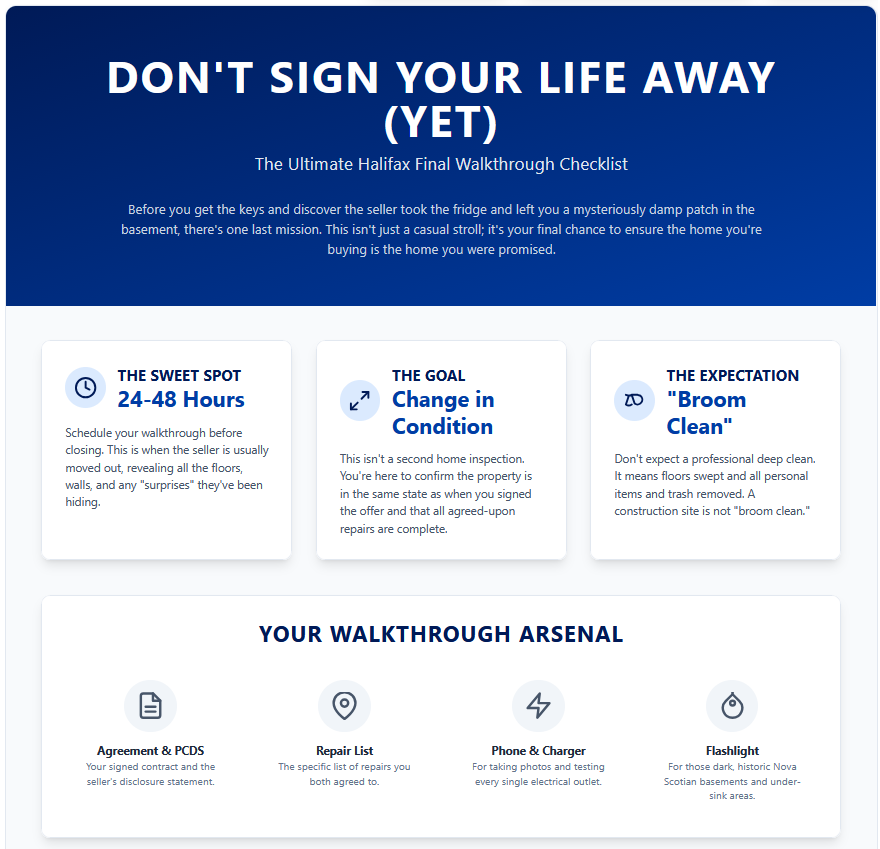
Timing is everything when you are executing your final walkthrough checklist for buyers Halifax. You want to schedule this visit roughly 24 to 48 hours before the closing date. This window is the "sweet spot" because the seller has usually moved most of their belongings out, revealing the floors and walls they’ve been hiding for years. You should always be accompanied by your agent, Land Rhindress, who acts as a steady hand to spot issues you might miss in the excitement. If major repairs were part of your agreement, you might even bring a specialized contractor—whom you can source via a directory like 78+ Services—to ensure the work was done to a professional standard rather than just a "duct tape and a prayer" fix.
You will often hear the term "broom clean" used in Halifax contracts. Let's be clear: this does not mean the house will be sparkling. It means the seller should have swept the floors, removed all trash, and cleared out their collection of half-empty paint cans from 1994. If the house looks like a construction site or a landfill, it is time to have a serious conversation with your agent about holdbacks before you sign those final papers.
Walkthrough vs. Inspection: Know the Difference
Do not mistake this for a second home inspection. You aren't here to spend three hours crawling through a damp crawlspace in the North End. Instead, you are looking for a "change in condition." You want to ensure that the house is in the same shape it was when you signed the offer. Check for new holes in the drywall from moving day, missing light fixtures that were supposed to stay, or a sudden lack of hot water that wasn't an issue three weeks ago.
What to Bring to Your Halifax Walkthrough
Come prepared so you aren't just staring blankly at the walls. You need a copy of your signed agreement and the Property Condition Disclosure Statement (PCDS) to verify inclusions. Bring a phone charger to test that the outlets actually work and a high-powered flashlight for those dark, historic Nova Scotia basements. Most importantly, bring the list of agreed-upon repairs from your inspection response to tick them off one by one. If you find yourself unsure about the numbers, you can always use a mortgage calculator to see how much room you have for unexpected repairs, though the goal is to ensure the seller pays for their own mistakes.
The Ultimate Halifax Home Buyer’s Checklist
Now that we’ve established the legal weight of this visit, it’s time to get your hands dirty. This is where your final walkthrough checklist for buyers Halifax becomes your best friend. You aren't just here to admire the crown moulding; you're here to hold the seller accountable to their Property Condition Disclosure Statement (PCDS). In Nova Scotia, the PCDS is a legally binding document where the seller discloses known defects. If they stated the dishwasher worked and it currently sounds like a bag of gravel in a blender, you have a problem that needs immediate attention.
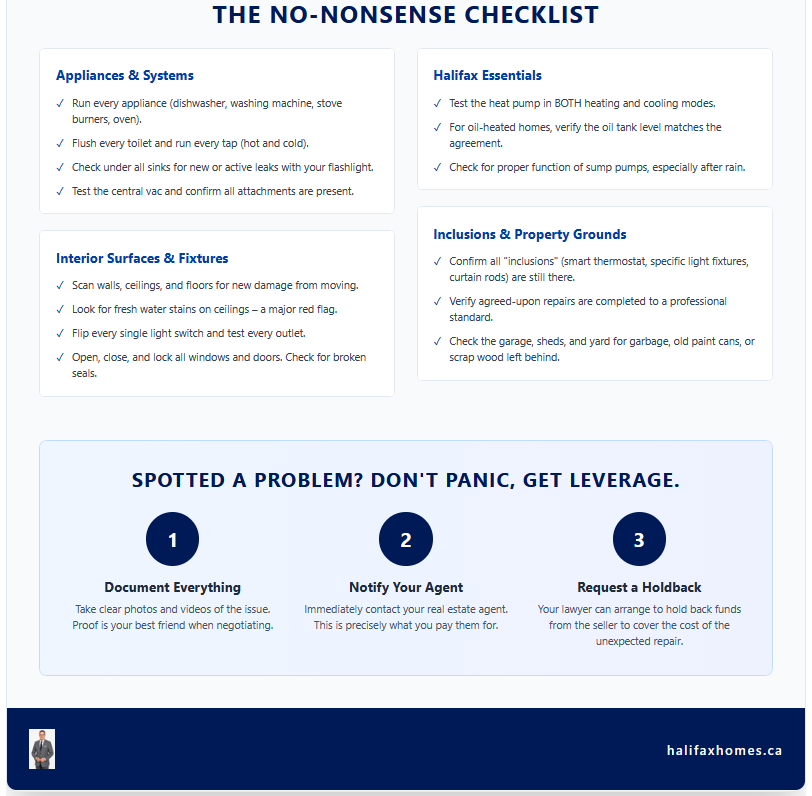
Test every appliance. Turn on every burner on the stove and let them get hot. Run a quick cycle on the dishwasher to ensure it actually drains and doesn't leave a puddle on the hardwood. You should also test the "invisible" systems. Flush every toilet like you're trying to set a world record and run every tap. Crawl under the sinks with that flashlight we mentioned earlier to check for fresh leaks. In Halifax, windows and doors are your primary defence against a damp Atlantic winter. Open, close, and lock every single one to ensure the seals aren't blown and the hardware actually functions.
Don't forget to verify the inclusions. Sellers have a funny way of "forgetting" that the smart thermostat or those high-end curtain rods were part of the deal. If you find the perfect property through a home finder service, you expect those details to be there on closing day. Check that the light fixtures haven't been swapped for cheaper alternatives and that the central vacuum attachments haven't vanished into the seller's moving truck.
Interior Surfaces and Fixtures
Scan the ceilings for water stains. Halifax rainstorms are legendary for finding the tiniest roof leak, and a fresh stain is a major red flag. Flip every light switch to ensure no "creative" DIY wiring has appeared since your last visit. Ensure that all fixtures, from towel racks to hardwired mirrors, are exactly where they should be.
Exterior and Property Grounds
Walk the perimeter of the lot. Sellers sometimes leave "parting gifts" like old tires, half-empty paint cans, or piles of scrap wood behind the garage. Ensure the garage and any outbuildings are completely empty and swept out. Finally, test the doorbell and all outdoor security lights to ensure your new home is as functional as it is beautiful.
Checking Systems and Seasonal Red Flags in Nova Scotia
Halifax homes are charming, but they come with regional quirks that can turn into expensive hobbies if you aren't careful. Your final walkthrough checklist for buyers Halifax must account for the Atlantic climate and the specific systems we rely on here. Heat pumps are now standard in most Sackville and Bedford homes, but don't just check if they turn on. Test both the heating and cooling modes. It doesn't matter if it's mid-January; you need to know that the reversing valve actually works before you take possession. A heat pump that only blows cold air in the dead of winter is just a very expensive paperweight.
If your new place uses oil, go straight to the tank. Sellers are required to leave the oil level exactly as specified in the adjustment agreement, which is usually full. If the gauge shows a quarter tank but you’ve already paid for a full one through your lawyer, that is a several-hundred-dollar discrepancy that needs to be addressed before closing. While you're in the utility room, check the foundation walls for efflorescence. This white, powdery substance might look like harmless salt, but it's actually a sign of mineral deposits left by evaporating water. Land Rhindress knows exactly what to look for in an HRM basement, so lean on that expertise if you spot suspicious dampness.
Always verify these findings against the Property Disclosure Statement (PDS) your agent should have had you request in your offer. If the seller claimed the basement was dry but you’re currently standing in a puddle after a classic East Coast downpour, the contract has been breached. Don't let a seller's "I forgot" become your "I have to pay for this."
Winter Walkthrough Challenges in HRM
Inspecting a home in February requires a bit of grit. Check the roofline for ice dams, which often signal poor attic insulation or ventilation issues common in older North End properties. If the house has been vacant for a few days, verify that the pipes haven't frozen. A burst pipe behind a wall is a disaster you don't want to buy. Test the furnace or boiler extensively. "It worked last week" is the favourite refrain of a seller with a dying heating system; make sure it works today.
Summer and Shoulder Season Checks
During the spring thaw or after a heavy autumn rain, pay close attention to the grading around the house. Water should flow away from the foundation, not toward it. If you're buying in the heat of July, ensure the AC isn't just moving air; it needs to be actively cooling the space. Also, take a minute to inspect the deck or patio. Nova Scotia frost can be brutal, and you want to ensure the ground hasn't shifted and pulled the ledger board away from the house structure.
If you're worried about what these potential repairs might do to your monthly budget, use our mortgage calculator to see how much flexibility you have for future home improvements.
Resolving Issues and Crossing the Finish Line
You’ve finished your final walkthrough checklist for buyers Halifax and, unfortunately, you found a few "surprises." Maybe the seller decided that their collection of "vintage" tires and crusty paint cans was a lovely housewarming gift for you to dispose of, or perhaps the dishwasher has suddenly entered its retirement phase. When the reality of the home doesn't match the promise of the contract, you have to act quickly. Document everything immediately with clear photos and videos. Your agent, Land Rhindress, will use this evidence to communicate with the seller’s representative before you head to the lawyer’s office.
In Nova Scotia, we have a powerful tool called a "holdback." This is where your lawyer withholds a specific portion of the sale proceeds in trust until the seller rectifies the issue. If the seller was supposed to fix a leaking pipe but "forgot," a holdback ensures they have a financial incentive to get a plumber over there post-haste. It is much easier to negotiate when the seller is staring at a smaller-than-expected cheque on closing day. However, you must distinguish between deal-breakers and nuisances. A non-functional furnace is a deal-breaker; a missing lightbulb or a small scratch on the baseboard is a nuisance. Don't let the small stuff derail your excitement, but don't let the big stuff become your financial burden.
Negotiating Last-Minute Credits
Sometimes, a holdback is too much paperwork for a minor problem. In these cases, your agent can often negotiate a cash credit. If the house was supposed to be "broom clean" but looks like it hosted a glitter-themed rave, asking for a few hundred dollars off the closing price to cover a professional cleaning crew is perfectly reasonable. Once the money is sorted, you'll eventually receive the seller’s "mystery box" of keys; which usually contains three that actually work and twelve that likely belong to a shed in Truro they sold back in 2008.
Your Closing Day Resources
As you prepare for the final hand-off, make sure your finances are as tidy as you hope your new home will be. You can use our Mortgage Calculator for any last-minute budget adjustments if credits or holdbacks change your final numbers. If you are still in the early stages or helping a friend, keep an eye on the Home Finder to stay updated on the local market. For a deeper dive into the legal finish line, check out our guide on What to Expect on Closing Day in Nova Scotia. Once the paperwork is signed and the keys are in your hand, the only thing left to do is start making your new Halifax house a home.
Secure Your Investment and Start Unpacking
By now, you realise that the final walkthrough is far more than a chance to measure for curtains. It's your ultimate safeguard against inheriting the seller's plumbing disasters or a "forgotten" pile of old tires behind the shed. Treat this visit as a contract verification; testing every heat pump mode and verifying oil levels ensures your first night in your new home isn't spent shivering or calling an emergency technician. Armed with a final walkthrough checklist for buyers Halifax residents can rely on, you have the leverage to request holdbacks and ensure that "broom clean" actually involves a broom.
Ready to find your next Halifax home? Start your search with Land Rhindress today.
Your new chapter in Nova Scotia is just a few signatures away. Take that final step with confidence and enjoy every moment of homeownership.
Frequently Asked Questions
What happens if I find a problem during the final walkthrough?
If you discover an issue, don't panic or start a frantic group chat; document it with photos immediately and notify your agent. We then negotiate a solution, such as a last-minute cash credit at closing or a formal holdback through your lawyer to ensure the repair actually gets done. It is much easier to get a seller to cooperate when their final cheque is on the line, so use your final walkthrough checklist for buyers Halifax to catch these discrepancies before the keys change hands.
Can I cancel my home purchase after the final walkthrough in Nova Scotia?
Cancelling the deal is the "nuclear option" and is extremely rare in Nova Scotia real estate. You generally cannot walk away just because you found a few scuffs on the baseboards or a missing lightbulb. Rescinding an offer usually requires a catastrophic change in the property's condition that violates the fundamental terms of the contract. Instead of walking away, we use legal mechanisms like holdbacks to ensure the home is restored to the condition you were promised.
How long does a final walkthrough usually take in Halifax?
Expect to spend 30 to 60 minutes on the property, which is just enough time to realise the seller's "modern" dishwasher sounds like a tractor. This isn't a second three-hour home inspection, but you shouldn't rush it either. You need enough time to run a quick appliance cycle, flush every toilet, and verify that the seller didn't decide to take the "included" smart thermostat as a souvenir.
Should the seller be present during the final walkthrough?
Unless you enjoy the awkwardness of a seller watching you judge their "unique" wall colours, they should stay away. You want the freedom to open every cupboard and test every faucet without someone hovering or trying to explain away a fresh water stain. It is much more productive to have just you and your agent present to objectively assess the property against your final walkthrough checklist for buyers Halifax.
What does "broom clean" condition actually mean?
Broom clean is the bare minimum of human decency in a real estate transaction; it means the seller has removed all trash and swept the floors. It does not mean the house will be sparkling or move-in ready by hotel standards. Expect some dust and maybe a few stray crumbs. However, if the seller left a basement full of old tires or a fridge full of science experiments, they haven't met the standard, and we need to talk about cleaning credits.
What if the seller hasn’t moved out by the time of the walkthrough?
If you arrive and the seller is still eating breakfast amidst a sea of unpacked boxes, it is time to call the lawyer. This is a major red flag that they might not be out by the closing deadline. We may need to delay the walkthrough or negotiate a financial penalty to ensure you aren't trying to move your sofa in while they are still looking for their packing tape.