
What if the most expensive "welcome to the neighbourhood" gift you receive isn't a basket of local preserves, but a five-figure tax bill from the municipality? It's a classic East Coast surprise: you've finally found the perfect home, only to realize the Deed Transfer Tax is about to take a massive bite out of your new furniture budget. We can all agree that closing costs are the least charming part of the home-buying process. Using a land transfer tax calculator Nova Scotia buyers rely on is the only way to ensure your financial plans don't capsize before you even get the keys.
You shouldn't need a PhD in economics just to move to the Maritimes. This guide will help you master the math so you can avoid the 10% provincial non-resident tax trap and budget with professional precision. We'll walk through the specific 2026 municipal rates, identify which buyers qualify for exemptions, and give you the confidence to make an offer that accounts for every cent. By the time you finish reading, you'll know exactly what to set aside for the tax man before you start picking out paint colours.
Key Takeaways
Demystify the "Deed Transfer Tax" label so you aren't searching for a tax that doesn't technically exist under that name on your Nova Scotia legal paperwork.
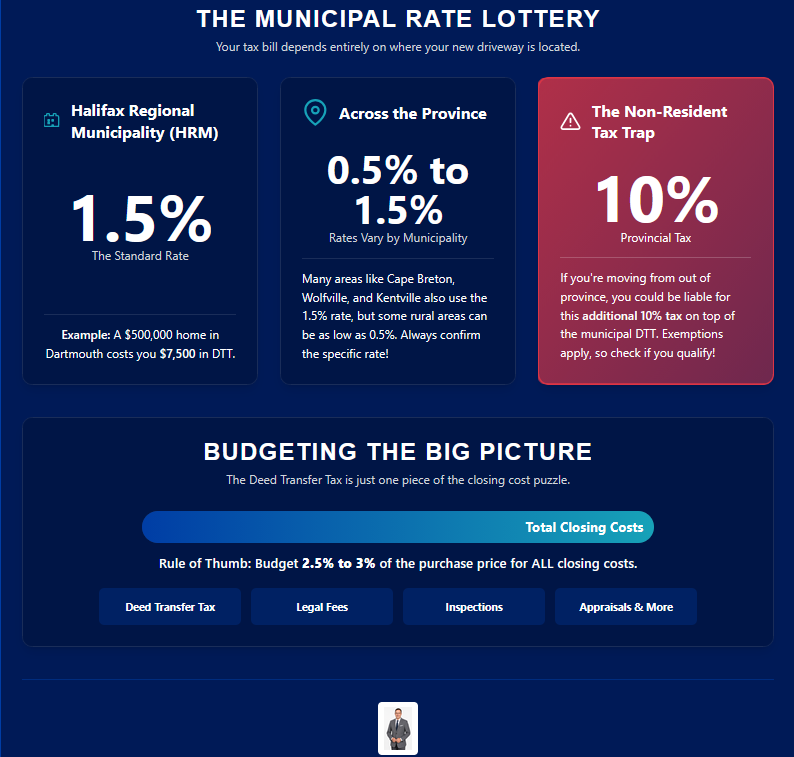
Learn how to calculate your specific municipal rate, which ranges from 0.5% to the 1.5% standard found in the Halifax Regional Municipality.
Determine if you are liable for the 10% provincial non-resident tax or if you qualify for a residency exemption by using our land transfer tax calculator Nova Scotia guide.
View the "big picture" of your closing budget by accounting for the 2.5% to 3% rule of thumb for total expenses like legal fees, inspections, and appraisals.
What is the Nova Scotia Deed Transfer Tax?
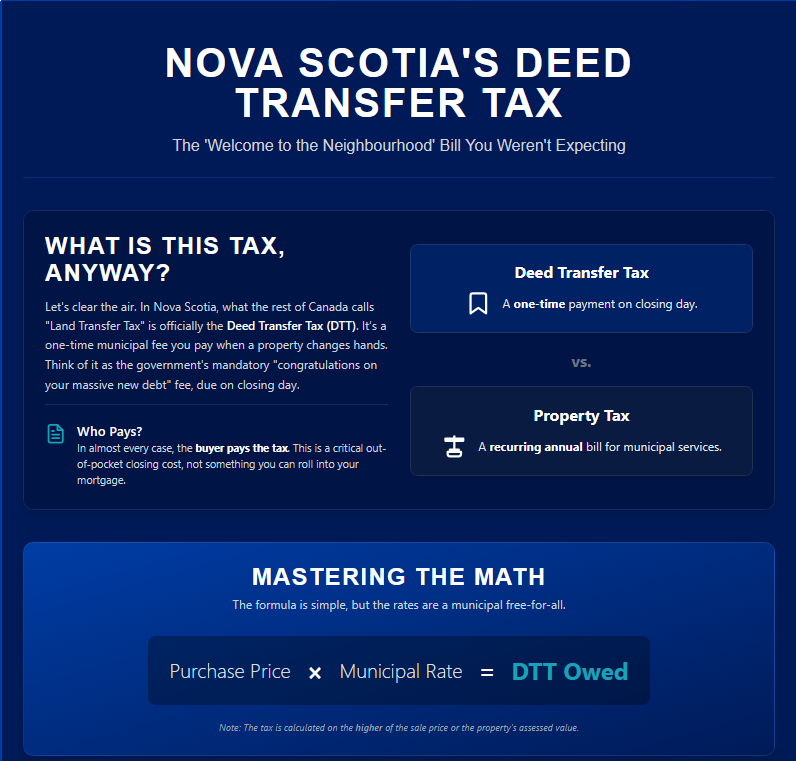
If you have spent any time on Google recently, you have probably searched for a land transfer tax calculator Nova Scotia only to find yourself buried in articles about something called a "Deed Transfer Tax." Let's clear the air: they are the same thing. While the rest of Canada likes the generic "Land Transfer Tax" label, Nova Scotia prefers to be a bit more specific. Legally, it is the Deed Transfer Tax (DTT), a municipal fee triggered when the ownership of a property changes hands. Think of it as the government's mandatory "congratulations on your massive debt" fee. It is a one-time payment due at the Land Registration Office on the day you close your deal.
In Nova Scotia, this is not a provincial cash grab; it is a municipal one. Every municipality has the right to set its own rate. This is why your tax bill might look wildly different if you buy a cottage in Guysborough versus a condo in downtown Halifax. The money stays local, helping to fund the very streets and services you will soon be using as a resident.
Deed Transfer Tax vs. Property Tax: Don't get them confused
It is easy to confuse DTT with your regular property taxes, but they are entirely different animals. Property tax is the recurring annual bill you pay for things like snow removal and trash collection. DTT, on the other hand, is a one-off transaction tax. Crucially, while some lenders allow you to wrap property taxes into your monthly mortgage payment, the DTT is a closing cost. It is a lump sum you pay once and never think about again, until you decide to move and do it all over. Because it is a legal requirement for the transfer of the deed, your lawyer, not your bank, is usually the one who handles the logistics of this payment on closing day.
Who pays the tax in Nova Scotia?
In 99% of residential transactions in our province, the buyer (legally known as the "grantee") is responsible for the bill. This is a critical out-of-pocket expense. You cannot simply tack this onto your mortgage principal and pay it off over 25 years. You need to have this cash ready in your lawyer's trust account before the keys are handed over. Using a land transfer tax calculator Nova Scotia buyers trust can help you visualize this cost alongside your down payment.
Every buyer must also sign an "Affidavit of Value." This is a sworn statement confirming the actual purchase price. This ensures the municipality gets its fair share based on what you actually paid, rather than an outdated assessment. To see the full financial picture of your purchase, you can use our mortgage calculator to help balance these one-time costs against your long-term monthly budget.
Calculating Your Tax: Municipal Rates from Halifax to Guysborough
Calculating your tax in Nova Scotia isn't as simple as looking up a single provincial bracket. It is more of a municipal free-for-all. Every local government across the province has the authority to set its own rate, meaning your closing costs can shift significantly based on which side of a county line your new driveway sits. The basic formula is straightforward: Purchase Price × Municipal Tax Rate = DTT Owed. However, there is a catch. The municipality will calculate this based on either the sale price or the assessed value, whichever happens to be higher. In a healthy market like we are seeing in 2026, the sale price is almost always the number that determines your bill.
Because these rates can change annually, you must verify the 2026 figures before you finalize your budget. Relying on an outdated land transfer tax calculator Nova Scotia guide could leave you short a few thousand dollars on closing day. Accuracy is the difference between a smooth move and a frantic call to the bank.
The Halifax Regional Municipality (HRM) Standard
If your heart is set on the HRM, you need to prepare for the 1.5% standard. This rate applies to Halifax, Dartmouth, Bedford, and all the surrounding communities within the regional municipality. It is one of the higher rates in the province, so the math adds up quickly. For example, if you buy a $500,000 home in Dartmouth, you are looking at a $7,500 tax bill due immediately. You can browse homes for sale in Dartmouth to see how this 1.5% rate fits into your overall investment strategy.
Rates Across the Rest of the Province
Once you step outside the HRM, the financial landscape changes. While Cape Breton and many towns like Wolfville or Kentville also sit at the 1.5% mark, other areas offer a bit of relief. You might find rates at 1.25%, 1.0%, or even as low as 0.5% in specific rural pockets. Moving just ten minutes down the road into a different county could save you enough to pay for your entire move or a new set of appliances. Always ask your realtor to confirm the specific rate for the property's PID (Property Identification Number). To keep your monthly and one-time costs in balance, check our mortgage calculator for a clearer view of your total financial commitment.
The Non-Resident Tax Trap: Are you moving from out of province?
If you are planning a move from away, sit down before you check your closing budget. Nova Scotia welcomes everyone with open arms, but if you are currently a non-resident, the provincial government welcomes your bank account with a 10% Provincial Non-Resident Deed Transfer Tax (PDTT). This is not an alternative to the municipal tax we covered earlier; it is a massive second layer. If you are using a land transfer tax calculator Nova Scotia residents rely on, make sure it has a toggle for residency status, or your math will be off by tens of thousands of dollars. Nova Scotia loves your presence, but if you're coming from Ontario or BC, they clearly love your tax dollars a little bit more.
As of July 2026, this 10% rate applies to the greater of the purchase price or the assessed value for any buyer who is not a resident of the province. On a $500,000 home, that is an extra C$50,000 due on closing day. It is a heavy hit designed to cool the market, but there is a way to keep that money in your pocket if you are actually planning to live here.
How to qualify for the Residency Exemption
You can dodge the 10% PDTT entirely if you intend to make Nova Scotia your primary home. The "6-month rule" is your best friend here. If you move to the province and establish residency within 180 days of the property transfer, you can qualify for an exemption. However, the government does not just take your word for it. You will need to provide concrete proof that you have arrived, such as Nova Scotia Power bills, a provincial health card, or a changed driver's license. You cannot just say you are moving; you have to actually do it. If you fail to prove residency within that window, expect a very unpleasant bill from the Department of Finance.
Exemptions that actually exist (Yes, really)
While the non-resident tax is aggressive, some exemptions still exist for specific situations. Transfers between spouses or from an estate to a beneficiary are generally exempt from the Deed Transfer Tax. To claim these, your lawyer will submit a mandatory document called an "Affidavit of Value." This form is where you legally declare why you shouldn't pay the standard rate. It is a confusing piece of paperwork, but it is the only way to navigate these rare loopholes.
One thing to keep in mind is that Nova Scotia does not currently offer a first-time home buyer rebate for the Deed Transfer Tax, which often catches buyers from Ontario or British Columbia off guard. To make sure your offer is actually affordable once these taxes are added, use our home finder service to track properties that fit within your total after-tax budget.
Beyond the Tax: Budgeting for Your Total Closing Costs
Congratulations, you have successfully navigated the Deed Transfer Tax without crying too much. But before you start shopping for that oversized sectional, remember that the DTT is just the biggest shark in the pond. There is a whole school of smaller piranhas waiting to nibble at your closing budget. While a land transfer tax calculator Nova Scotia buyers use will give you the headline figure, you need to look at the fine print to avoid a frantic trip to the ATM on moving day. To keep your blood pressure stable, we recommend using our mortgage calculator to balance these one-time hits against your long-term monthly reality.
Land Rhindress has spent years helping buyers in the HRM see these costs coming from a mile away. You don't want to be the person who realizes forty-eight hours before closing that they forgot about title insurance or legal disbursements. It's much better to have a steady hand guiding you through the paperwork than to wing it and hope for the best.
The 'Hidden' Fees Checklist
Even after you've mastered the land transfer tax calculator Nova Scotia math, keep these Canadian Dollar (C$) figures in your back pocket. They are the "standard" costs that vary depending on your specific property:
Legal fees and disbursements: Expect to pay between C$1,000 and C$2,000 for a standard residential purchase. Your lawyer is the one doing the heavy lifting to ensure the deed actually belongs to you.
Title Insurance: This is a small but vital cost. It protects your investment against issues like survey errors or previous owners who had "creative" ideas about property lines.
Adjustments: This is the classic Maritime surprise. You'll likely need to reimburse the seller for pre-paid property taxes or a full tank of heating oil. If they just filled the tank, that could be an extra C$800 to C$1,200 right there.
For a deeper dive into the final moments of the deal, see my final walkthrough checklist for more pre-closing tips that will save your sanity.
Ready to find your Nova Scotia home?
If you need to sell your current place before you can tackle these new taxes, start with a professional home evaluation to see exactly what you're working with. Don't let the math scare you away from the coast. Let's find a house that makes every cent of that tax bill worth it. Contact Land Rhindress today for a personalized breakdown of HRM buying costs. Your bank account might feel a bit lighter after closing, but at least you will have a nice ocean breeze to console you.
Take the Guesswork Out of Your Move
By now, you realize that the Deed Transfer Tax is less of a "welcome" and more of a mandatory donation to your new municipality. You've learned that the 1.5% rate in the Halifax Regional Municipality is the standard to beat, and that the 10% non-resident tax doesn't have to be your reality if you follow the residency rules we've discussed. Armed with a land transfer tax calculator Nova Scotia buyers can trust, you are already miles ahead of most people currently browsing the market with only a down payment in mind.
But mastering the math is only half the battle. Navigating the specific bylaws of Halifax and Dartmouth requires a steady hand and specialized local knowledge. Land Rhindress offers personalized closing cost breakdowns that account for every adjustment and legal fee before you sign on the dotted line. We focus on demystifying the financial hurdles so you can focus on the excitement of your new home. Don't let the paperwork dampen the thrill of finding your perfect East Coast retreat.
Start your HRM home search with Land Rhindress today and move forward with the confidence of a local expert by your side. Your new neighbourhood is waiting.
Frequently Asked Questions
Is there a first-time home buyer land transfer tax rebate in Nova Scotia?
No, Nova Scotia currently does not offer a first-time home buyer rebate for the Deed Transfer Tax. While provinces like Ontario might give you a financial break for being a newcomer to the market, our province expects you to pay the full municipal rate regardless of your experience level. It is vital to use a land transfer tax calculator Nova Scotia to ensure you have the cash on hand, as there are no "get out of tax free" cards for first-timers here.
When is the Nova Scotia Deed Transfer Tax actually due?
The tax is due on the day you close your property purchase. Your lawyer typically handles the logistics, collecting the funds from you and remitting them to the appropriate municipality. While the legal deadline for the paperwork is often within 10 days of the transfer, the Land Registration Office won't officially record your deed until the bill is settled. In the world of real estate, no money means no deed.
Does the deed transfer tax apply to newly built homes?
Yes, the Deed Transfer Tax applies to newly constructed homes just as it does to resale properties. The municipality calculates the tax based on the total purchase price. Be aware that for new builds, this price includes HST. This means your tax bill will be slightly higher because you are essentially paying a municipal tax on top of a federal tax. It's a double-dip that every new homeowner should budget for early.
How much is the non-resident property tax in Nova Scotia for 2026?
The Provincial Non-Resident Deed Transfer Tax is currently 10% of the purchase price as of July 2026. This is a massive addition to the local municipal tax. If you aren't a resident yet, your land transfer tax calculator Nova Scotia results will look much more intimidating unless you qualify for the residency exemption by moving here within six months of your closing date.
Can I add the land transfer tax to my mortgage principal?
No, you cannot usually add the Deed Transfer Tax to your mortgage principal. Lenders generally require you to prove you have the funds to cover all closing costs out of pocket before they will fund your loan. It is a one-time, upfront cash expense that needs to be sitting in your lawyer's trust account before the keys change hands. Banks like to lend for the house, not for your tax obligations.
What happens if I don't pay the deed transfer tax within 30 days?
If you fail to pay the tax within 30 days, you will face immediate interest charges and a hefty 10% penalty. Most municipalities in Nova Scotia are quite efficient at collecting what they are owed. Since your deed won't be properly registered without payment, you risk more than just a fine; you risk your legal standing as the property owner. It is much cheaper to pay on time than to deal with the municipal collection office.